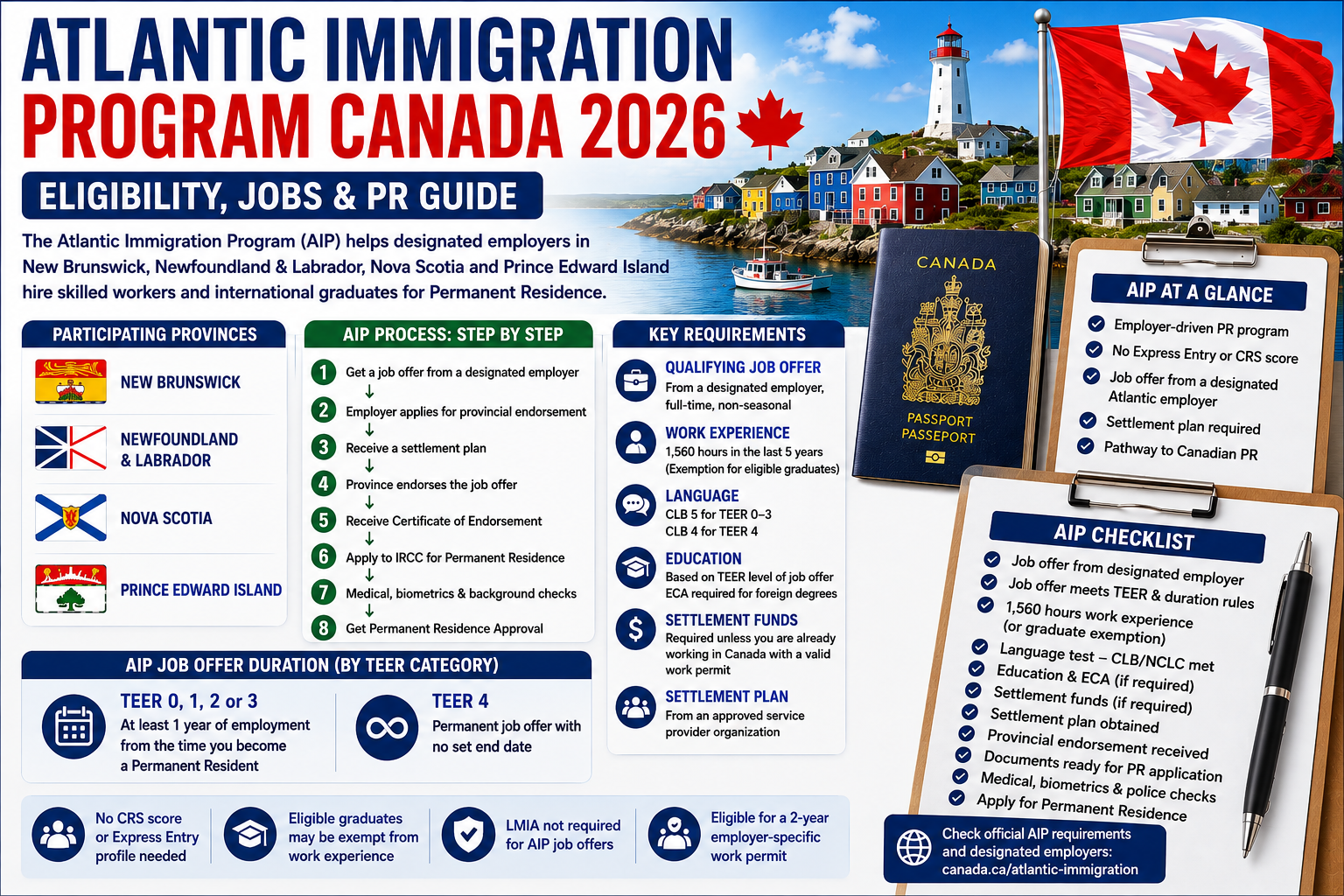
The Atlantic Immigration Program, commonly called the AIP, is a Canadian permanent residence pathway designed to help employers in Atlantic Canada hire qualified skilled workers and eligible international graduates.
The program covers four Atlantic provinces:
- New Brunswick
- Newfoundland and Labrador
- Nova Scotia
- Prince Edward Island
Unlike Express Entry, the Atlantic Immigration Program does not rank candidates using a CRS score.
Instead, an applicant generally needs a qualifying job offer from a designated Atlantic employer, must meet the program’s work experience, education and language requirements, obtain a settlement plan and receive provincial endorsement before applying for permanent residence.
Eligible recent international graduates from recognized Atlantic Canadian institutions may be exempt from the work experience requirement.
This guide explains the Atlantic Immigration Program in Canada in 2026, including eligibility, designated employers, job offers, NOC and TEER requirements, language scores, education, settlement funds, endorsement and the permanent residence process.
What Is the Atlantic Immigration Program?
The Atlantic Immigration Program is an economic immigration pathway for skilled foreign workers and eligible international graduates who want to live and work in Atlantic Canada.
It allows designated employers in participating provinces to hire qualified candidates when they need workers to fill positions.
The four participating provinces are:
- New Brunswick
- Newfoundland and Labrador
- Nova Scotia
- Prince Edward Island
The Atlantic Immigration Program is a federal-provincial program. Employers work with their province during the designation and endorsement process, while Immigration, Refugees and Citizenship Canada, or IRCC, makes the final decision on permanent residence.
Is the Atlantic Immigration Program Part of Express Entry?
No.
The Atlantic Immigration Program is separate from the federal Express Entry system.
You do not need an Express Entry profile to apply through the AIP, and there is no federal Comprehensive Ranking System score used to rank Atlantic Immigration Program candidates.
If you are comparing immigration options, read our complete Express Entry Canada 2026 guide.
Who Can Apply for the Atlantic Immigration Program?
Under the current program, an applicant generally needs to:
- Get a valid job offer from a designated employer in Atlantic Canada
- Have qualifying work experience, unless eligible for the Atlantic international graduate exemption
- Meet the education requirement for the job offer
- Take an approved English or French language test and meet the minimum score
- Show sufficient settlement funds when required
- Obtain a settlement plan from an approved service provider organization
- Receive provincial endorsement of the job offer
- Meet federal permanent residence and admissibility requirements
You can review the official AIP eligibility requirements before applying.
Which Provinces Participate in AIP?
New Brunswick
New Brunswick participates in the Atlantic Immigration Program and designates employers that can hire eligible foreign workers through the program.
Employment opportunities can vary based on the province’s labour-market needs and employer demand.
Newfoundland and Labrador
Newfoundland and Labrador also participates in AIP and maintains its own employer designation and endorsement process.
Nova Scotia
Nova Scotia has designated employers in different industries that may use the Atlantic Immigration Program to recruit qualified candidates.
Prince Edward Island
Prince Edward Island participates in the program and handles employer designation and job-offer endorsement at the provincial level.
Each province controls its own list of designated employers and endorsement procedures.
What Is a Designated Employer?
A designated employer is an employer that has received approval from one of the four Atlantic provinces to participate in the Atlantic Immigration Program.
A normal Canadian employer cannot simply give you a job offer and automatically make that job eligible for AIP.
The employer must first be designated by the province.
Each participating province maintains information about employers designated under the program.
IRCC’s official AIP job-offer page provides links to the provincial websites.
Does a Designated Employer Guarantee a Job?
No.
Being on a designated employer list does not necessarily mean an employer is currently hiring.
Designation only means the employer is approved to participate in the Atlantic Immigration Program.
You still need to find a real vacancy, meet the employer’s requirements, go through the hiring process and receive a genuine job offer.
Does AIP Find a Job for You?
No.
The Atlantic Immigration Program does not match immigration candidates with employers.
Candidates generally need to search for jobs themselves, while designated employers can also recruit candidates directly.
You can use resources such as the Government of Canada’s Job Bank, company career pages and provincial employer lists when researching opportunities.
AIP Job Offer Requirements in 2026
A qualifying Atlantic Immigration Program job offer must meet several requirements.
Under current rules, it generally must be:
- From a designated employer in New Brunswick, Newfoundland and Labrador, Nova Scotia or Prince Edward Island
- Full-time
- At least 30 hours per week
- Non-seasonal
- Paid consistently throughout the year
- For a job you are able and willing to perform
- At an appropriate NOC and TEER level
The required duration of the job offer depends on its TEER category.
How Long Must the AIP Job Offer Last?
For a job offer in TEER 0, 1, 2 or 3, the employment must generally last for at least one year from the time you become a permanent resident.
For a TEER 4 job offer, the position must generally be permanent, with no set end date.
This distinction is important when reviewing an employment contract.
Can a TEER 4 Job Qualify for AIP?
Yes.
AIP currently allows qualifying job offers in TEER 4 occupations.
This makes the program different from some federal economic immigration pathways that focus more heavily on TEER 0, 1, 2 and 3 work experience.
However, a TEER 4 AIP job offer generally must be for permanent employment with no set end date.
Can a TEER 5 Job Qualify for AIP?
Current AIP job-offer rules are structured around NOC 2021 TEER categories 0 through 4.
TEER 5 job offers are not included in the current AIP job-offer eligibility structure.
Always verify your exact occupation and current program requirements before relying on a job for immigration.
Why Your NOC and TEER Matter
Your National Occupation Classification code identifies the occupation that best matches your actual work.
Your NOC also determines your TEER category.
For AIP, NOC and TEER can affect:
- Whether the job offer is eligible
- The required duration of the job offer
- The language requirement
- The education requirement
- Which previous work experience can qualify
If you are unsure which code matches your work, read our step-by-step NOC and TEER guide.
AIP Work Experience Requirement
Most AIP applicants currently need at least 1,560 hours of qualifying work experience during the previous 5 years.
This is approximately equivalent to working 30 hours per week for one year.
The hours must have been accumulated over a period of at least one year.
Your qualifying experience must generally:
- Be paid employment
- Not be unpaid volunteer work
- Not be an unpaid internship
- Not be self-employment
- Match the actions described in the applicable NOC
- Include most of the NOC’s main duties
- Meet the TEER relationship required for the job offer
If the work experience was gained in Canada, you must have been legally authorized to work.
Can Self-Employment Count for AIP?
Under the current Atlantic Immigration Program work-experience rules, self-employed work does not count toward the qualifying work experience requirement.
Applicants should rely on eligible paid employment that can be documented properly.
Can Volunteer Work Count?
No.
Volunteer work and unpaid internships do not count toward the required 1,560 hours.
The work experience used for AIP must be paid.
Does Your Previous Work Need to Be the Same TEER as Your Job Offer?
Your qualifying work experience must be in the same TEER category as your AIP job offer or at a higher skill level according to the program’s current rules.
The current relationship is:
| Job Offer | Qualifying Work Experience Can Be |
|---|---|
| TEER 0 | TEER 0, 1, 2, 3 or 4 |
| TEER 1 | TEER 1, 2, 3 or 4 |
| TEER 2 | TEER 2, 3 or 4 |
| TEER 3 | TEER 3 or 4 |
| TEER 4 | TEER 4 |
Eligible Atlantic international graduates who qualify for the work-experience exemption are treated differently because they do not need to meet the normal work-experience requirement.
Special Health-Care Work Experience Rules
Current AIP rules also contain an exception for certain health-care workers.
Qualifying work experience as a licensed practical nurse under NOC 32101 or registered nurse under NOC 31301 may be used with certain lower-TEER health-care job offers, including eligible nurse aide or home-support occupations.
Because health-care occupations can also be regulated, candidates should verify both immigration eligibility and provincial licensing requirements.
How Do You Prove AIP Work Experience?
IRCC may expect supporting evidence that demonstrates your employment history.
Examples can include:
- Employer reference letters
- Employment contracts
- Pay stubs
- Canadian work permits where applicable
- T4 slips where applicable
- Notices of Assessment where applicable
A strong employer reference letter should clearly show information such as:
- Your employment dates
- Main responsibilities and duties
- Your NOC code if known
- Salary and benefits
- Hours worked per week
- Employer contact information
AIP International Graduate Work Experience Exemption
Some recent international graduates from Atlantic Canada do not need to meet the normal 1,560-hour work experience requirement.
To qualify for this exemption under current rules, you generally need a degree, diploma, certificate, or trade or apprenticeship certification that:
- Took at least 2 years to complete
- Was obtained from a recognized post-secondary institution in one of the four Atlantic provinces
- Was received less than 2 years before you apply for permanent residence
You must also generally have:
- Been a full-time student during the entire program
- Lived in Atlantic Canada for at least 16 months during the final 2 years before graduation
- Had the required legal status or permits while studying, working or training in Canada
Which Atlantic Graduate Programs Do Not Qualify for the Exemption?
Your studies may not qualify for the AIP international graduate exemption if:
- English or French as a second language made up at least half of your program
- Distance learning made up at least half of your program
- You received a scholarship or fellowship that required you to return to your home country to use the knowledge or skills gained
Always confirm that your institution and credential satisfy the current IRCC requirements.
Do Atlantic Graduates Still Need a Job Offer?
Yes.
The international graduate exemption removes the normal work-experience requirement.
It does not remove the need for a qualifying job offer from a designated Atlantic employer.
Eligible graduates must still satisfy the other applicable AIP requirements.
AIP Language Requirements in 2026
Applicants must take an approved English or French language test.
The minimum language score depends on the TEER category of the job offer.
- TEER 0, 1, 2 or 3: minimum CLB 5 in English or equivalent NCLC level in French
- TEER 4: minimum CLB 4 in English or equivalent NCLC level in French
You need to meet the minimum requirement in all four language abilities:
- Reading
- Writing
- Listening
- Speaking
Which English Tests Does AIP Accept?
IRCC currently accepts these English tests for the Atlantic Immigration Program:
- IELTS General Training
- CELPIP-General
- PTE Core
For French, the approved tests are:
- TEF Canada
- TCF Canada
You can verify the score conversions through IRCC’s official AIP language test page.
How Long Are Language Test Results Valid?
Your language test results must currently be less than 2 years old when you apply.
Do not wait until the last moment if your language results are close to expiring.
AIP PTE Core Requirements
PTE Core is currently accepted for the Atlantic Immigration Program.
Because PTE Core scores use a different scale from CLB, compare your results with IRCC’s official conversion table.
Do not use PTE Academic results when a Canadian immigration program specifically requires PTE Core.
AIP Education Requirements
The minimum educational requirement depends on the TEER category of your job offer.
TEER 0 or TEER 1 Job Offer
You generally need at least:
- A Canadian one-year post-secondary credential or higher, or
- A foreign credential assessed as equivalent to at least a Canadian one-year post-secondary credential
TEER 2, TEER 3 or TEER 4 Job Offer
You generally need at least:
- A Canadian high-school diploma or higher, or
- A foreign credential assessed as equivalent to a Canadian high-school diploma or higher
Individual occupations can require additional education, licensing or certification beyond the minimum immigration requirement.
Do Foreign Degrees Need an ECA?
Yes, if you are using education completed outside Canada, you generally need an Educational Credential Assessment for immigration purposes.
The ECA confirms how your foreign education compares with Canadian education.
Under current rules, the ECA must generally:
- Come from a designated organization
- Be for immigration purposes
- Be less than 5 years old when you apply
You can review the official AIP education requirements.
What If Your Occupation Is Regulated?
Meeting the AIP education requirement does not automatically give you permission to work in a regulated Canadian occupation.
Professions such as medicine, nursing, pharmacy, engineering and some skilled trades may have separate provincial licensing or certification requirements.
An ECA alone does not guarantee professional licensing.
Research the regulatory authority in the Atlantic province where you plan to work.
Do You Need Settlement Funds for AIP?
Most applicants need to show that they have enough money to support themselves and their family after arriving in Canada.
However, under the current rules, you do not need to show AIP settlement funds if you are already working in Canada with a valid work permit.
IRCC updates settlement-fund requirements periodically, so always check the official amount before submitting your application.
Current AIP Settlement Funds
As of the current IRCC table, last updated July 29, 2025, the minimum amounts are:
| Family Size | Minimum Funds |
|---|---|
| 1 person | $3,815 CAD |
| 2 people | $4,750 CAD |
| 3 people | $5,840 CAD |
| 4 people | $7,090 CAD |
| 5 people | $8,042 CAD |
| 6 people | $9,070 CAD |
| 7 people | $10,098 CAD |
For each additional family member beyond seven, the current table adds $1,028 CAD.
These amounts can change. Check IRCC’s current AIP proof-of-funds page immediately before applying.
Who Counts in Your Family Size?
When calculating settlement funds, IRCC generally requires you to include:
- Yourself
- Your spouse or common-law partner
- Your dependent children
- Your spouse or common-law partner’s dependent children
Family members may need to be counted even if they are not accompanying you to Canada.
Can You Borrow Settlement Funds?
No.
The settlement money must be legally available to you.
You cannot rely on money borrowed from another person simply to satisfy the requirement.
Equity in real property also does not count as accessible settlement funds.
What Is an AIP Settlement Plan?
After receiving a qualifying job offer from a designated employer, you need a settlement plan from an approved settlement service provider organization.
The settlement plan is designed to help you and your family prepare for life in Atlantic Canada.
It may provide information and referrals related to:
- Housing
- Employment support
- Language services
- Education
- Community services
- Health services
- Transportation
- Other settlement needs
The settlement plan is free.
Who Arranges the Settlement Plan?
Your employer may recommend an approved settlement service provider, or you may choose an eligible provider.
The service provider will assess the settlement needs of you and your accompanying family members and prepare a personalized plan.
You then provide a copy of the settlement plan to your employer.
The employer includes it in the provincial endorsement process.
You also need to include the required settlement-plan documentation with your permanent residence application.
What Is Provincial Endorsement?
A job offer from a designated employer is not enough by itself.
The Atlantic province must also endorse the job offer.
After you have your settlement plan, the designated employer submits an endorsement application to the provincial government.
The province reviews whether the job offer and candidate meet the applicable program requirements.
If the province approves the endorsement, the candidate receives a Certificate of Endorsement.
You need this endorsement before submitting your AIP permanent residence application.
Who Applies for the AIP Endorsement?
The employer handles the provincial endorsement application.
The employer generally needs to demonstrate that:
- The job offer meets AIP requirements
- The employer has followed the required recruitment and program procedures
- The candidate has a settlement plan
- The employment is genuine
The province makes the endorsement decision.
Does AIP Require an LMIA?
The AIP endorsement process does not require a Labour Market Impact Assessment, commonly called an LMIA.
This is one of the differences between AIP and some other employer-based immigration or work-permit processes.
However, the employer still needs to be designated, the job offer must satisfy AIP requirements and the province must endorse the offer.
AIP Application Process Step by Step
The overall Atlantic Immigration Program process generally looks like this:
- Determine whether Atlantic Canada fits your career and settlement goals.
- Identify your correct NOC and TEER.
- Search for jobs with designated Atlantic employers.
- Apply for legitimate vacancies.
- Receive a qualifying job offer.
- Make sure you meet the work experience requirement or graduate exemption.
- Meet the language requirement.
- Meet the education requirement.
- Obtain a settlement plan.
- Give the settlement plan to your employer.
- The employer applies to the province for endorsement.
- Receive your Certificate of Endorsement if approved.
- Gather your permanent residence documents.
- Apply to IRCC for permanent residence through the PR Portal.
- Complete biometrics, medical and other federal requirements when requested.
- Wait for IRCC’s final decision.
How Do You Apply for AIP Permanent Residence?
Once you are eligible and your job offer has been endorsed, you can apply online for permanent residence through IRCC’s PR Portal.
You should not submit the permanent residence application before confirming that the province has endorsed the job offer.
Follow IRCC’s current AIP permanent residence instructions.
Documents You May Need for AIP
Your exact document checklist depends on your situation, but commonly required evidence can include:
- Passport or travel document
- Language test results
- Education credentials
- Educational Credential Assessment where applicable
- Work-experience documents
- Employer reference letters
- Designated employer documentation
- Offer of Employment form
- Certificate of Endorsement
- Settlement plan
- Proof of funds where required
- Police certificates
- Medical examination information
- Civil-status documents
- Documents for accompanying family members
Always follow the current IRCC checklist for your application.
Can You Get a Work Permit While AIP PR Is Processing?
Potentially.
Applicants who meet the AIP requirements may be eligible to apply for a temporary work permit that allows them to begin working while their permanent residence application is being processed.
Under the current program, this work permit:
- Is specifically connected to the Atlantic Immigration Program
- Can be valid for up to 2 years
- Is employer-specific
- Allows you to work only for the employer that offered the qualifying job
Obtaining the temporary work permit does not guarantee approval of the permanent residence application.
What Do You Need for the AIP Temporary Work Permit?
Current requirements include a qualifying job offer from a designated employer and a referral letter from the Atlantic province where you will work.
You also generally need to demonstrate that you meet the applicable:
- Language requirement
- Education requirement
- Work-experience requirement, unless you qualify for the Atlantic graduate exemption
You can check the current AIP temporary work-permit instructions.
Can Your Spouse Get an Open Work Permit?
Under current AIP temporary work-permit guidance, the spouse or common-law partner of an eligible AIP worker may be able to apply for an open work permit.
The spouse must still meet the applicable immigration requirements.
AIP vs Express Entry
The Atlantic Immigration Program and Express Entry are different immigration systems.
Atlantic Immigration Program
- Requires a qualifying job offer from a designated Atlantic employer
- Requires provincial endorsement
- Does not use CRS ranking
- Can include eligible TEER 4 job offers
- Requires a settlement plan
- Is limited to four Atlantic provinces
Express Entry
- Uses the Comprehensive Ranking System
- Manages CEC, Federal Skilled Worker and Federal Skilled Trades applications
- A job offer is not required for CEC or FSWP eligibility
- Has invitation rounds and CRS cut-offs
- Is not limited to Atlantic Canada
Read our Express Entry 2026 guide for a complete explanation.
AIP vs Canadian Experience Class
The Canadian Experience Class is an Express Entry program for people with qualifying Canadian skilled work experience.
AIP can be different because:
- It requires a designated Atlantic employer job offer
- It can accept qualifying TEER 4 job offers
- Its normal work-experience period looks back 5 years
- Eligible Atlantic graduates may be exempt from the work-experience requirement
- It does not use CRS ranking
AIP vs Provincial Nominee Program
AIP and the Provincial Nominee Program both involve provincial governments, but they are separate immigration pathways.
Under the Provincial Nominee Program, provinces nominate candidates through their own immigration streams.
Under AIP, participating Atlantic provinces designate employers and endorse qualifying job offers under the federal-provincial Atlantic program.
An Express Entry provincial nomination can provide 600 CRS points.
AIP does not use CRS points.
Is AIP Easier Than Express Entry?
There is no immigration program that is automatically easier for everyone.
AIP may be a strong option for someone who:
- Has a genuine offer from a designated Atlantic employer
- Meets the applicable work-experience requirement
- Has the required education
- Meets CLB/NCLC 4 or 5 depending on the job
- Genuinely wants to settle in Atlantic Canada
Express Entry may be more suitable for someone with a competitive federal immigration profile who does not have an Atlantic job offer.
Your strongest pathway depends on your actual qualifications and circumstances.
What Jobs Can Qualify for AIP?
AIP is not restricted to one short list of occupations.
Qualifying job offers can generally fall within eligible TEER 0, 1, 2, 3 and 4 occupations, provided the job and candidate meet all program rules.
Potential sectors may include:
- Health care
- Information technology
- Construction
- Skilled trades
- Hospitality
- Food services
- Manufacturing
- Transportation
- Administration
- Business services
- Social services
- Other occupations required by Atlantic employers
The important question is not whether an occupation sounds “in demand.”
You need a genuine qualifying offer from an employer designated under AIP.
How to Find AIP Jobs in Canada
A practical job-search strategy is:
- Choose one or more Atlantic provinces where you genuinely want to live.
- Open that province’s current designated employer information.
- Research the companies.
- Visit their official career pages.
- Check Job Bank and other legitimate employment websites.
- Search for vacancies matching your experience and NOC.
- Create a Canadian-style resume for each relevant position.
- Write a targeted cover letter.
- Apply directly according to the employer’s instructions.
- Prepare for interviews.
Do Not Email Every Designated Employer Randomly
A designated employer list is not simply a list of companies offering immigration sponsorship.
Sending the same generic resume to hundreds of companies is usually not an effective strategy.
Instead:
- Check whether the company is actually hiring
- Apply for jobs matching your skills
- Customize your application
- Clearly demonstrate your relevant experience
- Follow the employer’s application instructions
Prepare a Canadian Resume for AIP Jobs
Your resume should focus on your qualifications for the actual job rather than only discussing immigration.
Use our Canadian Resume Format 2026 guide to prepare a clear Canadian-style resume.
Make sure your experience, skills and accomplishments are easy for the employer to understand.
Write a Targeted Canadian Cover Letter
A strong cover letter can explain why your experience fits the position and why you are genuinely interested in the employer and location.
Use our Canadian Cover Letter Format 2026 guide when preparing your application.
Can Jobs in Atlantic Canada Support PR?
Potentially, but a Canadian job does not automatically provide permanent residence.
AIP is one example of how employment can connect with an immigration pathway when all requirements are satisfied.
Our guide to jobs in Canada that may support PR pathways explains this distinction in more detail.
Best Jobs for Newcomers in Canada
If you are still deciding which occupations match your experience, you can also review our jobs for newcomers in Canada guide.
Remember that career suitability and immigration eligibility are separate considerations.
Can You Apply for AIP From Outside Canada?
Yes, eligible candidates can potentially use the Atlantic Immigration Program from outside Canada.
You still need to satisfy the applicable AIP requirements, including obtaining the qualifying designated-employer job offer and provincial endorsement.
Can You Apply for AIP While Already in Canada?
Yes, candidates already in Canada may potentially qualify.
You must maintain valid immigration status and work authorization where required.
If you are already working in Canada with a valid work permit, you are currently exempt from the AIP settlement-funds requirement.
Does AIP Guarantee Permanent Residence?
No.
A designated-employer job offer and provincial endorsement do not guarantee final permanent residence approval.
IRCC still assesses your:
- Program eligibility
- Supporting documents
- Employment information
- Education
- Language results
- Work experience where required
- Admissibility
- Medical requirements
- Criminality and security requirements
The final permanent residence decision is made by IRCC.
AIP Biometrics and Medical Examination
After submitting a complete PR application, IRCC may provide instructions for biometrics and medical examinations.
Under the current AIP process, most applicants between ages 14 and 79 need to provide biometrics when instructed.
If IRCC sends a biometrics instruction letter, the current deadline is generally 30 days from the date of the letter.
You and applicable family members must also satisfy immigration medical requirements.
Common AIP Mistakes to Avoid
- Assuming every Atlantic employer can use AIP
- Confusing a designated employer with an employer currently hiring
- Accepting a job that does not meet AIP requirements
- Using the wrong NOC or TEER
- Counting self-employment toward qualifying work experience
- Counting unpaid work toward the 1,560 hours
- Using an expired language test
- Using the wrong English examination
- Submitting an expired ECA
- Assuming graduating in Atlantic Canada automatically gives PR
- Applying before provincial endorsement is completed
- Failing to obtain a settlement plan
- Using fake employer documents
- Paying someone for a fake job offer
- Assuming a temporary AIP work permit guarantees PR approval
Beware of Fake AIP Job Offers
Immigration-related job scams can target people looking for Canadian permanent residence.
Be cautious if someone claims:
- They can guarantee an AIP job for a large payment
- You do not need to interview or meet job requirements
- You can buy a designated employer letter
- They can guarantee permanent residence
- You should provide false work experience
- You should pay for a fake payroll arrangement
A genuine job offer should represent real employment.
Verify employer information independently and check official provincial sources.
Does a Designated Employer Charge You for Endorsement?
You should be very cautious about paying for a job offer or provincial endorsement.
Employer designation and endorsement are immigration-program processes, not products that candidates should purchase as fake employment arrangements.
If something appears suspicious, verify the employer through the province and seek legitimate immigration or legal advice if necessary.
AIP 2026 Checklist
Before relying on the Atlantic Immigration Program as your PR strategy, check each of these items:
- I want to live in New Brunswick, Newfoundland and Labrador, Nova Scotia or Prince Edward Island.
- I identified my correct NOC and TEER.
- My employer is designated under AIP.
- My job offer meets the full-time and non-seasonal requirements.
- My job-offer duration meets the TEER requirement.
- I have 1,560 hours of eligible work experience, or I qualify for the Atlantic graduate exemption.
- My work experience matches the applicable NOC duties.
- I meet the language requirement.
- My language results will still be valid when I apply.
- I meet the education requirement.
- I have a valid ECA if required.
- I have sufficient settlement funds if required.
- I obtained a settlement plan.
- My employer completed the provincial endorsement process.
- I received the required endorsement documentation.
- I prepared my federal permanent residence documents.
Where to Check Official AIP Information
Because immigration rules and provincial procedures can change, always verify important information through official government sources.
Start with the Government of Canada’s Atlantic Immigration Program page.
You can then use the official provincial websites to check designated employers and province-specific endorsement procedures.
Final Thoughts
The Atlantic Immigration Program can be a valuable Canadian permanent residence pathway for qualified workers and eligible international graduates who genuinely want to build their lives in Atlantic Canada.
The program covers New Brunswick, Newfoundland and Labrador, Nova Scotia and Prince Edward Island.
The most important requirement is generally a genuine qualifying job offer from a designated employer.
Most candidates also need at least 1,560 hours of eligible work experience during the previous five years, although qualifying recent graduates from recognized Atlantic institutions may be exempt from this requirement.
The minimum language level is currently CLB or NCLC 5 for TEER 0, 1, 2 and 3 job offers and CLB or NCLC 4 for TEER 4 job offers.
Education requirements also depend on the TEER of the job offer.
After receiving a qualifying job offer, candidates need a settlement plan and the employer must obtain provincial endorsement before the permanent residence application is submitted.
AIP does not use Express Entry CRS ranking, and a qualifying AIP job does not automatically guarantee permanent residence.
The strongest approach is to identify your correct NOC, research genuine designated employers, apply for jobs that match your actual skills and verify every immigration requirement using current government information.
You can find more immigration guides in our PR Pathways in Canada section.