Tag: Express Entry

  • Canadian Experience Class 2026: Eligibility, Work Experience & PR Guide

    Canadian Experience Class 2026: Eligibility, Work Experience & PR Guide

    The Canadian Experience Class, commonly called the CEC, is one of Canada’s main permanent residence pathways for skilled workers who have eligible Canadian work experience.

    For many temporary foreign workers and international graduates, the CEC can become an important pathway after gaining qualifying work experience in Canada.

    However, simply working in Canada does not automatically make someone eligible.

    Your occupation, NOC and TEER category, number of work hours, legal authorization to work, language results and other requirements all matter.

    This guide explains the Canadian Experience Class requirements in 2026 and how to determine whether your Canadian work experience may qualify.

    What Is the Canadian Experience Class?

    The Canadian Experience Class is an immigration program managed through Canada’s Express Entry system.

    It is designed for skilled workers who have eligible Canadian work experience and want to become permanent residents.

    The CEC is different from the Federal Skilled Worker Program because its main work-experience requirement focuses specifically on qualifying experience gained in Canada.

    It is also different from the Federal Skilled Trades Program, which has separate requirements for skilled trades.

    Canadian Experience Class Requirements in 2026

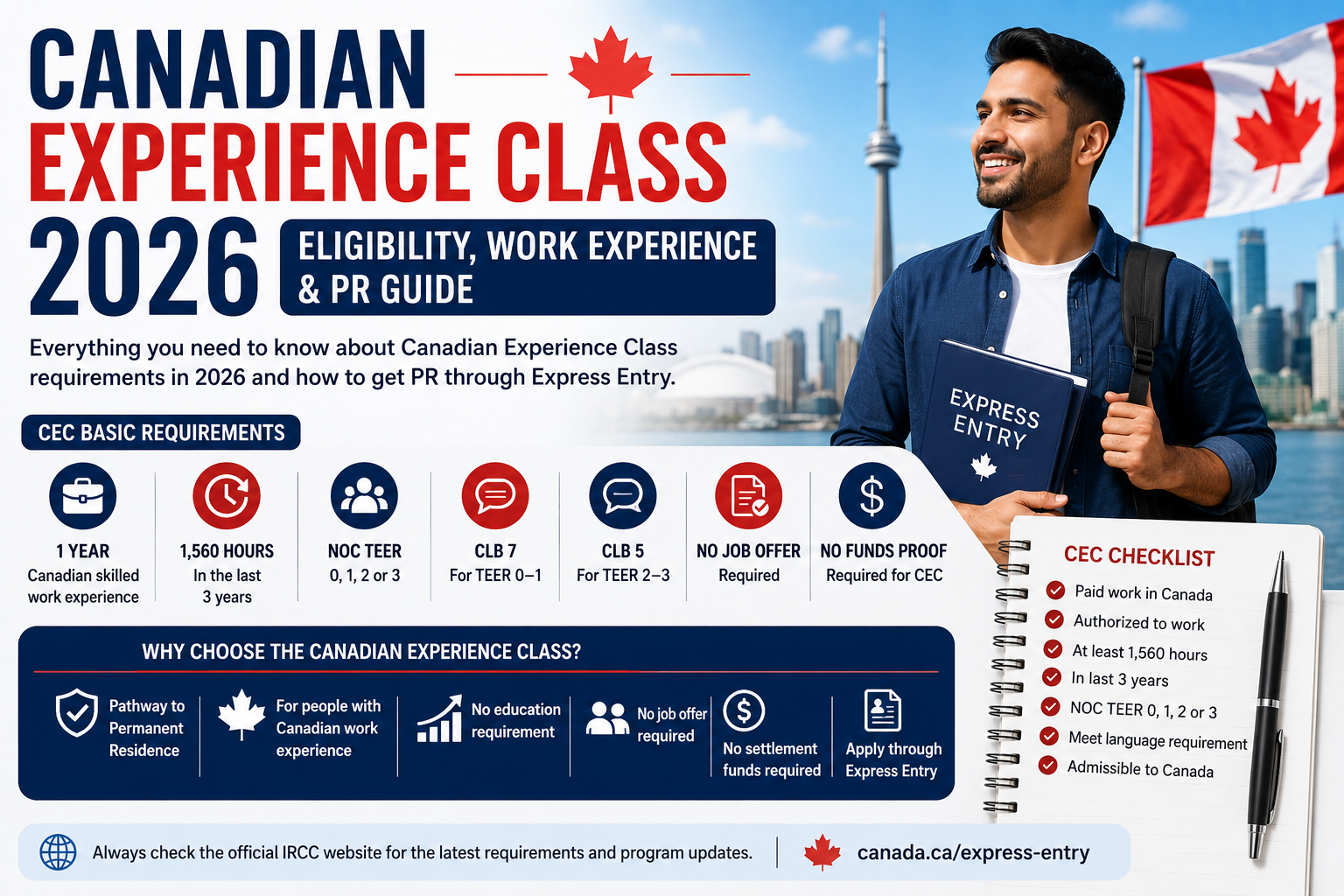
    To meet the basic Canadian skilled work-experience requirement, your experience must generally:

    • Be in NOC TEER 0, 1, 2 or 3
    • Have been gained while working in Canada
    • Have been gained while you were authorized to work
    • Be paid employment
    • Total at least 1,560 eligible hours
    • Have been gained during the three years before you apply
    • Match the lead statement and most of the main duties of your NOC

    You must also meet the required language level for your occupation and be admissible to Canada.

    How Much Canadian Work Experience Do You Need?

    The current minimum requirement is at least one year of qualifying Canadian skilled work experience in the three years before you apply.

    IRCC uses 1,560 hours as the equivalent of one year of full-time work.

    There are different ways to reach this requirement.

    Option 1: One Full-Time Job

    You can meet the requirement by working up to 30 hours per week for 12 months.

    For example:

    • 30 hours per week
    • 52 weeks
    • 1,560 hours total

    Hours worked above the amount IRCC counts as full-time do not allow you to complete the one-year requirement in only a few months.

    Option 2: Part-Time Work

    Part-time employment can also qualify.

    For example, someone working approximately 15 hours per week could accumulate 1,560 hours over about 24 months.

    You may use more than one eligible part-time job to meet the requirement as long as the work satisfies the CEC rules.

    Option 3: More Than One Job

    Your qualifying Canadian experience can come from more than one job.

    IRCC allows eligible experience in more than one NOC, provided the work meets the program requirements and falls within TEER 0, 1, 2 or 3.

    This is useful for people who change employers or occupations while building Canadian work experience.

    Which TEER Categories Qualify for CEC?

    For the Canadian Experience Class, qualifying Canadian work experience must be in:

    • TEER 0
    • TEER 1
    • TEER 2
    • TEER 3

    Work in TEER 4 or TEER 5 generally does not meet the minimum skilled-work requirement for the CEC.

    If you are unsure about your occupation, use our complete guide on how to find your NOC and TEER code in Canada.

    Why Your NOC Duties Matter

    Your job title alone does not determine whether your work experience qualifies.

    IRCC expects your work to match the National Occupational Classification associated with the occupation you claim.

    You should be able to show that you performed the actions described in the NOC lead statement and most of the occupation’s main duties.

    For example, two employees may both have the title “IT Technician,” but one may primarily provide user support while another manages networks.

    Those positions could belong to different NOC codes.

    Always choose the NOC that accurately reflects what you actually did at work.

    Does Work While Studying Count for CEC?

    Generally, no.

    Work experience gained while you were a full-time student does not count toward the Canadian Experience Class minimum work-experience requirement.

    This includes work performed during a co-op term while you were a full-time student.

    This rule is particularly important for international students who worked part-time while studying in Canada.

    You may have legally worked during your studies, but that does not necessarily make those hours eligible for the CEC minimum requirement.

    When Can International Graduates Start Building CEC Experience?

    Many international graduates begin building qualifying Canadian work experience after completing their studies and becoming legally authorized to work in Canada.

    For example, an eligible graduate may work under a Post-Graduation Work Permit or another valid work authorization.

    The work still needs to satisfy all CEC requirements, including the correct TEER category.

    Do not assume that simply holding a work permit makes every job eligible for CEC.

    Does Self-Employment Count for Canadian Experience Class?

    For the standard CEC minimum requirements, self-employment generally does not count.

    IRCC also has a specific temporary public policy affecting certain physicians providing publicly funded medical services in Canada.

    If you are self-employed or your employment arrangement is unusual, verify the current rules carefully before relying on that experience.

    Do Remote Jobs Count for CEC?

    A remote job may count only when it satisfies the Canadian work-experience requirements.

    IRCC states that if you worked remotely, you must have been physically in Canada and working for a Canadian employer for that experience to qualify under the CEC work-experience requirement.

    Working remotely for a Canadian company while physically living outside Canada is therefore not the same as qualifying Canadian work experience for CEC.

    CEC Language Requirements in 2026

    You must take an IRCC-approved language test.

    The minimum language requirement depends on the TEER category of your occupation.

    • TEER 0 or TEER 1: minimum CLB 7 in English or NCLC 7 in French
    • TEER 2 or TEER 3: minimum CLB 5 in English or NCLC 5 in French

    You need to meet the minimum level in all four language abilities:

    • Speaking
    • Listening
    • Reading
    • Writing

    Which English Tests Are Accepted for CEC?

    For English, IRCC currently accepts:

    • IELTS General Training
    • CELPIP-General
    • PTE Core

    Make sure you take the correct version of the exam.

    For example, IELTS Academic is not the Express Entry language test. Express Entry requires IELTS General Training.

    Pearson applicants must use PTE Core.

    Which French Tests Are Accepted?

    For French, IRCC currently accepts:

    • TEF Canada
    • TCF Canada

    French ability can also potentially improve an Express Entry profile beyond simply meeting CEC minimum eligibility.

    How Long Are Language Test Results Valid?

    Your language test results must be less than two years old when you create or maintain the relevant Express Entry profile requirements and when you submit your permanent residence application.

    If your results are close to expiring, plan carefully.

    An application submitted with expired language results can be refused.

    Do You Need Education for Canadian Experience Class?

    There is currently no minimum education requirement for the Canadian Experience Class.

    However, education can still be important for your Comprehensive Ranking System score.

    If you completed education in Canada, eligible Canadian credentials can help increase your ranking.

    If you completed education outside Canada, an Educational Credential Assessment may allow eligible foreign education to contribute to your Express Entry score.

    Do You Need a Job Offer for CEC?

    No.

    A job offer is not required to qualify for the Canadian Experience Class.

    You also do not necessarily need to be working at the exact time you submit your CEC application, as long as your qualifying Canadian work experience falls within the required period and you meet all other requirements.

    A job may still be important for your career and for other immigration pathways, but it is not a basic CEC eligibility requirement.

    If you are researching occupations for immigration, read our guide on jobs in Canada that may support PR pathways.

    Do Job Offers Give Express Entry CRS Points?

    A separate Express Entry rule changed in March 2025.

    Job offers no longer provide the additional 50 or 200 Comprehensive Ranking System points that were previously available for certain qualifying offers.

    However, a job offer may still be relevant to other immigration programs or provincial pathways.

    Always distinguish between:

    • CEC eligibility
    • CRS ranking
    • Requirements of other immigration programs

    Do CEC Applicants Need Proof of Funds?

    Canadian Experience Class applicants do not need to meet the Express Entry settlement-funds requirement.

    The official Express Entry proof-of-funds guidance specifically lists Canadian Experience Class applicants as exempt.

    However, the Express Entry system may still request a proof-of-funds document during the application process.

    If you are invited under the CEC and do not need settlement funds, IRCC currently instructs applicants to upload a letter explaining that they were invited under the Canadian Experience Class.

    Can You Apply for CEC While Living in Quebec?

    Canadian work experience gained while living in Quebec can potentially count.

    However, the Canadian Experience Class is for applicants who plan to live outside Quebec.

    Quebec selects its own skilled workers through separate immigration programs.

    If your qualifying work experience was gained in Quebec, you may need to demonstrate that you do not intend to settle permanently in Quebec.

    Can One Year of Work Be in Different NOCs?

    Yes.

    CEC work experience may be accumulated in more than one eligible NOC.

    The occupations still need to fall within TEER 0, 1, 2 or 3 and satisfy the other Canadian work-experience rules.

    This flexibility can help someone who changed positions during the three-year qualifying period.

    Example: Administrative Assistant

    Suppose someone works as an administrative assistant in Canada under NOC 13110.

    This occupation is classified as TEER 3.

    If the person:

    • Works legally in Canada
    • Performs duties that match the occupation
    • Receives wages or commission
    • Accumulates the required eligible hours
    • Meets at least CLB 5 or NCLC 5 in all four abilities

    the experience may potentially satisfy the CEC skilled-work requirement, subject to all other rules.

    Example: Software Developer

    Software developers and programmers fall under NOC 21232, which is TEER 1.

    A person relying on this occupation for CEC would need to meet the higher language threshold for TEER 0 and TEER 1 occupations.

    That means at least CLB 7 in English or NCLC 7 in French in all four abilities.

    Example: User Support Technician

    User support technicians are classified under NOC 22221, a TEER 2 occupation.

    For CEC minimum language eligibility, a TEER 2 occupation requires at least CLB 5 or NCLC 5 in all four abilities.

    The applicant would still need the required amount of eligible Canadian work experience.

    Does Your Salary Determine CEC Eligibility?

    CEC is not simply based on earning a particular salary.

    The classification and nature of your work, authorization to work, hours, duties and other program requirements are more important to determining whether your experience meets the minimum rules.

    Your employment documents should accurately reflect your real job and compensation.

    Documents That Can Help Prove Canadian Work Experience

    When you apply for permanent residence, IRCC may require documents supporting the work experience claimed in your profile.

    Depending on your circumstances, evidence can include:

    • Employer reference or experience letters
    • Employment contracts
    • Pay stubs
    • T4 tax slips
    • Notices of Assessment
    • Other employment records requested by IRCC

    Your employer letter should accurately describe your actual employment rather than simply copying an NOC description.

    Common CEC Mistakes to Avoid

    Avoid these common mistakes:

    • Counting work performed while studying full time
    • Using TEER 4 or TEER 5 work as the CEC minimum skilled experience
    • Choosing a NOC based only on the job title
    • Counting unpaid internships or volunteer work
    • Counting unauthorized work
    • Using expired language test results
    • Assuming a Canadian job automatically qualifies for CEC
    • Claiming duties that do not match the work actually performed
    • Assuming a job offer is required for CEC

    How to Improve Your Express Entry Profile After Becoming CEC Eligible

    Meeting CEC eligibility does not guarantee permanent residence.

    Once you enter the Express Entry pool, candidates are ranked using the Comprehensive Ranking System.

    Factors that can affect your CRS score include:

    • Age
    • Education
    • English and French language ability
    • Canadian work experience
    • Foreign work experience
    • Spouse or partner factors where applicable
    • Provincial nomination
    • Other eligible additional-point factors

    You can check current scoring rules using IRCC’s official Comprehensive Ranking System criteria.

    Can More Canadian Work Experience Increase Your CRS Score?

    Yes, additional eligible Canadian work experience can affect your CRS ranking.

    CEC minimum eligibility begins at one year of qualifying Canadian experience, but the CRS awards different levels of points based on Canadian work experience.

    This means becoming eligible for CEC and having a competitive CRS score are two different issues.

    Can Better Language Scores Help?

    Yes.

    The language score required to qualify for CEC is only the minimum.

    Higher English or French scores can substantially improve an Express Entry profile.

    For many candidates, improving language performance can be one of the most practical ways to increase CRS points.

    Can French Help a CEC Candidate?

    Yes.

    French proficiency can contribute to Express Entry scoring and French-language proficiency is also used as a category in category-based selection.

    A candidate may therefore benefit from strong French even when their original CEC work experience was performed in an English-speaking workplace.

    CEC and Provincial Nominee Programs

    A person who qualifies for the CEC may also potentially qualify for a Provincial Nominee Program.

    An Express Entry-linked provincial nomination can provide a major increase in CRS points.

    Provincial programs have their own criteria and can change frequently.

    Always check the official immigration website of the province or territory you are interested in.

    CEC and Express Entry Category-Based Selection

    Being eligible for the Canadian Experience Class does not prevent you from also meeting the criteria for an Express Entry category-based round.

    For example, a CEC candidate could also have eligible experience in healthcare, trades, education, STEM or transport.

    French-speaking CEC candidates may also meet the requirements of the French-language proficiency category.

    Category requirements and eligible occupations can change, so check IRCC’s current category-based selection information.

    How to Prepare Before Creating Your Express Entry Profile

    Before creating a profile, organize your information carefully.

    Check:

    • Your correct NOC and TEER
    • Your eligible work dates
    • Your total qualifying work hours
    • Your work authorization during those periods
    • Your language test validity
    • Your education information
    • Your employment records
    • Your passport validity

    Make sure the information you enter matches the documents you will later provide.

    Build Your Career While Preparing for PR

    Immigration strategy should not completely replace career planning.

    Try to build experience that supports both your permanent residence goals and your long-term career.

    Our guide to jobs for newcomers in Canada can help you compare different occupations.

    When applying, prepare a strong Canadian-style resume and customize your cover letter for each important opportunity.

    Canadian Experience Class Checklist

    Before relying on the CEC pathway, confirm that:

    • Your Canadian work is in TEER 0, 1, 2 or 3
    • You have at least 1,560 qualifying hours
    • The experience is from the previous three years
    • You were authorized to work in Canada
    • Your work was paid
    • Your NOC duties accurately match your real work
    • You are not improperly counting full-time student work
    • You meet the language requirement for your TEER
    • Your language results are still valid
    • You plan to live outside Quebec
    • You understand that CEC eligibility does not guarantee an invitation

    Final Thoughts

    The Canadian Experience Class can be an important permanent residence pathway for people who build eligible skilled work experience in Canada.

    In 2026, the basic work-experience requirement remains at least one year, or 1,560 hours, of qualifying Canadian work in TEER 0, 1, 2 or 3 during the previous three years.

    Your language requirement depends on your occupation: TEER 0 and 1 require at least CLB or NCLC 7, while TEER 2 and 3 require at least CLB or NCLC 5.

    A job offer and minimum education are not required for CEC eligibility, and CEC applicants are exempt from the Express Entry settlement-funds requirement.

    However, meeting minimum eligibility does not guarantee permanent residence.

    Your CRS score, invitation rounds and overall Express Entry profile still matter.

    Always verify your NOC, work history and current immigration rules using official Immigration, Refugees and Citizenship Canada information before making an important decision.