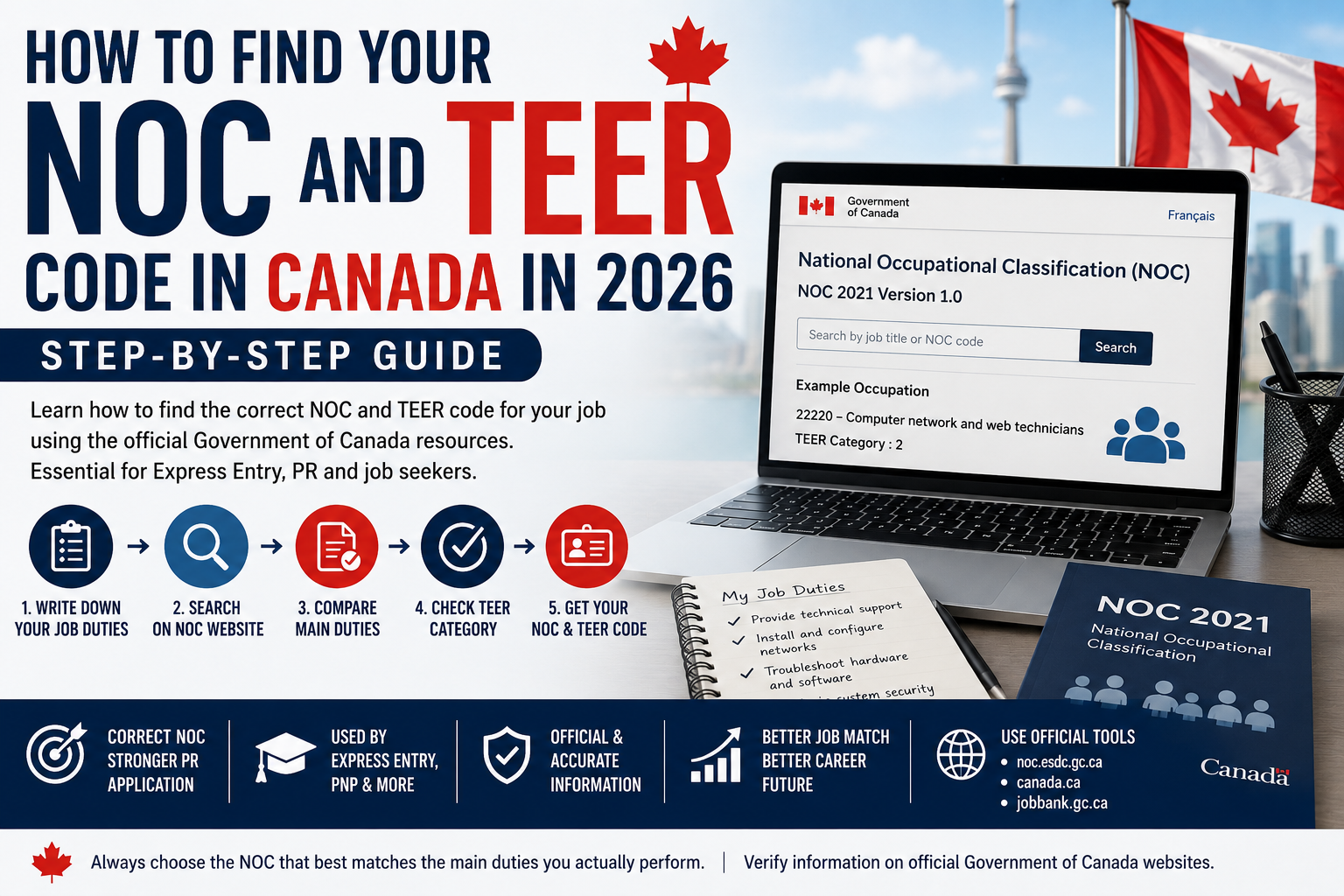
Finding the correct National Occupational Classification, or NOC, is one of the most important steps when researching Canadian jobs or preparing for certain immigration programs.
Your NOC identifies the type of work you perform, while the TEER category describes the typical training, education, experience and responsibilities associated with that occupation.
Using the wrong NOC can create problems because Canadian immigration programs often use NOC and TEER information to determine whether work experience meets program requirements.
This guide will show you how to find your NOC and TEER code in Canada step by step.
What Is the National Occupational Classification?
The National Occupational Classification, commonly called the NOC, is Canada’s official system for classifying occupations.
The current system used by Immigration, Refugees and Citizenship Canada is NOC 2021 Version 1.0.
Each occupation is assigned a five-digit NOC code.
For example:
- Administrative assistants — NOC 13110
- Software developers and programmers — NOC 21232
- Computer network and web technicians — NOC 22220
- Registered nurses and registered psychiatric nurses — NOC 31301
The NOC code is based on the occupation and the type of work performed, not simply the company where you work.
What Does TEER Mean?
TEER stands for:
- Training
- Education
- Experience
- Responsibilities
The TEER system replaced the older NOC skill-level system.
There are six TEER categories: TEER 0, 1, 2, 3, 4 and 5.
Understanding the Six TEER Categories
TEER 0
TEER 0 generally includes management occupations.
Examples can include financial managers, engineering managers, restaurant managers and other management positions.
TEER 1
TEER 1 occupations usually require a university degree or significant experience in a related occupation.
Examples include software engineers, accountants, registered nurses, engineers and many other professional occupations.
TEER 2
TEER 2 occupations usually require a college diploma, apprenticeship training of two or more years, or involve supervisory responsibilities.
Examples include computer network technicians, licensed practical nurses and many skilled trade or supervisory occupations.
TEER 3
TEER 3 occupations usually require a college diploma, apprenticeship training of less than two years, or more than six months of on-the-job training.
Examples include administrative assistants and several technical or skilled occupations.
TEER 4
TEER 4 occupations usually require a high school diploma or several weeks of on-the-job training.
Examples can include receptionists and retail salespersons.
TEER 5
TEER 5 occupations usually require short-term work demonstration and no formal educational requirement.
Examples can include certain labour and support occupations.
How the Five-Digit NOC Code Works
NOC 2021 uses a five-digit occupation code.
The first digit represents the broad occupational category.
The second digit represents the TEER category.
The full five-digit number identifies the specific NOC unit group.
For example, consider:
NOC 22220 — Computer network and web technicians
The first digit, 2, places the occupation in natural and applied sciences and related occupations.
The second digit, 2, indicates TEER 2.
The complete code 22220 identifies the specific occupation group.
Step 1: Write Down Your Actual Job Duties
Before searching for your NOC, write down what you actually do at work.
Do not focus only on your job title.
For example, two employers may use the title “IT Technician,” but the employees may perform completely different duties.
One person may mainly provide user support, while another may configure and maintain computer networks.
Those jobs may belong to different NOC codes.
Write down approximately five to ten of your main responsibilities before beginning your search.
Step 2: Search Your Job Title on the Official NOC Website
Go to the official Government of Canada NOC website.
Select NOC 2021 Version 1.0 if the website asks you to choose a classification version.
Search using your job title.
Try different versions of your title if necessary.
For example, someone working in technical support might search:
- IT support technician
- User support technician
- Technical support specialist
- Computer support technician
The search results may show several possible occupations.
Do not immediately choose the first result.
Step 3: Compare the Main Duties
This is one of the most important steps.
Open the NOC occupation that appears closest to your job and read its description carefully.
Compare the listed main duties with the work you actually perform.
IRCC advises applicants to make sure the main duties listed for the NOC match what they did in their job.
If the duties do not match, search for another occupation.
Your job title can be different from the official NOC title as long as the occupation description and duties accurately represent your real work.
Step 4: Check the Lead Statement
Many NOC profiles include a lead statement describing the general type of work performed and where people in that occupation may work.
Read this section carefully.
Your employment should reasonably fit the occupation described.
If the lead statement describes a completely different type of work, that may be a sign that you have selected the wrong NOC.
Step 5: Write Down the Five-Digit NOC Code
Once you find an occupation whose description and duties accurately match your work, write down its five-digit NOC code.
For example:
- Administrative assistants — 13110
- Cybersecurity specialists — 21220
- Software developers and programmers — 21232
- Computer network and web technicians — 22220
- Licensed practical nurses — 32101
Make sure you save the full five-digit code.
Step 6: Identify the TEER Category
After finding your NOC, check the TEER category shown on the occupation profile.
You can also understand it from the second digit of the NOC 2021 code.
For example:
- NOC 21232 — the second digit is 1, so it is TEER 1
- NOC 22220 — the second digit is 2, so it is TEER 2
- NOC 13110 — the second digit is 3, so it is TEER 3
This TEER information can be important when checking immigration program requirements.
Why NOC and TEER Matter for Express Entry
Several Canadian immigration programs classify work experience using the NOC and TEER system.
For example, the Canadian Experience Class generally requires qualifying Canadian skilled work experience in TEER 0, 1, 2 or 3.
This is why you should check the classification of your occupation rather than assuming every Canadian job counts in the same way.
Our guide on jobs in Canada that may support PR pathways explains this in more detail.
NOC and Express Entry Category-Based Selection
NOC codes are also important for Express Entry category-based selection.
Canada currently uses occupation-based categories in areas such as healthcare and social services, STEM, trades, education and transport.
Each category has an official list of eligible NOC codes.
You can review the current lists on the official Express Entry category-based selection page.
Do not assume that every job in a broad industry is included.
The exact NOC code matters.
Example: Administrative Assistant
Suppose you work as an administrative assistant.
The current NOC classification lists:
NOC 13110 — Administrative assistants
This occupation is TEER 3.
If your actual responsibilities include administrative support duties that match this NOC profile, this may be the appropriate classification.
However, an administrative officer, receptionist or executive assistant may have a different NOC.
This is why matching duties is more important than relying only on a similar job title.
Example: IT Support Worker
Suppose your employer calls your position “IT Support Specialist.”
Depending on your actual duties, you might find a classification such as:
NOC 22221 — User support technicians
This occupation is TEER 2.
However, someone who mainly installs, maintains and manages networks may fit another occupation such as:
NOC 22220 — Computer network and web technicians
Both can sound similar in everyday conversation, but the correct NOC depends on what the worker actually does.
Example: Registered Nurse
Registered nurses and registered psychiatric nurses are classified under:
NOC 31301
This occupation is TEER 1.
A licensed practical nurse, however, has a different classification:
NOC 32101
That occupation is TEER 2.
Similar healthcare job titles can therefore have different NOC codes and TEER categories.
What If Your Job Duties Match More Than One NOC?
This can happen.
First, compare the lead statements and main duties of each possible occupation.
Ask yourself which occupation best represents the majority of your actual work.
Do not choose a NOC simply because it has a lower TEER number or appears more attractive for immigration.
Your classification should accurately represent your employment.
If your situation is complicated or has major immigration consequences, consider obtaining advice from an authorized immigration professional.
Can You Choose a NOC Based Only on Your Job Title?
No.
A job title can help you find possible NOC classifications, but it should not be the only factor you use.
Different employers can use different titles for very similar jobs.
The opposite can also happen: two employees may have the same title while performing substantially different work.
Always compare the duties.
Can Your NOC Change When You Change Jobs?
Yes.
Your NOC describes the occupation associated with a particular job.
If you move into a position with substantially different responsibilities, your new job may have a different NOC and TEER category.
For example, an employee may move from a retail salesperson position into a retail supervisor position.
Those occupations can have different classifications.
Therefore, do not assume that one NOC applies to your entire career.
Should Your Employment Letter Match Your NOC?
If an immigration program requires proof of work experience, your employment documents should accurately describe the work you actually performed.
The responsibilities described by your employer should genuinely support the occupation you are claiming.
Do not ask an employer to copy NOC duties word for word if those are not your real responsibilities.
Misrepresenting your job duties can create serious immigration problems.
Common NOC Mistakes to Avoid
Avoid these common mistakes:
- Choosing a NOC only because the job title looks similar
- Using an old four-digit NOC 2016 code when a current NOC 2021 code is required
- Choosing a NOC because its TEER category seems better for immigration
- Ignoring the main duties
- Copying NOC duties into an employment letter when they are not accurate
- Confusing a supervisor occupation with the occupation of the employees being supervised
- Assuming every job in the same industry has the same TEER
NOC 2016 vs NOC 2021
Canada previously used NOC 2016, which used four-digit occupation codes and skill levels.
IRCC switched to NOC 2021 on November 16, 2022.
NOC 2021 uses five-digit codes and the six-category TEER system.
If you find an old article or document showing a four-digit NOC code, verify the current equivalent before relying on it.
The official NOC website provides current occupation information and tools for comparing classification versions.
How NOC Can Help With Your Job Search
NOC research is useful even if you are not currently applying for permanent residence.
Understanding your occupation can help you research:
- Typical job titles
- Job duties
- Employment requirements
- Related occupations
- Career pathways
- Canadian labour-market information
You can also use Canada’s Job Bank to research occupations and available jobs.
If you are currently looking for employment, our guide to jobs for newcomers in Canada can help you compare different career options.
Use the Correct NOC When Preparing Your Canadian Career Plan
Understanding your NOC can help you connect your job search with your longer-term plans.
Once you know your occupation, you can research whether it appears in particular immigration programs or provincial streams.
You can then focus your job search on legitimate opportunities that match your experience.
When applying for jobs, use a strong Canadian-style resume and a customized cover letter.
Official Tools to Find Your NOC
For current information, use official Government of Canada resources.
You can start with IRCC’s Find your National Occupational Classification page.
You can then verify the occupation directly through the official NOC website.
If information from another website conflicts with the official NOC classification, rely on the Government of Canada information.
Final NOC and TEER Checklist
Before using a NOC code for an important immigration or employment purpose, confirm that:
- You are using NOC 2021 Version 1.0
- You have the complete five-digit NOC code
- Your actual duties match the occupation
- The lead statement reasonably matches your work
- You know the TEER category
- You checked the official NOC website
- You reviewed the requirements of the immigration program you are considering
Final Thoughts
Finding your NOC and TEER code is not simply a matter of typing your job title into a search box and choosing the first result.
The most important step is comparing your real job responsibilities with the official occupation description.
Canada currently uses NOC 2021 Version 1.0, with five-digit NOC codes and TEER categories ranging from 0 to 5.
Once you identify the correct occupation, you can use that information to research employment opportunities, Express Entry requirements, Provincial Nominee Programs and other Canadian immigration pathways.
Always verify important NOC and immigration information through official Government of Canada sources because classifications and program requirements can change.