Tag: Canadian resume

  • 10 Best Jobs in Canada for Newcomers in 2026: Pay, Requirements & Tips

    10 Best Jobs in Canada for Newcomers in 2026: Pay, Requirements & Tips

    Finding Good Jobs in Canada as a Newcomer

    Starting a career in a new country can feel challenging. Newcomers may have international education and work experience, but Canadian employers can have different expectations for resumes, licenses, certifications and workplace experience.

    The good news is that Canada has opportunities across healthcare support, transportation, construction, warehousing, security, administration, retail, hospitality and technology.

    The “best” job is different for every person. A job that is suitable for one newcomer may not be suitable for another. Your education, previous experience, English or French level, location, licence requirements and career goals should all be considered.

    Here are 10 jobs worth exploring in Canada in 2026.

    1. Administrative Assistant

    Administrative assistants work in offices across the private and public sectors. Their duties may include scheduling appointments, preparing documents, handling correspondence, organizing files and supporting managers or other employees.

    Job Bank currently lists a Canada-wide median wage of about $26.44 per hour for administrative assistants. It says this occupation commonly requires post-secondary education, an apprenticeship of less than two years, or substantial on-the-job training.

    This can be a good career option for newcomers who have strong communication, organization, computer and customer-service skills.

    Knowledge of Microsoft Word, Excel, Outlook and professional email communication can make an applicant more competitive.

    2. Transport Truck Driver

    Truck drivers transport goods between cities, provinces and sometimes across the Canada–U.S. border.

    Job Bank reports a national median wage of approximately $26.42 per hour for transport truck drivers.

    However, this is not a job that someone can simply start without the proper licence. Job Bank states that secondary school is usually required, training may be necessary, and the appropriate commercial driver’s licence depends on the vehicle. For example, a Class 1 or A licence is required for long combination vehicles, while additional endorsements may be required for air brakes or dangerous goods.

    This occupation may suit newcomers who enjoy driving, can work independently and are comfortable spending significant time on the road.

    3. Construction Helper or Labourer

    Construction helpers assist skilled tradespeople and perform general labour at construction sites.

    Job Bank currently shows a median wage of about $25.00 per hour in Canada for construction helpers. It also says this occupation usually involves on-the-job training, short-term work experience and no formal education requirement.

    Typical work can involve moving materials, cleaning work areas, assisting tradespeople and using basic tools or equipment.

    Physical fitness, reliability, safety awareness and the ability to work outdoors can be important.

    Construction can also provide a path toward learning a skilled trade over time.

    4. Material Handler or Warehouse Worker

    Warehouses, distribution centres, manufacturers and transportation companies employ material handlers to move, load, unload and organize products and materials.

    Job Bank lists a Canada-wide median wage of approximately $22.00 per hour for material handlers. It states that this occupation generally requires short-term work experience and on-the-job training rather than formal education.

    Some employers may prefer applicants who have forklift experience, warehouse experience, safety training or the ability to perform physical work.

    For newcomers trying to gain Canadian work experience quickly, warehousing can be one area worth researching.

    5. Retail Store Supervisor

    Retail supervisors coordinate employees working in stores and other retail businesses. Their responsibilities may include assigning duties, handling customer problems, managing inventory, training employees and helping with daily store operations.

    Job Bank reports a median wage of about $22.00 per hour nationally.

    Job Bank says secondary school is usually required, along with previous experience in retail sales or similar customer-facing roles.

    This role can be attractive to newcomers who already have experience in customer service, sales, cashier work or retail operations and want to move into a supervisory position.

    6. Security Guard

    Security guards work in office buildings, hospitals, residential buildings, retail stores, transportation facilities, events and many other locations.

    Job Bank currently lists a Canada-wide median wage of approximately $21.00 per hour for private security officers and related security occupations.

    Requirements vary depending on the position and province. Job Bank says secondary school is usually required and some security roles require specific certification or licensing.

    Anyone considering security work should check the licensing requirements for the province or territory where they plan to work before applying.

    Strong observation, communication, reliability and conflict-management skills can be valuable in this field.

    7. Home Support Worker or Caregiver

    Home support workers provide personal care and companionship to seniors, people with disabilities and individuals recovering from illness.

    Job Bank reports a national median wage of approximately $20.50 per hour for home support workers. It says this occupation commonly requires a secondary school diploma or several weeks of on-the-job training.

    The work may involve helping clients with daily activities, meal preparation, companionship and household tasks.

    Patience, communication, compassion and dependability are especially important.

    People with previous healthcare, caregiving or personal-support experience may find this field particularly relevant.

    8. Light Duty Cleaner

    Cleaners work in hotels, hospitals, schools, offices, residential buildings, recreational facilities and private homes.

    Job Bank lists a Canada-wide median wage of approximately $19.74 per hour for light duty cleaners.

    Job Bank states that there are generally no specific education requirements for this occupation, although some employers may ask for housekeeping-related certification or experience.

    Cleaning work can provide an entry point into the Canadian labour market for people who are dependable, physically active and comfortable working independently.

    Hours can include mornings, evenings, nights and weekends depending on the employer.

    9. Food Service Supervisor

    Food service supervisors oversee employees who prepare and serve food in restaurants, cafeterias, hospitals, catering businesses and other food-service establishments.

    Job Bank currently reports a national median wage of approximately $19.00 per hour.

    Secondary school is usually required. Job Bank says candidates generally need either related college education or several years of experience in food preparation or service.

    Someone who begins in an entry-level restaurant position may be able to progress toward supervisory work after gaining experience.

    Customer service, teamwork, time management and the ability to work in a fast-paced environment are useful skills.

    10. Software Developer

    Software development is one of the higher-paying options on this list, although it also has higher education and skill requirements.

    Software developers design, write and test software and computer systems. They work for technology companies, consulting firms, game developers and IT departments in many industries.

    Job Bank currently lists a Canada-wide median wage of approximately $48.08 per hour for software developers.

    Job Bank says a bachelor’s degree in computer science, software engineering or another programming-focused discipline, or a related college program, is usually required.

    Newcomers with international IT experience should make their technical skills easy to identify on their resume and consider developing a portfolio that demonstrates real projects.

    Which Job Is Best for You?

    Do not choose an occupation only because the salary looks attractive.

    First consider your existing education and experience. Someone with several years of IT experience may be better positioned for software or technical roles, while someone with retail experience may have a faster path toward customer service or supervision.

    Also check whether your occupation requires a provincial licence, certification or credential recognition.

    Pay attention to the city and province as well. Job availability and wages can vary considerably across Canada, so a position that has strong opportunities in one province may be more competitive in another.

    How Newcomers Can Improve Their Chances of Getting Hired

    Your first goal should be to make it easy for employers to understand how your experience matches their job.

    Use a Canadian-style resume and customize it for each important application. Do not send exactly the same resume to every employer.

    Focus on relevant skills and accomplishments rather than only listing job duties.

    Use keywords from the job posting naturally when they genuinely describe your experience.

    Also consider improving your English or French, obtaining job-specific licences or certifications, building Canadian references and networking with people in your industry.

    When searching online, always verify the employer and job posting before providing personal information.

    Where to Search for Jobs in Canada

    A useful starting point is the Government of Canada’s Job Bank, where job seekers can search jobs and research occupations, wages, requirements and labour-market information.

    Job Bank data also shows that job prospects vary by province and territory, which is why checking the specific region where you plan to work is important.

    You can also search employer career pages, LinkedIn and established Canadian job websites.

    Final Thoughts

    There is no single best job for every newcomer in Canada.

    Some people need an entry-level job to build Canadian experience, while others are ready to continue an established professional career.

    Construction, transportation, warehousing, security, caregiving, administration, retail, hospitality and technology all offer different opportunities.

    Start with your existing skills, research the requirements for your occupation and location, and build a strong Canadian-style resume that clearly explains what you can offer an employer.

    A realistic first job can be the beginning of a much stronger long-term career in Canada.

  • Canadian Resume Format 2026: Step-by-Step Guide for Newcomers

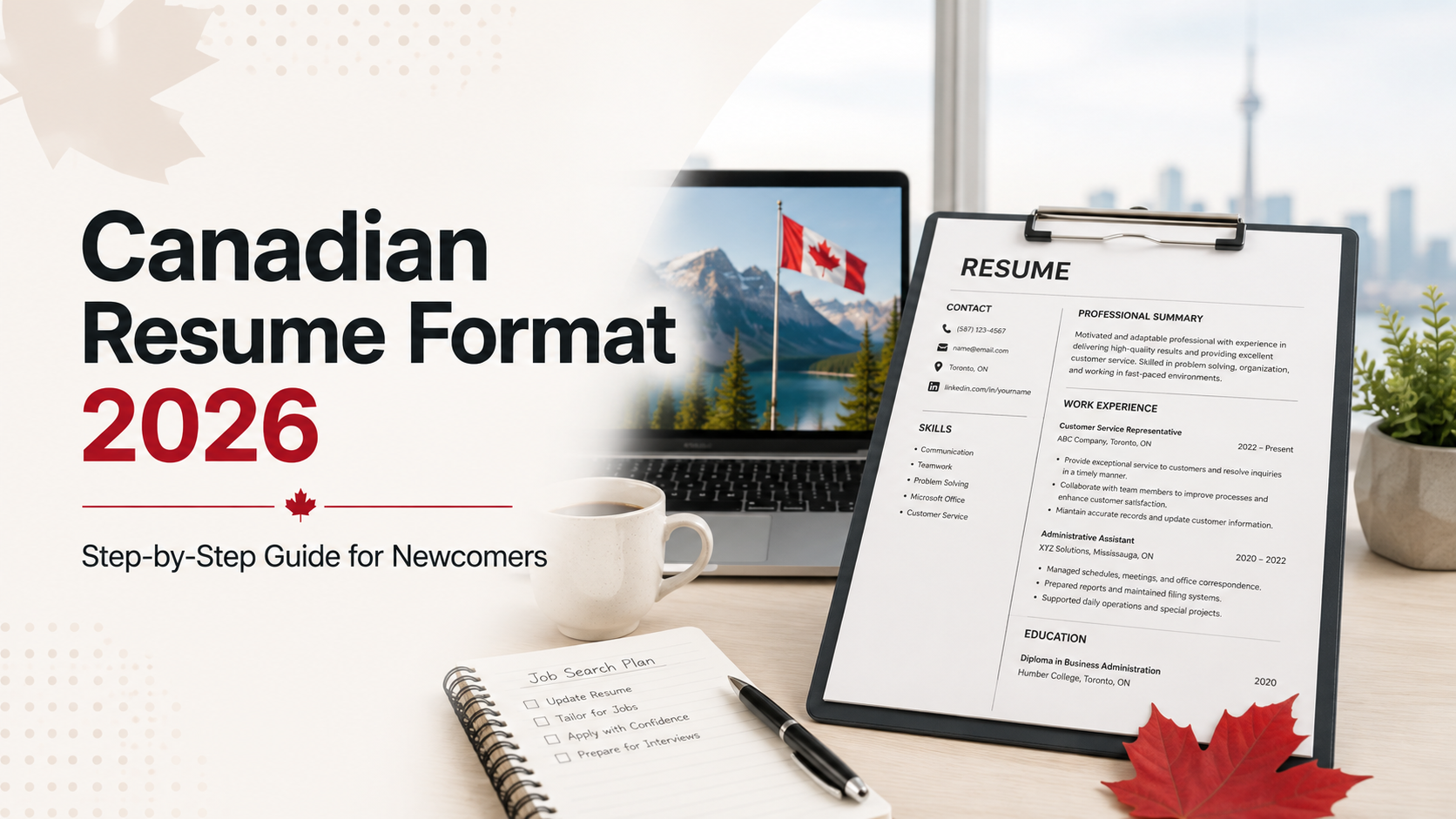
    Canadian Resume Format 2026: Step-by-Step Guide for Newcomers

    Canadian Resume Format 2026: What Newcomers Need to Know

    If you are applying for jobs in Canada, your resume may need to look different from the one you used in your home country. Canadian employers usually prefer a resume that is simple, easy to read, focused on relevant skills, and customized for the position.

    There is no single mandatory Canadian resume format. Job Bank currently provides a traditional template for experienced workers and another format for youth and recent graduates. The most important thing is choosing a format that clearly shows why you are suitable for the job.

    1. Start With Your Contact Information

    At the top of your resume, include your full name, phone number, professional email address, and city and province.

    You normally do not need to include your complete street address.

    Keep this section simple so an employer can quickly see who you are and how to contact you.

    2. Write a Short Professional Summary

    Add a short summary of about two to four lines explaining your experience, strongest skills, and the type of value you can bring to an employer.

    For example:

    Reliable customer service professional with experience working in fast-paced environments. Strong communication, teamwork, and problem-solving skills with a focus on providing excellent service and completing tasks efficiently.

    Avoid writing a long personal introduction. Your summary should focus on professional qualifications.

    3. Add Relevant Skills

    Include skills that match the job posting.

    For example, an office position may require Microsoft Office, communication, organization, data entry, and customer service skills. A warehouse position may focus more on inventory handling, safety procedures, teamwork, order picking, and physical organization.

    Do not use the same skills for every application. Read the job description and adjust your resume for each position. Job Bank specifically recommends customizing your resume for the job you want.

    4. List Your Work Experience

    Generally, start with your most recent job and work backward.

    For each position, include the job title, employer, location, dates worked, and several short bullet points describing your accomplishments and relevant responsibilities.

    Try not to write only basic duties.

    Instead of:

    Responsible for customer service.

    Write something stronger, such as:

    Assisted customers with questions and resolved concerns while maintaining professional and friendly service.

    Where possible, show results using numbers or specific examples.

    For example:

    Processed 50+ customer transactions during busy shifts while maintaining accuracy.

    Job Bank recommends highlighting achievements and specific examples rather than simply listing routine responsibilities.

    5. Add Your Education

    List your most recent and relevant education.

    Include the program or credential, school or college name, location, and completion date or expected graduation date.

    Newcomers can include education completed outside Canada. You do not need to hide international education or experience simply because it was obtained in another country.

    If a profession is regulated in Canada, however, you may need to have your credentials assessed or recognized before working in that occupation. Canada also offers newcomer and pre-arrival services that can help with employment preparation and credential recognition.

    6. Include Certifications When Relevant

    Add licences and certifications that are useful for the position.

    Examples could include First Aid and CPR, security licences, WHMIS, Smart Serve, forklift certification, industry certifications, or professional licences.

    Only include certifications that are current and relevant.

    What You Should NOT Put on a Canadian Resume

    Canadian resume practices can be different from those in some other countries.

    Do not normally include a photograph, age or date of birth, marital status, religion, political views, weight or height, Social Insurance Number, banking information, or other unnecessary sensitive information.

    Job Bank specifically states that including a photograph is not the norm in Canada and advises applicants not to include unnecessary personal information. Government newcomer guidance also says not to include details such as age, marital status, gender, religion, SIN, political affiliation, or immigration status.

    How Long Should a Canadian Resume Be?

    For most job seekers, aim for one or two pages.

    If you are a recent graduate or have limited experience, one page may be enough. If you have several years of relevant experience, two pages can be appropriate.

    Job Bank recommends limiting a resume to two pages and keeping information concise and easy to scan.

    Make Your Resume ATS-Friendly

    Many employers use software to help manage job applications.

    Keep your formatting simple. Use clear headings such as Work Experience, Education, Skills, and Certifications. Avoid complicated tables, excessive graphics, unusual fonts, or unnecessary design elements.

    Most importantly, read the job posting carefully and naturally include relevant skills and terminology that genuinely match your experience.

    For Government of Canada applications specifically, applicants are advised to tailor their resume and use relevant keywords from the position requirements.

    Canadian Resume Checklist

    Before sending your resume, check that:

    • Your contact information is correct.
    • The resume is tailored to the job.
    • Your most relevant skills are easy to find.
    • Your work experience starts with the most recent position.
    • Your bullet points show accomplishments where possible.
    • Spelling and grammar have been checked.
    • The resume is no longer than necessary.
    • You have removed unnecessary personal information and photos.
    • You have not included references unless specifically requested.

    Final Thoughts

    A strong Canadian resume does not need complicated graphics or a fancy design. It needs to clearly show an employer that your skills and experience match the job.

    For newcomers, the biggest adjustment is often learning to focus less on personal information and more on relevant skills, accomplishments, and experience.

    Create a strong master resume first, but customize it before every important application. Small changes to your summary, skills, and experience sections can make your application much more relevant to the employer.