
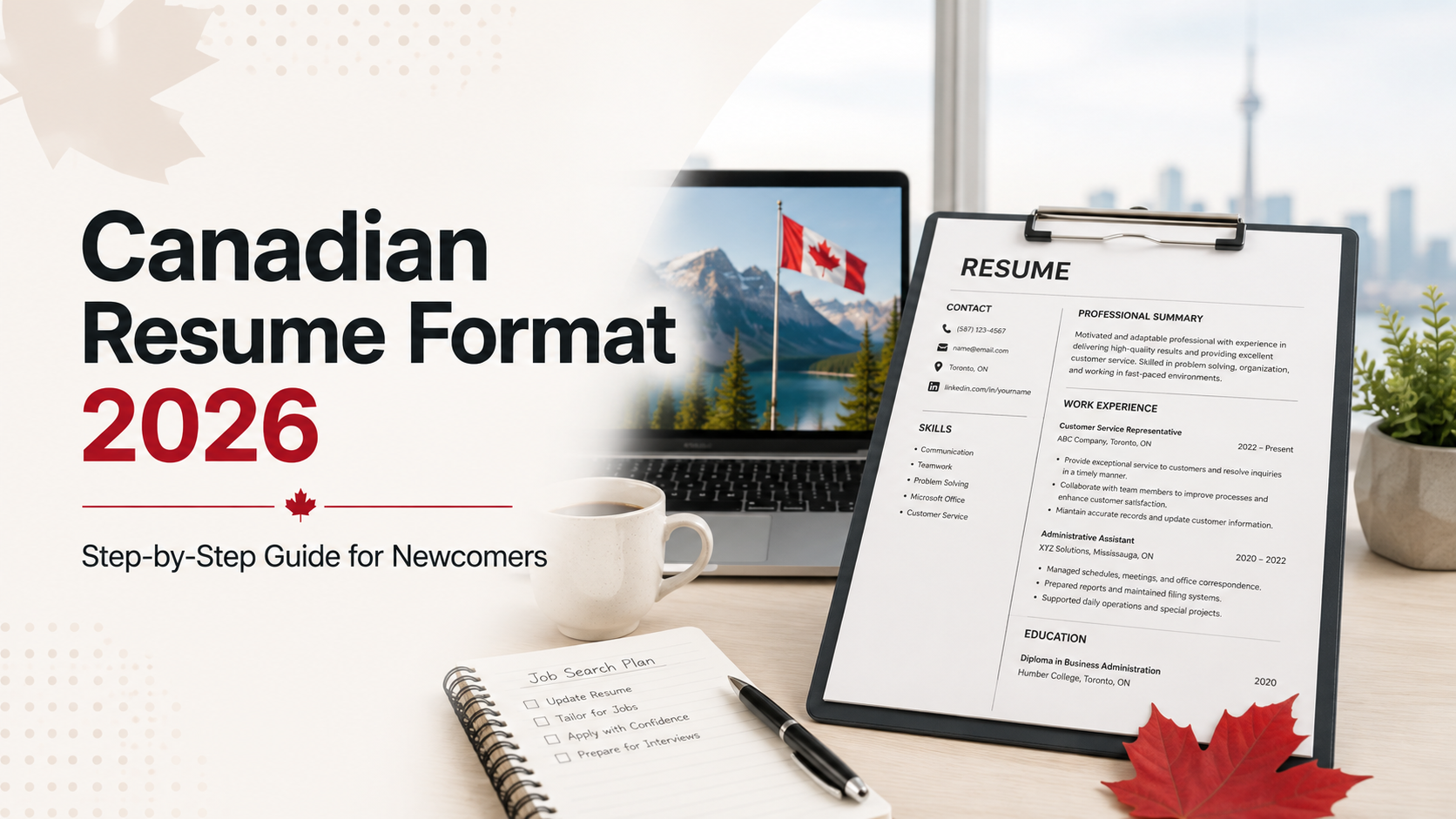
Canadian Resume Format 2026: What Newcomers Need to Know
If you are applying for jobs in Canada, your resume may need to look different from the one you used in your home country. Canadian employers usually prefer a resume that is simple, easy to read, focused on relevant skills, and customized for the position.
There is no single mandatory Canadian resume format. Job Bank currently provides a traditional template for experienced workers and another format for youth and recent graduates. The most important thing is choosing a format that clearly shows why you are suitable for the job.
Canadian Resume Template 2026
Use this simple order for most Canadian job applications. Replace every bracketed item with accurate information and adjust the skills and examples for each position.
[YOUR FULL NAME]
[City, Province] · [Phone Number] · [Professional Email] · [LinkedIn URL, optional]PROFESSIONAL SUMMARY
[Job title or professional identity] with [number] years of experience in [relevant field]. Skilled in [skill 1], [skill 2] and [skill 3], with experience [one short statement that matches the target job].KEY SKILLS
[Relevant skill] · [Relevant skill] · [Software or equipment] · [Language, if relevant] · [Certification]WORK EXPERIENCE
[Job Title] — [Employer], [City, Country]
[Month Year]–[Month Year or Present]
- [Action verb] [task or accomplishment] to [result or purpose].
- [Action verb] [relevant responsibility], demonstrating [skill].
- [Action verb] [work performed]; include a truthful number or result when available.
EDUCATION
[Credential or Program] — [School], [City, Country]
[Completion Year]CERTIFICATIONS
[Current, job-relevant certification] — [Year, if useful]
Before submitting: remove all brackets, keep only relevant sections, use consistent dates and formatting, and confirm that every statement is truthful.
Recommended Section Order
- Contact information
- Professional summary
- Key skills
- Work experience in reverse chronological order
- Education
- Relevant licences and certifications
After preparing the resume, use our Canadian cover letter template to create a matching application.
1. Start With Your Contact Information
At the top of your resume, include your full name, phone number, professional email address, and city and province.
You normally do not need to include your complete street address.
Keep this section simple so an employer can quickly see who you are and how to contact you.
2. Write a Short Professional Summary
Add a short summary of about two to four lines explaining your experience, strongest skills, and the type of value you can bring to an employer.
For example:
Reliable customer service professional with experience working in fast-paced environments. Strong communication, teamwork, and problem-solving skills with a focus on providing excellent service and completing tasks efficiently.
Avoid writing a long personal introduction. Your summary should focus on professional qualifications.
3. Add Relevant Skills
Include skills that match the job posting.
For example, an office position may require Microsoft Office, communication, organization, data entry, and customer service skills. A warehouse position may focus more on inventory handling, safety procedures, teamwork, order picking, and physical organization.
Do not use the same skills for every application. Read the job description and adjust your resume for each position. Job Bank specifically recommends customizing your resume for the job you want.
4. List Your Work Experience
Generally, start with your most recent job and work backward.
For each position, include the job title, employer, location, dates worked, and several short bullet points describing your accomplishments and relevant responsibilities.
Try not to write only basic duties.
Instead of:
Responsible for customer service.
Write something stronger, such as:
Assisted customers with questions and resolved concerns while maintaining professional and friendly service.
Where possible, show results using numbers or specific examples.
For example:
Processed 50+ customer transactions during busy shifts while maintaining accuracy.
Job Bank recommends highlighting achievements and specific examples rather than simply listing routine responsibilities.
5. Add Your Education
List your most recent and relevant education.
Include the program or credential, school or college name, location, and completion date or expected graduation date.
Newcomers can include education completed outside Canada. You do not need to hide international education or experience simply because it was obtained in another country.
If a profession is regulated in Canada, however, you may need to have your credentials assessed or recognized before working in that occupation. Canada also offers newcomer and pre-arrival services that can help with employment preparation and credential recognition.
6. Include Certifications When Relevant
Add licences and certifications that are useful for the position.
Examples could include First Aid and CPR, security licences, WHMIS, Smart Serve, forklift certification, industry certifications, or professional licences.
Only include certifications that are current and relevant.
What You Should NOT Put on a Canadian Resume
Canadian resume practices can be different from those in some other countries.
Do not normally include a photograph, age or date of birth, marital status, religion, political views, weight or height, Social Insurance Number, banking information, or other unnecessary sensitive information.
Job Bank specifically states that including a photograph is not the norm in Canada and advises applicants not to include unnecessary personal information. Government newcomer guidance also says not to include details such as age, marital status, gender, religion, SIN, political affiliation, or immigration status.
How Long Should a Canadian Resume Be?
For most job seekers, aim for one or two pages.
If you are a recent graduate or have limited experience, one page may be enough. If you have several years of relevant experience, two pages can be appropriate.
Job Bank recommends limiting a resume to two pages and keeping information concise and easy to scan.
Make Your Resume ATS-Friendly
Many employers use software to help manage job applications.
Keep your formatting simple. Use clear headings such as Work Experience, Education, Skills, and Certifications. Avoid complicated tables, excessive graphics, unusual fonts, or unnecessary design elements.
Most importantly, read the job posting carefully and naturally include relevant skills and terminology that genuinely match your experience.
For Government of Canada applications specifically, applicants are advised to tailor their resume and use relevant keywords from the position requirements.
Canadian Resume Checklist
Before sending your resume, check that:
- Your contact information is correct.
- The resume is tailored to the job.
- Your most relevant skills are easy to find.
- Your work experience starts with the most recent position.
- Your bullet points show accomplishments where possible.
- Spelling and grammar have been checked.
- The resume is no longer than necessary.
- You have removed unnecessary personal information and photos.
- You have not included references unless specifically requested.
Need help writing the first lines? Use our Canadian resume summary examples.
Final Thoughts
A strong Canadian resume does not need complicated graphics or a fancy design. It needs to clearly show an employer that your skills and experience match the job.
For newcomers, the biggest adjustment is often learning to focus less on personal information and more on relevant skills, accomplishments, and experience.
Create a strong master resume first, but customize it before every important application. Small changes to your summary, skills, and experience sections can make your application much more relevant to the employer.
Canadian Resume Summary Examples
Your professional summary sits near the top of the resume. Use two or three lines to show the type of work you can do, your strongest skills and the value you bring. Do not copy these word for word; make every detail truthful.
Customer Service Resume Summary
Customer-focused professional with experience supporting clients in fast-paced environments. Skilled in communication, problem solving, teamwork and learning new systems. Seeking a customer service role where I can provide reliable and respectful support.
Security Guard Resume Summary
Licensed security professional with strong observation, customer-service and incident-reporting skills. Comfortable following site procedures, responding calmly to concerns and maintaining a professional presence in public-facing environments.
General Labour Resume Summary
Reliable and safety-conscious worker with experience completing physical tasks, following instructions and contributing to team goals. Known for punctuality, attention to detail and the ability to work efficiently in busy environments.
ATS-Friendly Resume Checklist
- Use a simple one-column layout with clear headings.
- Match important skills and job titles from the posting when they honestly describe your experience.
- Use standard headings such as Professional Summary, Work Experience, Education and Skills.
- Save the file in the format requested by the employer.
- Proofread company names, dates, phone number and email before applying.
Frequently Asked Questions About Canadian Resumes
How long should a Canadian resume be?
One or two pages is common. Keep the most relevant experience easy to find instead of adding every past responsibility.
Should I include a photo on my resume in Canada?
Usually no. Focus on your name, contact details, skills, experience and achievements. Add only information that helps an employer assess your fit for the role.
Can I use international work experience?
Yes. Explain the responsibilities and results in clear language, and connect them with the skills required in the Canadian job posting.
Use Your Resume and Cover Letter Together
After tailoring your resume, write a matching Canadian cover letter that highlights two or three relevant achievements. Then use trusted job-search sources, including our guide to the best job websites in Canada, to find openings that fit your experience.
Leave a Reply