Tag: PR pathways Canada

  • Atlantic Immigration Program Canada 2026: Eligibility, Jobs & PR Guide

    Atlantic Immigration Program Canada 2026: Eligibility, Jobs & PR Guide

    The Atlantic Immigration Program, commonly called the AIP, is a Canadian permanent residence pathway designed to help employers in Atlantic Canada hire qualified skilled workers and eligible international graduates.

    The program covers four Atlantic provinces:

    • New Brunswick
    • Newfoundland and Labrador
    • Nova Scotia
    • Prince Edward Island

    Unlike Express Entry, the Atlantic Immigration Program does not rank candidates using a CRS score.

    Instead, an applicant generally needs a qualifying job offer from a designated Atlantic employer, must meet the program’s work experience, education and language requirements, obtain a settlement plan and receive provincial endorsement before applying for permanent residence.

    Eligible recent international graduates from recognized Atlantic Canadian institutions may be exempt from the work experience requirement.

    This guide explains the Atlantic Immigration Program in Canada in 2026, including eligibility, designated employers, job offers, NOC and TEER requirements, language scores, education, settlement funds, endorsement and the permanent residence process.

    What Is the Atlantic Immigration Program?

    The Atlantic Immigration Program is an economic immigration pathway for skilled foreign workers and eligible international graduates who want to live and work in Atlantic Canada.

    It allows designated employers in participating provinces to hire qualified candidates when they need workers to fill positions.

    The four participating provinces are:

    • New Brunswick
    • Newfoundland and Labrador
    • Nova Scotia
    • Prince Edward Island

    The Atlantic Immigration Program is a federal-provincial program. Employers work with their province during the designation and endorsement process, while Immigration, Refugees and Citizenship Canada, or IRCC, makes the final decision on permanent residence.

    Is the Atlantic Immigration Program Part of Express Entry?

    No.

    The Atlantic Immigration Program is separate from the federal Express Entry system.

    You do not need an Express Entry profile to apply through the AIP, and there is no federal Comprehensive Ranking System score used to rank Atlantic Immigration Program candidates.

    If you are comparing immigration options, read our complete Express Entry Canada 2026 guide.

    Who Can Apply for the Atlantic Immigration Program?

    Under the current program, an applicant generally needs to:

    • Get a valid job offer from a designated employer in Atlantic Canada
    • Have qualifying work experience, unless eligible for the Atlantic international graduate exemption
    • Meet the education requirement for the job offer
    • Take an approved English or French language test and meet the minimum score
    • Show sufficient settlement funds when required
    • Obtain a settlement plan from an approved service provider organization
    • Receive provincial endorsement of the job offer
    • Meet federal permanent residence and admissibility requirements

    You can review the official AIP eligibility requirements before applying.

    Which Provinces Participate in AIP?

    New Brunswick

    New Brunswick participates in the Atlantic Immigration Program and designates employers that can hire eligible foreign workers through the program.

    Employment opportunities can vary based on the province’s labour-market needs and employer demand.

    Newfoundland and Labrador

    Newfoundland and Labrador also participates in AIP and maintains its own employer designation and endorsement process.

    Nova Scotia

    Nova Scotia has designated employers in different industries that may use the Atlantic Immigration Program to recruit qualified candidates.

    Prince Edward Island

    Prince Edward Island participates in the program and handles employer designation and job-offer endorsement at the provincial level.

    Each province controls its own list of designated employers and endorsement procedures.

    What Is a Designated Employer?

    A designated employer is an employer that has received approval from one of the four Atlantic provinces to participate in the Atlantic Immigration Program.

    A normal Canadian employer cannot simply give you a job offer and automatically make that job eligible for AIP.

    The employer must first be designated by the province.

    Each participating province maintains information about employers designated under the program.

    IRCC’s official AIP job-offer page provides links to the provincial websites.

    Does a Designated Employer Guarantee a Job?

    No.

    Being on a designated employer list does not necessarily mean an employer is currently hiring.

    Designation only means the employer is approved to participate in the Atlantic Immigration Program.

    You still need to find a real vacancy, meet the employer’s requirements, go through the hiring process and receive a genuine job offer.

    Does AIP Find a Job for You?

    No.

    The Atlantic Immigration Program does not match immigration candidates with employers.

    Candidates generally need to search for jobs themselves, while designated employers can also recruit candidates directly.

    You can use resources such as the Government of Canada’s Job Bank, company career pages and provincial employer lists when researching opportunities.

    AIP Job Offer Requirements in 2026

    A qualifying Atlantic Immigration Program job offer must meet several requirements.

    Under current rules, it generally must be:

    • From a designated employer in New Brunswick, Newfoundland and Labrador, Nova Scotia or Prince Edward Island
    • Full-time
    • At least 30 hours per week
    • Non-seasonal
    • Paid consistently throughout the year
    • For a job you are able and willing to perform
    • At an appropriate NOC and TEER level

    The required duration of the job offer depends on its TEER category.

    How Long Must the AIP Job Offer Last?

    For a job offer in TEER 0, 1, 2 or 3, the employment must generally last for at least one year from the time you become a permanent resident.

    For a TEER 4 job offer, the position must generally be permanent, with no set end date.

    This distinction is important when reviewing an employment contract.

    Can a TEER 4 Job Qualify for AIP?

    Yes.

    AIP currently allows qualifying job offers in TEER 4 occupations.

    This makes the program different from some federal economic immigration pathways that focus more heavily on TEER 0, 1, 2 and 3 work experience.

    However, a TEER 4 AIP job offer generally must be for permanent employment with no set end date.

    Can a TEER 5 Job Qualify for AIP?

    Current AIP job-offer rules are structured around NOC 2021 TEER categories 0 through 4.

    TEER 5 job offers are not included in the current AIP job-offer eligibility structure.

    Always verify your exact occupation and current program requirements before relying on a job for immigration.

    Why Your NOC and TEER Matter

    Your National Occupation Classification code identifies the occupation that best matches your actual work.

    Your NOC also determines your TEER category.

    For AIP, NOC and TEER can affect:

    • Whether the job offer is eligible
    • The required duration of the job offer
    • The language requirement
    • The education requirement
    • Which previous work experience can qualify

    If you are unsure which code matches your work, read our step-by-step NOC and TEER guide.

    AIP Work Experience Requirement

    Most AIP applicants currently need at least 1,560 hours of qualifying work experience during the previous 5 years.

    This is approximately equivalent to working 30 hours per week for one year.

    The hours must have been accumulated over a period of at least one year.

    Your qualifying experience must generally:

    • Be paid employment
    • Not be unpaid volunteer work
    • Not be an unpaid internship
    • Not be self-employment
    • Match the actions described in the applicable NOC
    • Include most of the NOC’s main duties
    • Meet the TEER relationship required for the job offer

    If the work experience was gained in Canada, you must have been legally authorized to work.

    Can Self-Employment Count for AIP?

    Under the current Atlantic Immigration Program work-experience rules, self-employed work does not count toward the qualifying work experience requirement.

    Applicants should rely on eligible paid employment that can be documented properly.

    Can Volunteer Work Count?

    No.

    Volunteer work and unpaid internships do not count toward the required 1,560 hours.

    The work experience used for AIP must be paid.

    Does Your Previous Work Need to Be the Same TEER as Your Job Offer?

    Your qualifying work experience must be in the same TEER category as your AIP job offer or at a higher skill level according to the program’s current rules.

    The current relationship is:

    Job Offer Qualifying Work Experience Can Be
    TEER 0 TEER 0, 1, 2, 3 or 4
    TEER 1 TEER 1, 2, 3 or 4
    TEER 2 TEER 2, 3 or 4
    TEER 3 TEER 3 or 4
    TEER 4 TEER 4

    Eligible Atlantic international graduates who qualify for the work-experience exemption are treated differently because they do not need to meet the normal work-experience requirement.

    Special Health-Care Work Experience Rules

    Current AIP rules also contain an exception for certain health-care workers.

    Qualifying work experience as a licensed practical nurse under NOC 32101 or registered nurse under NOC 31301 may be used with certain lower-TEER health-care job offers, including eligible nurse aide or home-support occupations.

    Because health-care occupations can also be regulated, candidates should verify both immigration eligibility and provincial licensing requirements.

    How Do You Prove AIP Work Experience?

    IRCC may expect supporting evidence that demonstrates your employment history.

    Examples can include:

    • Employer reference letters
    • Employment contracts
    • Pay stubs
    • Canadian work permits where applicable
    • T4 slips where applicable
    • Notices of Assessment where applicable

    A strong employer reference letter should clearly show information such as:

    • Your employment dates
    • Main responsibilities and duties
    • Your NOC code if known
    • Salary and benefits
    • Hours worked per week
    • Employer contact information

    AIP International Graduate Work Experience Exemption

    Some recent international graduates from Atlantic Canada do not need to meet the normal 1,560-hour work experience requirement.

    To qualify for this exemption under current rules, you generally need a degree, diploma, certificate, or trade or apprenticeship certification that:

    • Took at least 2 years to complete
    • Was obtained from a recognized post-secondary institution in one of the four Atlantic provinces
    • Was received less than 2 years before you apply for permanent residence

    You must also generally have:

    • Been a full-time student during the entire program
    • Lived in Atlantic Canada for at least 16 months during the final 2 years before graduation
    • Had the required legal status or permits while studying, working or training in Canada

    Which Atlantic Graduate Programs Do Not Qualify for the Exemption?

    Your studies may not qualify for the AIP international graduate exemption if:

    • English or French as a second language made up at least half of your program
    • Distance learning made up at least half of your program
    • You received a scholarship or fellowship that required you to return to your home country to use the knowledge or skills gained

    Always confirm that your institution and credential satisfy the current IRCC requirements.

    Do Atlantic Graduates Still Need a Job Offer?

    Yes.

    The international graduate exemption removes the normal work-experience requirement.

    It does not remove the need for a qualifying job offer from a designated Atlantic employer.

    Eligible graduates must still satisfy the other applicable AIP requirements.

    AIP Language Requirements in 2026

    Applicants must take an approved English or French language test.

    The minimum language score depends on the TEER category of the job offer.

    • TEER 0, 1, 2 or 3: minimum CLB 5 in English or equivalent NCLC level in French
    • TEER 4: minimum CLB 4 in English or equivalent NCLC level in French

    You need to meet the minimum requirement in all four language abilities:

    • Reading
    • Writing
    • Listening
    • Speaking

    Which English Tests Does AIP Accept?

    IRCC currently accepts these English tests for the Atlantic Immigration Program:

    • IELTS General Training
    • CELPIP-General
    • PTE Core

    For French, the approved tests are:

    • TEF Canada
    • TCF Canada

    You can verify the score conversions through IRCC’s official AIP language test page.

    How Long Are Language Test Results Valid?

    Your language test results must currently be less than 2 years old when you apply.

    Do not wait until the last moment if your language results are close to expiring.

    AIP PTE Core Requirements

    PTE Core is currently accepted for the Atlantic Immigration Program.

    Because PTE Core scores use a different scale from CLB, compare your results with IRCC’s official conversion table.

    Do not use PTE Academic results when a Canadian immigration program specifically requires PTE Core.

    AIP Education Requirements

    The minimum educational requirement depends on the TEER category of your job offer.

    TEER 0 or TEER 1 Job Offer

    You generally need at least:

    • A Canadian one-year post-secondary credential or higher, or
    • A foreign credential assessed as equivalent to at least a Canadian one-year post-secondary credential

    TEER 2, TEER 3 or TEER 4 Job Offer

    You generally need at least:

    • A Canadian high-school diploma or higher, or
    • A foreign credential assessed as equivalent to a Canadian high-school diploma or higher

    Individual occupations can require additional education, licensing or certification beyond the minimum immigration requirement.

    Do Foreign Degrees Need an ECA?

    Yes, if you are using education completed outside Canada, you generally need an Educational Credential Assessment for immigration purposes.

    The ECA confirms how your foreign education compares with Canadian education.

    Under current rules, the ECA must generally:

    • Come from a designated organization
    • Be for immigration purposes
    • Be less than 5 years old when you apply

    You can review the official AIP education requirements.

    What If Your Occupation Is Regulated?

    Meeting the AIP education requirement does not automatically give you permission to work in a regulated Canadian occupation.

    Professions such as medicine, nursing, pharmacy, engineering and some skilled trades may have separate provincial licensing or certification requirements.

    An ECA alone does not guarantee professional licensing.

    Research the regulatory authority in the Atlantic province where you plan to work.

    Do You Need Settlement Funds for AIP?

    Most applicants need to show that they have enough money to support themselves and their family after arriving in Canada.

    However, under the current rules, you do not need to show AIP settlement funds if you are already working in Canada with a valid work permit.

    IRCC updates settlement-fund requirements periodically, so always check the official amount before submitting your application.

    Current AIP Settlement Funds

    As of the current IRCC table, last updated July 29, 2025, the minimum amounts are:

    Family Size Minimum Funds
    1 person $3,815 CAD
    2 people $4,750 CAD
    3 people $5,840 CAD
    4 people $7,090 CAD
    5 people $8,042 CAD
    6 people $9,070 CAD
    7 people $10,098 CAD

    For each additional family member beyond seven, the current table adds $1,028 CAD.

    These amounts can change. Check IRCC’s current AIP proof-of-funds page immediately before applying.

    Who Counts in Your Family Size?

    When calculating settlement funds, IRCC generally requires you to include:

    • Yourself
    • Your spouse or common-law partner
    • Your dependent children
    • Your spouse or common-law partner’s dependent children

    Family members may need to be counted even if they are not accompanying you to Canada.

    Can You Borrow Settlement Funds?

    No.

    The settlement money must be legally available to you.

    You cannot rely on money borrowed from another person simply to satisfy the requirement.

    Equity in real property also does not count as accessible settlement funds.

    What Is an AIP Settlement Plan?

    After receiving a qualifying job offer from a designated employer, you need a settlement plan from an approved settlement service provider organization.

    The settlement plan is designed to help you and your family prepare for life in Atlantic Canada.

    It may provide information and referrals related to:

    • Housing
    • Employment support
    • Language services
    • Education
    • Community services
    • Health services
    • Transportation
    • Other settlement needs

    The settlement plan is free.

    Who Arranges the Settlement Plan?

    Your employer may recommend an approved settlement service provider, or you may choose an eligible provider.

    The service provider will assess the settlement needs of you and your accompanying family members and prepare a personalized plan.

    You then provide a copy of the settlement plan to your employer.

    The employer includes it in the provincial endorsement process.

    You also need to include the required settlement-plan documentation with your permanent residence application.

    What Is Provincial Endorsement?

    A job offer from a designated employer is not enough by itself.

    The Atlantic province must also endorse the job offer.

    After you have your settlement plan, the designated employer submits an endorsement application to the provincial government.

    The province reviews whether the job offer and candidate meet the applicable program requirements.

    If the province approves the endorsement, the candidate receives a Certificate of Endorsement.

    You need this endorsement before submitting your AIP permanent residence application.

    Who Applies for the AIP Endorsement?

    The employer handles the provincial endorsement application.

    The employer generally needs to demonstrate that:

    • The job offer meets AIP requirements
    • The employer has followed the required recruitment and program procedures
    • The candidate has a settlement plan
    • The employment is genuine

    The province makes the endorsement decision.

    Does AIP Require an LMIA?

    The AIP endorsement process does not require a Labour Market Impact Assessment, commonly called an LMIA.

    This is one of the differences between AIP and some other employer-based immigration or work-permit processes.

    However, the employer still needs to be designated, the job offer must satisfy AIP requirements and the province must endorse the offer.

    AIP Application Process Step by Step

    The overall Atlantic Immigration Program process generally looks like this:

    1. Determine whether Atlantic Canada fits your career and settlement goals.
    2. Identify your correct NOC and TEER.
    3. Search for jobs with designated Atlantic employers.
    4. Apply for legitimate vacancies.
    5. Receive a qualifying job offer.
    6. Make sure you meet the work experience requirement or graduate exemption.
    7. Meet the language requirement.
    8. Meet the education requirement.
    9. Obtain a settlement plan.
    10. Give the settlement plan to your employer.
    11. The employer applies to the province for endorsement.
    12. Receive your Certificate of Endorsement if approved.
    13. Gather your permanent residence documents.
    14. Apply to IRCC for permanent residence through the PR Portal.
    15. Complete biometrics, medical and other federal requirements when requested.
    16. Wait for IRCC’s final decision.

    How Do You Apply for AIP Permanent Residence?

    Once you are eligible and your job offer has been endorsed, you can apply online for permanent residence through IRCC’s PR Portal.

    You should not submit the permanent residence application before confirming that the province has endorsed the job offer.

    Follow IRCC’s current AIP permanent residence instructions.

    Documents You May Need for AIP

    Your exact document checklist depends on your situation, but commonly required evidence can include:

    • Passport or travel document
    • Language test results
    • Education credentials
    • Educational Credential Assessment where applicable
    • Work-experience documents
    • Employer reference letters
    • Designated employer documentation
    • Offer of Employment form
    • Certificate of Endorsement
    • Settlement plan
    • Proof of funds where required
    • Police certificates
    • Medical examination information
    • Civil-status documents
    • Documents for accompanying family members

    Always follow the current IRCC checklist for your application.

    Can You Get a Work Permit While AIP PR Is Processing?

    Potentially.

    Applicants who meet the AIP requirements may be eligible to apply for a temporary work permit that allows them to begin working while their permanent residence application is being processed.

    Under the current program, this work permit:

    • Is specifically connected to the Atlantic Immigration Program
    • Can be valid for up to 2 years
    • Is employer-specific
    • Allows you to work only for the employer that offered the qualifying job

    Obtaining the temporary work permit does not guarantee approval of the permanent residence application.

    What Do You Need for the AIP Temporary Work Permit?

    Current requirements include a qualifying job offer from a designated employer and a referral letter from the Atlantic province where you will work.

    You also generally need to demonstrate that you meet the applicable:

    • Language requirement
    • Education requirement
    • Work-experience requirement, unless you qualify for the Atlantic graduate exemption

    You can check the current AIP temporary work-permit instructions.

    Can Your Spouse Get an Open Work Permit?

    Under current AIP temporary work-permit guidance, the spouse or common-law partner of an eligible AIP worker may be able to apply for an open work permit.

    The spouse must still meet the applicable immigration requirements.

    AIP vs Express Entry

    The Atlantic Immigration Program and Express Entry are different immigration systems.

    Atlantic Immigration Program

    • Requires a qualifying job offer from a designated Atlantic employer
    • Requires provincial endorsement
    • Does not use CRS ranking
    • Can include eligible TEER 4 job offers
    • Requires a settlement plan
    • Is limited to four Atlantic provinces

    Express Entry

    • Uses the Comprehensive Ranking System
    • Manages CEC, Federal Skilled Worker and Federal Skilled Trades applications
    • A job offer is not required for CEC or FSWP eligibility
    • Has invitation rounds and CRS cut-offs
    • Is not limited to Atlantic Canada

    Read our Express Entry 2026 guide for a complete explanation.

    AIP vs Canadian Experience Class

    The Canadian Experience Class is an Express Entry program for people with qualifying Canadian skilled work experience.

    AIP can be different because:

    • It requires a designated Atlantic employer job offer
    • It can accept qualifying TEER 4 job offers
    • Its normal work-experience period looks back 5 years
    • Eligible Atlantic graduates may be exempt from the work-experience requirement
    • It does not use CRS ranking

    AIP vs Provincial Nominee Program

    AIP and the Provincial Nominee Program both involve provincial governments, but they are separate immigration pathways.

    Under the Provincial Nominee Program, provinces nominate candidates through their own immigration streams.

    Under AIP, participating Atlantic provinces designate employers and endorse qualifying job offers under the federal-provincial Atlantic program.

    An Express Entry provincial nomination can provide 600 CRS points.

    AIP does not use CRS points.

    Is AIP Easier Than Express Entry?

    There is no immigration program that is automatically easier for everyone.

    AIP may be a strong option for someone who:

    • Has a genuine offer from a designated Atlantic employer
    • Meets the applicable work-experience requirement
    • Has the required education
    • Meets CLB/NCLC 4 or 5 depending on the job
    • Genuinely wants to settle in Atlantic Canada

    Express Entry may be more suitable for someone with a competitive federal immigration profile who does not have an Atlantic job offer.

    Your strongest pathway depends on your actual qualifications and circumstances.

    What Jobs Can Qualify for AIP?

    AIP is not restricted to one short list of occupations.

    Qualifying job offers can generally fall within eligible TEER 0, 1, 2, 3 and 4 occupations, provided the job and candidate meet all program rules.

    Potential sectors may include:

    • Health care
    • Information technology
    • Construction
    • Skilled trades
    • Hospitality
    • Food services
    • Manufacturing
    • Transportation
    • Administration
    • Business services
    • Social services
    • Other occupations required by Atlantic employers

    The important question is not whether an occupation sounds “in demand.”

    You need a genuine qualifying offer from an employer designated under AIP.

    How to Find AIP Jobs in Canada

    A practical job-search strategy is:

    1. Choose one or more Atlantic provinces where you genuinely want to live.
    2. Open that province’s current designated employer information.
    3. Research the companies.
    4. Visit their official career pages.
    5. Check Job Bank and other legitimate employment websites.
    6. Search for vacancies matching your experience and NOC.
    7. Create a Canadian-style resume for each relevant position.
    8. Write a targeted cover letter.
    9. Apply directly according to the employer’s instructions.
    10. Prepare for interviews.

    Do Not Email Every Designated Employer Randomly

    A designated employer list is not simply a list of companies offering immigration sponsorship.

    Sending the same generic resume to hundreds of companies is usually not an effective strategy.

    Instead:

    • Check whether the company is actually hiring
    • Apply for jobs matching your skills
    • Customize your application
    • Clearly demonstrate your relevant experience
    • Follow the employer’s application instructions

    Prepare a Canadian Resume for AIP Jobs

    Your resume should focus on your qualifications for the actual job rather than only discussing immigration.

    Use our Canadian Resume Format 2026 guide to prepare a clear Canadian-style resume.

    Make sure your experience, skills and accomplishments are easy for the employer to understand.

    Write a Targeted Canadian Cover Letter

    A strong cover letter can explain why your experience fits the position and why you are genuinely interested in the employer and location.

    Use our Canadian Cover Letter Format 2026 guide when preparing your application.

    Can Jobs in Atlantic Canada Support PR?

    Potentially, but a Canadian job does not automatically provide permanent residence.

    AIP is one example of how employment can connect with an immigration pathway when all requirements are satisfied.

    Our guide to jobs in Canada that may support PR pathways explains this distinction in more detail.

    Best Jobs for Newcomers in Canada

    If you are still deciding which occupations match your experience, you can also review our jobs for newcomers in Canada guide.

    Remember that career suitability and immigration eligibility are separate considerations.

    Can You Apply for AIP From Outside Canada?

    Yes, eligible candidates can potentially use the Atlantic Immigration Program from outside Canada.

    You still need to satisfy the applicable AIP requirements, including obtaining the qualifying designated-employer job offer and provincial endorsement.

    Can You Apply for AIP While Already in Canada?

    Yes, candidates already in Canada may potentially qualify.

    You must maintain valid immigration status and work authorization where required.

    If you are already working in Canada with a valid work permit, you are currently exempt from the AIP settlement-funds requirement.

    Does AIP Guarantee Permanent Residence?

    No.

    A designated-employer job offer and provincial endorsement do not guarantee final permanent residence approval.

    IRCC still assesses your:

    • Program eligibility
    • Supporting documents
    • Employment information
    • Education
    • Language results
    • Work experience where required
    • Admissibility
    • Medical requirements
    • Criminality and security requirements

    The final permanent residence decision is made by IRCC.

    AIP Biometrics and Medical Examination

    After submitting a complete PR application, IRCC may provide instructions for biometrics and medical examinations.

    Under the current AIP process, most applicants between ages 14 and 79 need to provide biometrics when instructed.

    If IRCC sends a biometrics instruction letter, the current deadline is generally 30 days from the date of the letter.

    You and applicable family members must also satisfy immigration medical requirements.

    Common AIP Mistakes to Avoid

    • Assuming every Atlantic employer can use AIP
    • Confusing a designated employer with an employer currently hiring
    • Accepting a job that does not meet AIP requirements
    • Using the wrong NOC or TEER
    • Counting self-employment toward qualifying work experience
    • Counting unpaid work toward the 1,560 hours
    • Using an expired language test
    • Using the wrong English examination
    • Submitting an expired ECA
    • Assuming graduating in Atlantic Canada automatically gives PR
    • Applying before provincial endorsement is completed
    • Failing to obtain a settlement plan
    • Using fake employer documents
    • Paying someone for a fake job offer
    • Assuming a temporary AIP work permit guarantees PR approval

    Beware of Fake AIP Job Offers

    Immigration-related job scams can target people looking for Canadian permanent residence.

    Be cautious if someone claims:

    • They can guarantee an AIP job for a large payment
    • You do not need to interview or meet job requirements
    • You can buy a designated employer letter
    • They can guarantee permanent residence
    • You should provide false work experience
    • You should pay for a fake payroll arrangement

    A genuine job offer should represent real employment.

    Verify employer information independently and check official provincial sources.

    Does a Designated Employer Charge You for Endorsement?

    You should be very cautious about paying for a job offer or provincial endorsement.

    Employer designation and endorsement are immigration-program processes, not products that candidates should purchase as fake employment arrangements.

    If something appears suspicious, verify the employer through the province and seek legitimate immigration or legal advice if necessary.

    AIP 2026 Checklist

    Before relying on the Atlantic Immigration Program as your PR strategy, check each of these items:

    • I want to live in New Brunswick, Newfoundland and Labrador, Nova Scotia or Prince Edward Island.
    • I identified my correct NOC and TEER.
    • My employer is designated under AIP.
    • My job offer meets the full-time and non-seasonal requirements.
    • My job-offer duration meets the TEER requirement.
    • I have 1,560 hours of eligible work experience, or I qualify for the Atlantic graduate exemption.
    • My work experience matches the applicable NOC duties.
    • I meet the language requirement.
    • My language results will still be valid when I apply.
    • I meet the education requirement.
    • I have a valid ECA if required.
    • I have sufficient settlement funds if required.
    • I obtained a settlement plan.
    • My employer completed the provincial endorsement process.
    • I received the required endorsement documentation.
    • I prepared my federal permanent residence documents.

    Where to Check Official AIP Information

    Because immigration rules and provincial procedures can change, always verify important information through official government sources.

    Start with the Government of Canada’s Atlantic Immigration Program page.

    You can then use the official provincial websites to check designated employers and province-specific endorsement procedures.

    Final Thoughts

    The Atlantic Immigration Program can be a valuable Canadian permanent residence pathway for qualified workers and eligible international graduates who genuinely want to build their lives in Atlantic Canada.

    The program covers New Brunswick, Newfoundland and Labrador, Nova Scotia and Prince Edward Island.

    The most important requirement is generally a genuine qualifying job offer from a designated employer.

    Most candidates also need at least 1,560 hours of eligible work experience during the previous five years, although qualifying recent graduates from recognized Atlantic institutions may be exempt from this requirement.

    The minimum language level is currently CLB or NCLC 5 for TEER 0, 1, 2 and 3 job offers and CLB or NCLC 4 for TEER 4 job offers.

    Education requirements also depend on the TEER of the job offer.

    After receiving a qualifying job offer, candidates need a settlement plan and the employer must obtain provincial endorsement before the permanent residence application is submitted.

    AIP does not use Express Entry CRS ranking, and a qualifying AIP job does not automatically guarantee permanent residence.

    The strongest approach is to identify your correct NOC, research genuine designated employers, apply for jobs that match your actual skills and verify every immigration requirement using current government information.

    You can find more immigration guides in our PR Pathways in Canada section.

  • Provincial Nominee Program Canada 2026: PNP Streams, Eligibility & PR Guide

    Provincial Nominee Program Canada 2026: PNP Streams, Eligibility & PR Guide

    The Provincial Nominee Program, commonly called the PNP, is one of Canada’s major pathways to permanent residence for people who want to live and work in a particular province or territory.

    Unlike a single federal immigration program, the PNP is made up of different immigration streams operated by participating provinces and territories.

    Each province or territory can design streams based on its own economic needs, labour shortages and immigration priorities.

    This means PNP eligibility can be very different from one part of Canada to another.

    In 2026, some PNP pathways work with Express Entry while others use a separate non-Express Entry process.

    This guide explains how the Provincial Nominee Program works, how a nomination can affect your CRS score, the difference between Express Entry and non-Express Entry PNP streams and what to check before choosing a province.

    What Is the Provincial Nominee Program?

    The Provincial Nominee Program allows participating Canadian provinces and territories to nominate people who have the skills, education and work experience that may help their local economies.

    If a province or territory nominates you, it is indicating that it wants you to settle there and contribute to that region.

    However, receiving a nomination is not the same as automatically becoming a permanent resident.

    After nomination, you still need to complete the appropriate federal permanent residence process with Immigration, Refugees and Citizenship Canada, commonly called IRCC.

    Which Provinces and Territories Have PNPs?

    Participating PNP jurisdictions currently include:

    • Alberta
    • British Columbia
    • Manitoba
    • New Brunswick
    • Newfoundland and Labrador
    • Northwest Territories
    • Nova Scotia
    • Ontario
    • Prince Edward Island
    • Saskatchewan
    • Yukon

    Quebec and Nunavut do not operate Provincial Nominee Programs.

    Quebec operates its own immigration programs, while people interested in Nunavut must explore other applicable immigration options.

    Two Main Ways to Apply Through the PNP

    There are currently two main federal application processes for provincial nominees:

    • Express Entry PNP
    • Non-Express Entry PNP

    The route you use depends on the stream offered by the province or territory and whether you qualify for a federal Express Entry program.

    What Is Express Entry PNP?

    An Express Entry-linked PNP stream connects a provincial nomination with Canada’s Express Entry system.

    To use this route, you generally must:

    • Meet the requirements of an eligible provincial or territorial PNP stream
    • Be nominated by that province or territory
    • Qualify for at least one federal Express Entry program

    The three federal programs managed through Express Entry are:

    • Canadian Experience Class
    • Federal Skilled Worker Program
    • Federal Skilled Trades Program

    For a complete explanation of these programs and CRS ranking, read our Express Entry Canada 2026 guide.

    How Many CRS Points Does a Provincial Nomination Give?

    An accepted Express Entry-linked provincial or territorial nomination currently gives 600 additional CRS points.

    This is one of the largest possible increases under the Comprehensive Ranking System.

    For example, if a candidate had a CRS score of 430 before nomination, an accepted provincial nomination could raise the score to approximately 1,030, assuming no other profile changes.

    The 600-point nomination does not itself mean that IRCC has approved your permanent residence application.

    It significantly improves your Express Entry ranking and may help you receive an Invitation to Apply.

    Does a PNP Nomination Guarantee an Invitation to Apply?

    No immigration outcome should be treated as guaranteed.

    An accepted Express Entry nomination adds 600 CRS points, which can make a profile highly competitive.

    However, the candidate must remain eligible, keep the profile accurate and be selected in an applicable invitation round.

    IRCC makes the final decision on permanent residence after reviewing the application and supporting documents.

    How Do You Get an Express Entry Provincial Nomination?

    There are generally two ways a candidate may pursue an Express Entry-linked nomination.

    Apply Directly to a Province or Territory

    You can research the province where you genuinely want to live and check its current PNP streams.

    If you meet the requirements of an Express Entry-linked stream, you may be able to submit an application or expression of interest according to that province’s process.

    Be Identified Through the Express Entry Pool

    Participating provinces and territories can also search the Express Entry pool for candidates who may meet their immigration priorities.

    A province may send an eligible candidate a notification of interest or similar invitation to apply to its provincial program.

    Receiving interest from a province is not the same as receiving a final nomination.

    You must still follow the province’s instructions and satisfy its requirements.

    How Long Do You Have to Accept an Express Entry Nomination?

    After a province or territory electronically confirms an Express Entry nomination, IRCC sends a message to the candidate’s account.

    Under the current process, you have 30 calendar days to accept or reject the nomination.

    If you accept it and remain eligible, the 600 additional CRS points are added to your profile.

    If you reject or ignore the nomination, you do not receive those provincial nomination points.

    Can You Have More Than One Provincial Nomination?

    You may receive interest from more than one province or territory, depending on your circumstances.

    However, under the current Express Entry PNP process, you can only have one nomination at a time.

    If you already have a nomination offer but want to accept a different province’s nomination, you would need to deal with the existing nomination according to IRCC’s rules first.

    This is another reason not to apply to provinces randomly.

    You should genuinely intend to live in the province that nominates you.

    What Is the Non-Express Entry PNP Process?

    The non-Express Entry PNP process is used for provincial streams that are not connected to Express Entry.

    The basic process generally involves:

    1. Choose the province or territory where you genuinely intend to live.
    2. Find a non-Express Entry PNP stream for which you may qualify.
    3. Apply to the province or territory.
    4. Receive a provincial nomination if approved.
    5. Apply to IRCC for permanent residence through the non-Express Entry process.
    6. Complete federal admissibility and document requirements.

    For this route, receiving the provincial nomination comes before the federal permanent residence application.

    Express Entry PNP vs Non-Express Entry PNP

    The two processes have important differences.

    Express Entry PNP

    • You must qualify for an Express Entry federal program.
    • You need an Express Entry profile.
    • An accepted provincial nomination adds 600 CRS points.
    • You wait for an applicable Invitation to Apply.
    • You submit your permanent residence application through Express Entry.

    Non-Express Entry PNP

    • You apply under an eligible provincial non-Express Entry stream.
    • You do not need to qualify for a federal Express Entry program for that specific route.
    • CRS ranking is not used for the federal non-Express Entry application process.
    • After receiving a provincial nomination, you apply separately to IRCC for permanent residence.

    Neither route should be considered automatically better for everyone.

    Your best option depends on your immigration profile and the province’s current requirements.

    Do You Need a Job Offer for PNP?

    Not every PNP stream has the same job-offer requirement.

    Some streams are employer-driven and require a qualifying job offer.

    Other streams may select candidates based on factors such as:

    • Occupation
    • Work experience
    • Express Entry profile
    • Education
    • Language ability
    • Previous study in the province
    • Previous work in the province
    • Family or community connections
    • Regional labour-market needs

    Never assume that a job offer is required or not required without checking the exact stream.

    Do You Need Canadian Work Experience for PNP?

    Again, it depends on the stream.

    Some provincial programs are designed for people already working in the province.

    Others may consider candidates with foreign work experience.

    Some streams are connected to international graduates, skilled workers, healthcare workers, tradespeople or other groups.

    The exact criteria can change.

    Why Your NOC and TEER Matter for PNP

    Your occupation can play an important role in provincial selection.

    Some provinces may prioritize particular occupations based on labour-market demand.

    Other programs may require a minimum TEER level or specific work experience.

    Your NOC should accurately match the work you actually perform.

    Do not select a NOC just because you believe it gives you a better immigration opportunity.

    If you are unsure, use our NOC and TEER Code Canada guide.

    Can TEER 4 or TEER 5 Workers Use PNP?

    Potentially, depending on the province and the specific stream.

    This is one area where PNP can be different from programs such as the Canadian Experience Class, whose skilled-work requirement generally focuses on TEER 0, 1, 2 and 3.

    Some provincial streams may include opportunities for occupations outside those TEER levels where the province has specific labour-market needs.

    Always verify the current stream requirements.

    Canadian Experience Class vs PNP

    The Canadian Experience Class and PNP are different pathways, but they can sometimes work together.

    A person may qualify for the Canadian Experience Class and also receive an Express Entry provincial nomination.

    CEC eligibility depends primarily on meeting the federal Canadian skilled work-experience and language requirements.

    PNP eligibility depends on the province or territory’s own stream requirements.

    An Express Entry-linked nomination can then add 600 CRS points to the candidate’s profile.

    How Provinces Choose PNP Candidates

    Provinces and territories use PNPs to address their own economic and demographic needs.

    Depending on the stream, they may look at factors such as:

    • Your occupation
    • Your NOC and TEER
    • Years of work experience
    • Current employment
    • Job offer
    • Language score
    • Education
    • Age
    • Express Entry CRS score
    • Connection to the province
    • Whether you studied or worked there
    • Whether your skills match regional labour shortages

    There is no universal PNP points system that applies to every province.

    Alberta Provincial Nominee Program

    Alberta operates its own provincial immigration program and can select candidates based on provincial economic and labour-market priorities.

    Streams, eligibility requirements and selection priorities can change.

    If Alberta is your preferred destination, use the official Alberta government immigration website rather than relying only on old blogs or social-media posts.

    British Columbia Provincial Nominee Program

    British Columbia operates immigration pathways designed around the province’s labour-market and economic needs.

    Some opportunities may relate to skilled workers, graduates, healthcare, entrepreneurs or other targeted groups depending on current provincial policy.

    Always check the current British Columbia program requirements before applying.

    Manitoba Provincial Nominee Program

    Manitoba’s provincial immigration program can consider factors such as employment, skills, education and connection to the province depending on the stream.

    Some Manitoba pathways use expressions of interest and provincial ranking systems.

    Current eligibility and invitation criteria should be checked directly with Manitoba.

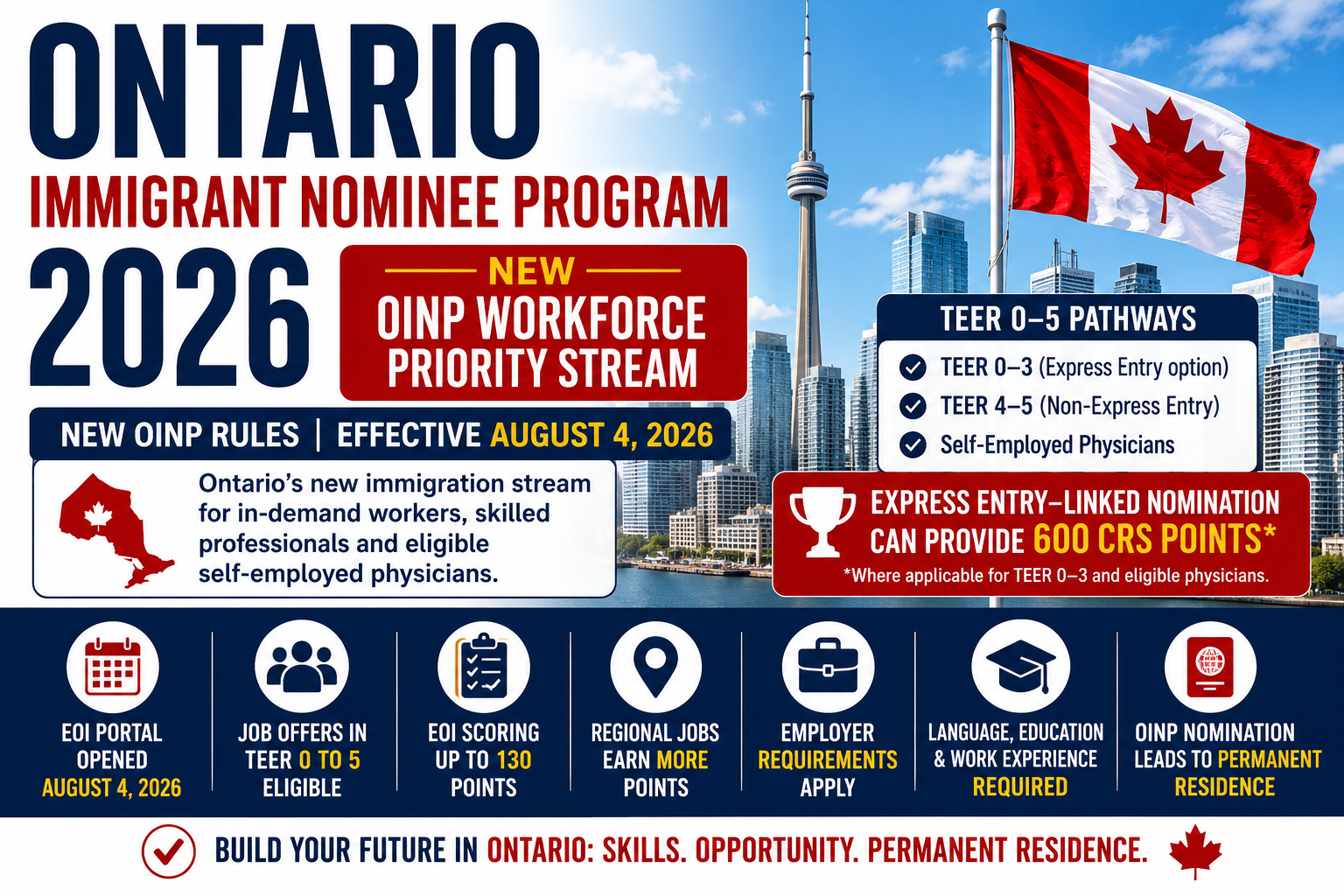
    Ontario Immigrant Nominee Program

    Ontario operates the Ontario Immigrant Nominee Program, commonly called OINP.

    Depending on current streams, Ontario can target people with job offers, Express Entry profiles, in-demand skills, graduate education or other qualifications.

    Because Ontario receives significant immigration interest, candidates should pay close attention to current stream status and invitation requirements.

    Saskatchewan Provincial Nominee Program

    Saskatchewan operates provincial immigration pathways for workers and other applicants who may help meet provincial economic needs.

    Occupation eligibility, employer requirements and application processes can change, so always check Saskatchewan’s current official guidance.

    Atlantic Province PNPs

    The Atlantic provinces that operate PNPs are:

    • New Brunswick
    • Newfoundland and Labrador
    • Nova Scotia
    • Prince Edward Island

    Each has its own provincial immigration streams.

    Do not confuse these programs with the Atlantic Immigration Program, which is a separate federal-provincial immigration pathway.

    Northwest Territories and Yukon

    The Northwest Territories and Yukon also operate territorial nominee programs.

    These programs may provide options for candidates who genuinely want to live and work in northern Canada and meet the applicable requirements.

    Regional labour-market needs can be particularly important in territorial immigration programs.

    Why Quebec Is Different

    Quebec does not participate in the Provincial Nominee Program.

    Quebec has separate immigration selection programs under its own immigration system.

    If your goal is to settle in Quebec, research Quebec’s official immigration programs instead of applying for PNP.

    Why Nunavut Is Different

    Nunavut currently does not operate a Provincial Nominee Program.

    People interested in living and working in Nunavut must consider other immigration pathways for which they may qualify.

    Do You Have to Live in the Province That Nominates You?

    A provincial nomination is based on the expectation that you genuinely intend to settle in the nominating province or territory.

    When applying for a PNP, you should be able to demonstrate a real intention to live there.

    Applying to a province only to obtain immigration points while planning from the beginning to settle somewhere else can create serious concerns.

    How Can You Show Your Intention to Live in a Province?

    Depending on your situation, factors that may support your intention can include:

    • Working in the province
    • A provincial job offer
    • Previous education in the province
    • Family or community connections
    • Research into housing and employment
    • Job applications in the province
    • Previous visits
    • A clear explanation of why the province fits your career and family plans

    The evidence relevant to you depends on the program and your personal circumstances.

    What Happens After an Express Entry Nomination?

    If a province nominates you through Express Entry, the process generally includes:

    1. The province or territory confirms the nomination electronically.
    2. You receive a message in your Express Entry account.
    3. You accept the nomination within the required period.
    4. Your profile receives 600 additional CRS points.
    5. You wait for an applicable Express Entry invitation round.
    6. If invited, you submit a complete permanent residence application.

    IRCC currently gives Express Entry applicants 60 calendar days after an Invitation to Apply to submit the permanent residence application.

    What Happens After a Non-Express Entry Nomination?

    After receiving a nomination under a non-Express Entry stream, you generally apply online for permanent residence through the federal PR Portal.

    You must submit the required forms, fees and supporting documents.

    IRCC then assesses your federal permanent residence application.

    Does a Provincial Nomination Give You a Work Permit?

    No.

    A provincial nomination by itself does not automatically give you authorization to work in Canada.

    If you need to work while your permanent residence application is being processed, you must have valid work authorization.

    Depending on your situation, you may qualify for a work permit or a bridging open work permit, but those have separate eligibility requirements.

    What Documents May Be Required for PNP?

    Requirements vary by province and stream, but documents may include:

    • Passport
    • Language test results
    • Education documents
    • Educational Credential Assessment where required
    • Employment reference letters
    • Job offer documents where required
    • Work permits
    • Proof of Canadian status
    • Proof of settlement funds where applicable
    • Provincial connection documents
    • Marriage or family documents where applicable
    • Police certificates
    • Medical examination information

    Do not prepare your application using a generic document checklist from another province.

    Follow the checklist for your exact stream.

    Do PNP Applicants Need Language Tests?

    Many PNP streams require approved language test results, but the minimum score varies by stream and occupation.

    For Express Entry-linked PNP streams, you also need to satisfy the language requirements of the federal Express Entry program for which you qualify.

    Accepted Express Entry tests currently include IELTS General Training, CELPIP-General and PTE Core for English, as well as TEF Canada and TCF Canada for French.

    Can French Help With PNP?

    French ability can potentially strengthen immigration options depending on the province and stream.

    Some provinces may target French-speaking or bilingual candidates.

    Strong French can also improve an Express Entry CRS profile.

    Do not assume that French automatically results in a nomination; you still need to meet the stream requirements.

    Can International Students Apply for PNP?

    Yes, some PNP streams may be available to eligible international graduates.

    However, graduating in a province does not automatically guarantee a nomination.

    Requirements may involve:

    • Type of credential
    • Institution
    • Length of study
    • Job offer
    • Occupation
    • Work experience
    • Language level
    • Intent to remain in the province

    Always verify the stream that applies to graduates in the province where you studied.

    Can Temporary Foreign Workers Apply for PNP?

    Many provincial pathways are relevant to temporary foreign workers who are already employed in Canada.

    The exact requirements may depend on occupation, employer, length of employment, work permit status and province.

    Having Canadian work experience can help in some streams but does not make everyone automatically eligible.

    Can Applicants Outside Canada Get a Provincial Nomination?

    Potentially.

    Some provincial streams can consider qualified candidates living outside Canada.

    Others require current employment, a job offer or a connection to the province.

    Your location alone does not determine eligibility.

    Do You Need a High CRS Score for PNP?

    Not every PNP stream uses your federal CRS score in the same way.

    For some Express Entry-linked streams, a province may use CRS or its own selection criteria when deciding whom to invite.

    Other streams use separate provincial scoring or eligibility systems.

    A lower federal CRS score does not automatically mean PNP is impossible.

    However, you must meet the exact provincial stream criteria.

    Can a PNP Help Someone With a Low CRS Score?

    An Express Entry provincial nomination can be particularly valuable for a candidate whose CRS score is not competitive in other invitation rounds because an accepted nomination adds 600 additional CRS points.

    But getting the nomination itself can be competitive.

    You should not treat PNP as an automatic backup plan.

    How to Choose the Best Province for Your PR Strategy

    Do not choose a province only because someone online says it has an “easy PNP.”

    Instead, compare:

    • Your occupation
    • Your NOC and TEER
    • Your work experience
    • Your language scores
    • Your education
    • Whether you have a qualifying job offer
    • Your current province of employment
    • Your family connections
    • Your willingness to genuinely settle there
    • The province’s current immigration priorities

    The best province is the one where your profile matches a real pathway and where you genuinely intend to build your life.

    Finding Jobs That May Support a PNP Pathway

    If a provincial stream requires employment or a job offer, focus on legitimate employers and occupations that match the stream.

    Our guide to jobs in Canada that may support PR pathways explains how employment and immigration can connect.

    You can also compare occupations in our jobs for newcomers in Canada guide.

    Prepare a Strong Job Application

    If a job offer is important for the provincial stream you are pursuing, prepare professional employment applications.

    Use a Canadian-style resume and customize your Canadian cover letter for the employer and position.

    Never pay someone for a fake job offer.

    A job used for immigration purposes should be a genuine employment opportunity.

    Beware of PNP Scams

    Be cautious if someone claims:

    • They can guarantee a provincial nomination
    • They can guarantee permanent residence
    • You must pay them for a fake employer letter
    • You can use job duties you never performed
    • You can claim you intend to live in a province when you do not
    • A closed or outdated stream is still accepting applications

    Verify program information through official provincial government websites and IRCC.

    Common PNP Mistakes to Avoid

    • Applying to a province where you do not genuinely intend to live
    • Using the wrong NOC
    • Assuming every PNP stream requires a job offer
    • Assuming no PNP stream requires a job offer
    • Using outdated eligibility requirements
    • Ignoring provincial application deadlines
    • Allowing language test results to expire
    • Providing inaccurate work experience
    • Failing to maintain Express Entry eligibility for an Express Entry PNP
    • Assuming nomination automatically gives work authorization
    • Assuming nomination automatically guarantees permanent residence

    Do PNP Streams Stay Open All Year?

    Not necessarily.

    Provincial programs can:

    • Open or close intake
    • Pause applications
    • Change occupation lists
    • Change scoring systems
    • Change job-offer requirements
    • Target specific sectors
    • Issue invitations periodically
    • Reach annual nomination allocations

    This is why older immigration articles and social-media videos can become outdated quickly.

    Does the Federal Government Still Review a PNP Application?

    Yes.

    A provincial nomination does not replace the federal permanent residence assessment.

    IRCC still reviews the application and determines whether the applicant meets federal requirements, including admissibility.

    Applicants may need medical examinations, police certificates, biometrics and other supporting documents depending on their situation.

    How Long Does PNP Take?

    There is no single processing time for every PNP application.

    Total time can depend on:

    • The province
    • The stream
    • How long provincial nomination takes
    • Whether the application is Express Entry or non-Express Entry
    • Whether the application is complete
    • Federal processing capacity
    • Background checks
    • Medical and security requirements
    • Annual immigration levels and available spaces

    Check the current provincial information and IRCC processing-time tools instead of relying on an old estimate.

    PNP 2026 Step-by-Step Checklist

    Before applying, work through this checklist:

    1. Choose the province or territory where you genuinely want to live.
    2. Check whether it operates a PNP.
    3. Review its currently open streams.
    4. Find your correct NOC and TEER.
    5. Check occupation requirements.
    6. Check language requirements.
    7. Check education requirements.
    8. Check whether a job offer is required.
    9. Check whether Canadian work experience is required.
    10. Determine whether the stream uses Express Entry or non-Express Entry.
    11. Prepare the exact provincial documents requested.
    12. Submit your provincial application correctly.
    13. If nominated, follow the federal permanent residence process.

    Important: Provincial Nomination Does Not Guarantee PR

    A provincial nomination can be extremely valuable, particularly when it is linked to Express Entry.

    However, nomination is only one stage of the immigration process.

    You still need to maintain eligibility, provide truthful documentation and satisfy IRCC’s permanent residence and admissibility requirements.

    PNP policies can also change according to provincial economic priorities and federal immigration levels.

    Where to Check Current PNP Information

    Start with the Government of Canada’s official Provincial Nominee Program page.

    From there, follow the official link for the province or territory you are interested in.

    For Express Entry nominations, also review IRCC’s official PNP Express Entry process.

    For nominations outside Express Entry, use IRCC’s non-Express Entry PNP guidance.

    Final Thoughts

    The Provincial Nominee Program remains an important permanent residence pathway in Canada in 2026.

    Participating provinces and territories use their programs to nominate candidates whose skills and experience match regional needs.

    There are two main application routes: Express Entry PNP and non-Express Entry PNP.

    If you receive and accept an Express Entry-linked provincial nomination, you currently receive 600 additional CRS points.

    However, each province has different streams, and requirements relating to jobs, occupations, language, education and work experience can vary significantly.

    The strongest strategy is not to search for an “easy PNP.”

    Instead, identify your correct NOC, understand your Express Entry profile, compare provincial requirements and focus on provinces where your qualifications match a current immigration pathway and where you genuinely want to live.

    Always verify the latest requirements through official provincial government websites and IRCC before making an important immigration decision.

    You can continue learning through our PR Pathways in Canada guides.

  • Express Entry Canada 2026: CRS Score, Eligibility, Categories & PR Guide

    Express Entry Canada 2026: CRS Score, Eligibility, Categories & PR Guide

    Express Entry is one of Canada’s main systems for managing permanent residence applications from skilled workers.

    But Express Entry is not a single immigration program.

    It is an online system used by Immigration, Refugees and Citizenship Canada, commonly called IRCC, to manage candidates under several economic immigration programs and rank eligible candidates using the Comprehensive Ranking System, or CRS.

    In 2026, understanding Express Entry requires more than simply checking one CRS score. You need to know which immigration program you qualify for, how your CRS score is calculated, whether you fit a category-based selection category and what happens if you receive an Invitation to Apply.

    This guide explains Express Entry Canada in 2026 step by step.

    What Is Express Entry Canada?

    Express Entry is the Government of Canada’s online system for managing applications from skilled workers who want to become permanent residents.

    The basic process is:

    1. Determine whether you qualify for an Express Entry immigration program.
    2. Create an Express Entry profile.
    3. Enter the Express Entry pool if you are eligible.
    4. Receive a Comprehensive Ranking System score.
    5. Wait for an eligible invitation round.
    6. Receive an Invitation to Apply if your profile is selected.
    7. Submit a complete permanent residence application.
    8. IRCC assesses your application and admissibility.

    Creating an Express Entry profile does not guarantee permanent residence or an invitation.

    Which Immigration Programs Use Express Entry?

    Express Entry currently manages three federal economic immigration programs:

    • Canadian Experience Class
    • Federal Skilled Worker Program
    • Federal Skilled Trades Program

    Candidates who qualify for one of these programs may enter the Express Entry pool.

    Eligible candidates can also be connected with an Express Entry-aligned Provincial Nominee Program.

    1. Canadian Experience Class

    The Canadian Experience Class, or CEC, is designed for skilled workers who have qualifying Canadian work experience.

    CEC applicants generally need at least one year of eligible Canadian work experience gained during the previous three years in an occupation classified as TEER 0, 1, 2 or 3.

    The minimum language requirement depends on the TEER category:

    • TEER 0 or 1: CLB 7 in English or NCLC 7 in French
    • TEER 2 or 3: CLB 5 in English or NCLC 5 in French

    CEC does not have a minimum education requirement and a job offer is not required.

    For a complete breakdown, read our Canadian Experience Class 2026 guide.

    2. Federal Skilled Worker Program

    The Federal Skilled Worker Program, or FSWP, is primarily for skilled workers with eligible Canadian or foreign work experience.

    Among the basic requirements, applicants generally need:

    • At least one year of continuous eligible skilled work experience
    • Work in TEER 0, 1, 2 or 3
    • Minimum CLB or NCLC 7 in all four abilities for the first official language
    • At least secondary education
    • At least 67 points out of 100 under the Federal Skilled Worker selection grid

    The 67-point Federal Skilled Worker selection grid is not the same as your CRS score.

    First, the 67-point grid helps determine whether you qualify for the Federal Skilled Worker Program. If eligible and placed in the Express Entry pool, the CRS is then used to rank your profile against other candidates.

    3. Federal Skilled Trades Program

    The Federal Skilled Trades Program, or FSTP, is for qualified workers in eligible skilled trades.

    Applicants generally need:

    • At least two years of eligible skilled-trade work experience during the previous five years
    • An eligible trade occupation
    • A valid full-time job offer for at least one year or a Canadian certificate of qualification in the skilled trade
    • Minimum language requirements

    The current minimum language level is generally:

    • CLB or NCLC 5 for speaking and listening
    • CLB or NCLC 4 for reading and writing

    There is no minimum education requirement for the Federal Skilled Trades Program, although education can still improve CRS ranking.

    What Is a CRS Score?

    The Comprehensive Ranking System is the points system IRCC uses to rank eligible Express Entry candidates.

    Your CRS score can be affected by factors including:

    • Age
    • Education
    • English ability
    • French ability
    • Canadian work experience
    • Foreign work experience
    • Spouse or common-law partner factors
    • Skill-transferability combinations
    • Canadian post-secondary education
    • French-language ability
    • A qualifying sibling in Canada
    • Provincial or territorial nomination

    A higher score generally improves your ranking in the Express Entry pool, but the CRS cut-off varies between invitation rounds.

    How Age Affects Your CRS Score

    Age can have a significant effect on CRS ranking.

    Under the current CRS system, candidates between ages 20 and 29 receive the maximum core age points.

    The number of age points gradually decreases after age 29.

    However, being older does not mean Express Entry is impossible.

    Strong language results, education, Canadian experience, foreign work experience, French ability or a provincial nomination can significantly affect the overall profile.

    How Education Affects CRS

    Higher levels of recognized education can increase CRS points.

    Canadian education may directly contribute to your profile, while eligible foreign education generally requires an Educational Credential Assessment, commonly called an ECA, if you want to use it for immigration purposes.

    An ECA shows how your foreign credential compares with Canadian education.

    Current immigration-purpose ECAs are generally valid for five years from their issue date.

    How Language Scores Affect Express Entry

    Language ability is one of the most important CRS factors.

    IRCC currently accepts these tests for English:

    • IELTS General Training
    • CELPIP-General
    • PTE Core

    For French, IRCC currently accepts:

    • TEF Canada
    • TCF Canada

    You can check current requirements on IRCC’s approved language test page.

    Your results are assessed across four abilities:

    • Speaking
    • Listening
    • Reading
    • Writing

    Why CLB 9 Can Be Important

    For many Express Entry candidates, reaching CLB 9 in all four first-language abilities can be particularly valuable.

    This is because higher language results can increase direct language points and can also improve skill-transferability points when combined with education or foreign work experience.

    However, your exact benefit depends on your complete profile.

    Can PTE Core Be Used for Express Entry?

    Yes.

    PTE Core is currently one of IRCC’s approved English language tests for Express Entry.

    Do not confuse PTE Core with other Pearson examinations.

    If your goal is Canadian permanent residence through Express Entry, make sure you register for the immigration-approved PTE Core exam.

    Can French Improve Your Express Entry Profile?

    Yes.

    Strong French can be especially valuable in Express Entry.

    Under the current CRS system, candidates can receive up to 50 additional points for strong French-language ability, depending on their English results.

    French-language proficiency is also one of Canada’s current category-based selection categories.

    To qualify for the French-language category in 2026, candidates currently need at least NCLC 7 in all four French abilities and must meet the requirements of the invitation round.

    What Is Skill Transferability?

    CRS also awards points for combinations of qualifications.

    Examples include combinations of:

    • Education and strong language ability
    • Education and Canadian work experience
    • Foreign work experience and language ability
    • Foreign work experience and Canadian work experience
    • A trade certificate of qualification and language ability

    These combinations can make improving one part of your profile more valuable than it first appears.

    How Much Does a Provincial Nomination Add?

    An Express Entry-aligned provincial or territorial nomination currently adds 600 CRS points.

    This is one of the largest possible increases available under the CRS.

    You can learn more through the official Provincial Nominee Program information.

    Provincial programs have their own criteria and can change frequently.

    Do Job Offers Give CRS Points in 2026?

    No additional CRS points are currently awarded simply for having a job offer.

    IRCC removed the former 50-point and 200-point job-offer CRS awards on March 25, 2025.

    This does not mean job offers have no immigration value.

    A valid job offer may still be important for eligibility under programs such as the Federal Skilled Trades Program, some Federal Skilled Worker selection factors and certain Provincial Nominee Program streams.

    If you are researching employment as part of a PR strategy, see our guide to jobs in Canada that may support PR pathways.

    What Are Express Entry Invitation Rounds?

    IRCC conducts rounds of invitations throughout the year.

    There are currently three main types of Express Entry invitation rounds.

    General Rounds

    General rounds consider top-ranking candidates who qualify for one of the three federal Express Entry programs.

    Program-Specific Rounds

    Program-specific rounds target candidates who qualify for a particular program or stream.

    For example, IRCC can hold a round targeting candidates eligible for the Provincial Nominee Program.

    Category-Based Rounds

    Category-based rounds target eligible candidates who meet an economic or immigration priority established by the Minister.

    Even in category-based rounds, eligible candidates are ranked using CRS scores.

    Express Entry Categories for 2026

    IRCC’s current 2026 category-based selection system includes:

    • French-language proficiency
    • Healthcare and social services occupations
    • Science, Technology, Engineering and Math occupations
    • Trade occupations
    • Education occupations
    • Transport occupations
    • Physicians with Canadian work experience
    • Senior managers with Canadian work experience
    • Researchers with Canadian work experience
    • Skilled military recruits

    IRCC reviews category-based priorities regularly, so candidates should verify the current categories before making major career or immigration decisions.

    Healthcare and Social Services Category

    This category targets candidates with eligible work experience in designated healthcare and social-services occupations.

    Current examples include occupations such as:

    • Doctors
    • Registered nurses
    • Licensed practical nurses
    • Pharmacists
    • Physiotherapists
    • Medical laboratory professionals
    • Social workers
    • Social and community service workers
    • Nurse aides and related occupations

    For occupation-based categories in 2026, candidates generally need at least 12 months of qualifying work experience in a single eligible occupation during the previous three years.

    The experience can generally be obtained in Canada or abroad for these renewed occupation-based categories, subject to the complete category rules.

    STEM Category

    The STEM category targets selected occupations in science, technology, engineering and mathematics.

    Do not assume that every technology or engineering occupation is included.

    The exact NOC code matters.

    Use our guide on how to find your NOC and TEER code before relying on your occupation for an immigration strategy.

    Trade Occupations Category

    The trades category currently includes selected occupations such as:

    • Electricians
    • Plumbers
    • Carpenters
    • Welders
    • Construction managers
    • Construction estimators
    • Heavy-duty equipment mechanics
    • HVAC mechanics
    • Bricklayers
    • Roofers

    Always check the official list because only specified NOC codes qualify.

    Education Category

    Selected education occupations are also included in category-based selection.

    Examples can include:

    • Secondary school teachers
    • Elementary and kindergarten teachers
    • Early childhood educators and assistants
    • Teacher assistants
    • Certain instructors working with persons with disabilities

    Transport Category

    The current transport category includes selected occupations such as:

    • Aircraft mechanics and inspectors
    • Air pilots and flight engineers
    • Aircraft avionics-related technicians
    • Automotive service technicians and certain truck and bus mechanics

    Not every transport job is included, so verify the exact NOC before relying on this category.

    New Canadian-Experience Categories in 2026

    Canada also introduced categories focused on attracting and retaining certain professionals with Canadian work experience.

    These include:

    • Physicians with Canadian work experience
    • Researchers with Canadian work experience
    • Senior managers with Canadian work experience

    These categories have their own eligibility requirements and eligible NOC codes.

    Skilled Military Recruits Category

    Skilled military recruits are also included in the current 2026 category system.

    This category is intended for eligible candidates with a qualifying job offer from the Canadian Armed Forces and who satisfy the applicable Express Entry and category requirements.

    Does Being in a Category Guarantee an Invitation?

    No.

    Being eligible for a category does not automatically result in an Invitation to Apply.

    You must first qualify for one of the three Express Entry programs and enter the pool.

    IRCC then identifies candidates who meet the requirements of a particular category and ranks eligible candidates using their CRS scores.

    The highest-ranking eligible candidates may receive invitations when IRCC holds a round for that category.

    What CRS Score Do You Need in 2026?

    There is no single CRS score that guarantees permanent residence.

    Cut-off scores vary depending on:

    • The type of invitation round
    • The number of invitations issued
    • The candidates currently in the pool
    • The immigration program being targeted
    • The category being targeted

    Instead of relying on an old cut-off from a previous draw, check IRCC’s current Express Entry rounds of invitations.

    What Is the Tie-Breaking Rule?

    If multiple candidates have the same CRS score at the cut-off, IRCC can use the date and time their Express Entry profiles were submitted as a tie-breaking rule.

    The exact tie-breaking information is published with the instructions for each invitation round.

    How Can You Improve Your CRS Score?

    There is no single strategy that works for everyone, but possible ways to strengthen an Express Entry profile can include:

    • Improving English scores
    • Improving French scores
    • Gaining additional eligible Canadian work experience
    • Gaining eligible foreign work experience
    • Completing additional recognized education
    • Obtaining eligible Canadian post-secondary education
    • Obtaining a provincial nomination
    • Updating spouse or partner factors where applicable

    Why Improving Language Scores Can Be Powerful

    Language improvement can affect several parts of the CRS at the same time.

    Higher language results may increase:

    • Core language points
    • Education and language skill-transferability points
    • Foreign work experience and language skill-transferability points
    • French additional points where applicable

    This is why language preparation can be strategically important for many candidates.

    Can Canadian Work Experience Increase CRS?

    Yes.

    Eligible Canadian work experience can directly contribute to CRS points and can interact with education and foreign work experience through skill-transferability factors.

    If you are currently working in Canada, make sure you understand whether your occupation and experience qualify.

    Can Foreign Work Experience Help?

    Yes.

    Eligible foreign work experience can contribute to skill-transferability points, particularly when combined with strong language results or Canadian work experience.

    Foreign experience may also be central to qualifying for the Federal Skilled Worker Program.

    Can Canadian Education Add CRS Points?

    Yes.

    Current CRS rules can provide additional points for eligible Canadian post-secondary education.

    The amount depends on the type and length of the eligible credential.

    Current additional points can reach:

    • 15 points for certain one- or two-year Canadian post-secondary credentials
    • 30 points for certain Canadian credentials of three years or longer

    Complete rules should always be checked on IRCC’s current CRS page.

    Can Having a Sibling in Canada Add Points?

    Under the current CRS system, an eligible brother or sister living in Canada who is at least 18 years old and is a Canadian citizen or permanent resident can provide 15 additional CRS points.

    Specific relationship requirements apply.

    Express Entry and Provincial Nominee Programs

    Express Entry and PNP can work together.

    A province or territory may nominate an eligible candidate through an Express Entry-aligned stream.

    An accepted provincial nomination currently provides 600 additional CRS points.

    If you receive a nomination, you are generally expected to settle in the province or territory that nominated you.

    Do Express Entry Applicants Need Proof of Funds?

    The answer depends on the immigration program and your situation.

    Canadian Experience Class applicants do not need to meet the Express Entry settlement-funds requirement.

    Federal Skilled Worker and Federal Skilled Trades applicants generally need to meet proof-of-funds requirements unless they qualify for an applicable exemption.

    Settlement-fund amounts can change, so check IRCC’s official proof of funds page rather than relying on an old number.

    What Documents Should You Prepare?

    Depending on your situation, Express Entry may require information or documents such as:

    • Passport or travel document
    • Approved language test results
    • Educational Credential Assessment where applicable
    • Canadian education documents
    • Employment records
    • Proof of qualifying work experience
    • Provincial nomination where applicable
    • Proof of funds where required
    • Police certificates
    • Medical examination information
    • Other documents requested by IRCC

    Review IRCC’s current Express Entry document guidance before applying.

    How to Create an Express Entry Profile

    Before creating your profile:

    1. Determine which Express Entry program you may qualify for.
    2. Identify your correct NOC and TEER.
    3. Complete an approved language test.
    4. Obtain an ECA if required for foreign education.
    5. Organize your work history.
    6. Gather the required document information.
    7. Create your profile through your IRCC secure account.

    If IRCC determines that you meet the requirements of an Express Entry program, your profile can be placed into the pool and assigned a CRS score.

    What Happens After You Enter the Express Entry Pool?

    Once you enter the pool:

    • You receive a CRS score.
    • Your profile is ranked against eligible candidates.
    • You may be considered in general rounds.
    • You may be considered in program-specific rounds.
    • You may be considered in category-based rounds if you meet a category’s requirements.

    You should keep your profile accurate and update it when important information changes.

    What Happens If You Receive an Invitation to Apply?

    If IRCC sends you an Invitation to Apply, commonly called an ITA, you currently have 60 days to submit your complete permanent residence application.

    Your invitation tells you which Express Entry program you have been invited under.

    You must provide truthful information and supporting documents.

    IRCC assesses whether the information in your application supports the information in your Express Entry profile.

    Should You Decline an ITA If Your Situation Changed?

    If your circumstances change and your updated CRS score would have been below the cut-off for the invitation you received, applying without carefully checking your eligibility can create serious problems.

    IRCC allows candidates to decline an invitation.

    If you decline and remain eligible, you can generally return to the pool and be considered in future rounds.

    There is no guarantee of receiving another invitation.

    Common Express Entry Mistakes to Avoid

    • Choosing the wrong NOC
    • Assuming every Canadian job qualifies as skilled work
    • Using the wrong language test
    • Allowing language results to expire
    • Entering incorrect work dates or job duties
    • Confusing the FSW 67-point grid with CRS points
    • Assuming a job offer still gives 50 or 200 CRS points
    • Assuming category eligibility guarantees an invitation
    • Using outdated draw scores as a guaranteed target
    • Failing to update the profile when circumstances change
    • Submitting documents that do not support the information claimed

    How NOC and TEER Connect to Express Entry

    Your NOC can affect:

    • Program eligibility
    • Whether your work experience qualifies
    • Your TEER category
    • Category-based selection eligibility
    • Employment documentation

    Do not choose a NOC because it appears more favourable for immigration.

    Choose the classification that accurately matches your real work duties.

    See our NOC and TEER step-by-step guide if you are unsure.

    How Your Career Strategy Can Support Express Entry

    Your immigration plan and career plan can support each other.

    If you are building Canadian experience, consider whether your job:

    • Matches your long-term career goals
    • Falls within an eligible TEER category
    • Can help build useful skilled experience
    • May connect with a provincial pathway
    • Fits a current category-based occupation where applicable

    You can review our guide to jobs for newcomers in Canada for additional career ideas.

    Prepare a Strong Canadian Job Application

    If gaining Canadian skilled work experience is part of your strategy, you still need a strong job application.

    Use a professional Canadian-style resume and a customized Canadian cover letter.

    Focus on legitimate jobs that match your skills instead of choosing work solely because someone claims it will guarantee PR.

    Express Entry 2026 Checklist

    Before creating or relying on an Express Entry profile, check:

    • Which Express Entry program you qualify for
    • Your correct NOC and TEER
    • Your work experience dates and duties
    • Your approved language test scores
    • Your education and ECA where applicable
    • Your current CRS score
    • Whether you qualify for any 2026 category
    • Whether you need proof of funds
    • Whether a provincial program may apply
    • Whether your documents support every claim in your profile

    Important: Express Entry Does Not Guarantee PR

    Entering the Express Entry pool does not guarantee an Invitation to Apply.

    Receiving an ITA also does not automatically guarantee permanent residence.

    IRCC still reviews your program eligibility, documents, information, category eligibility where applicable and admissibility.

    Immigration rules, category priorities and invitation patterns can change.

    Always verify current information directly through IRCC before making an important immigration decision.

    Final Thoughts

    Express Entry remains one of Canada’s most important economic immigration systems in 2026.

    The system currently manages the Canadian Experience Class, Federal Skilled Worker Program and Federal Skilled Trades Program.

    Eligible candidates enter the Express Entry pool and are ranked using the Comprehensive Ranking System.

    Your CRS score can be affected by age, education, language ability, Canadian and foreign work experience, spouse factors, skill-transferability combinations and additional factors such as French ability, Canadian education and a provincial nomination.

    In 2026, category-based selection continues to target French-language proficiency, healthcare and social services, STEM, trades, education and transport, along with specific Canadian-experience categories and skilled military recruits.

    There is no single CRS score that guarantees permanent residence because invitation scores and round types vary.

    The strongest strategy is to understand the immigration program you qualify for, calculate your current CRS accurately, improve the parts of your profile that can realistically be strengthened and keep checking current IRCC rules.

    You can explore more guides in our PR Pathways in Canada section.

  • Canadian Experience Class 2026: Eligibility, Work Experience & PR Guide

    Canadian Experience Class 2026: Eligibility, Work Experience & PR Guide

    The Canadian Experience Class, commonly called the CEC, is one of Canada’s main permanent residence pathways for skilled workers who have eligible Canadian work experience.

    For many temporary foreign workers and international graduates, the CEC can become an important pathway after gaining qualifying work experience in Canada.

    However, simply working in Canada does not automatically make someone eligible.

    Your occupation, NOC and TEER category, number of work hours, legal authorization to work, language results and other requirements all matter.

    This guide explains the Canadian Experience Class requirements in 2026 and how to determine whether your Canadian work experience may qualify.

    What Is the Canadian Experience Class?

    The Canadian Experience Class is an immigration program managed through Canada’s Express Entry system.

    It is designed for skilled workers who have eligible Canadian work experience and want to become permanent residents.

    The CEC is different from the Federal Skilled Worker Program because its main work-experience requirement focuses specifically on qualifying experience gained in Canada.

    It is also different from the Federal Skilled Trades Program, which has separate requirements for skilled trades.

    Canadian Experience Class Requirements in 2026

    To meet the basic Canadian skilled work-experience requirement, your experience must generally:

    • Be in NOC TEER 0, 1, 2 or 3
    • Have been gained while working in Canada
    • Have been gained while you were authorized to work
    • Be paid employment
    • Total at least 1,560 eligible hours
    • Have been gained during the three years before you apply
    • Match the lead statement and most of the main duties of your NOC

    You must also meet the required language level for your occupation and be admissible to Canada.

    How Much Canadian Work Experience Do You Need?

    The current minimum requirement is at least one year of qualifying Canadian skilled work experience in the three years before you apply.

    IRCC uses 1,560 hours as the equivalent of one year of full-time work.

    There are different ways to reach this requirement.

    Option 1: One Full-Time Job

    You can meet the requirement by working up to 30 hours per week for 12 months.

    For example:

    • 30 hours per week
    • 52 weeks
    • 1,560 hours total

    Hours worked above the amount IRCC counts as full-time do not allow you to complete the one-year requirement in only a few months.

    Option 2: Part-Time Work

    Part-time employment can also qualify.

    For example, someone working approximately 15 hours per week could accumulate 1,560 hours over about 24 months.

    You may use more than one eligible part-time job to meet the requirement as long as the work satisfies the CEC rules.

    Option 3: More Than One Job

    Your qualifying Canadian experience can come from more than one job.

    IRCC allows eligible experience in more than one NOC, provided the work meets the program requirements and falls within TEER 0, 1, 2 or 3.

    This is useful for people who change employers or occupations while building Canadian work experience.

    Which TEER Categories Qualify for CEC?

    For the Canadian Experience Class, qualifying Canadian work experience must be in:

    • TEER 0
    • TEER 1
    • TEER 2
    • TEER 3

    Work in TEER 4 or TEER 5 generally does not meet the minimum skilled-work requirement for the CEC.

    If you are unsure about your occupation, use our complete guide on how to find your NOC and TEER code in Canada.

    Why Your NOC Duties Matter

    Your job title alone does not determine whether your work experience qualifies.

    IRCC expects your work to match the National Occupational Classification associated with the occupation you claim.

    You should be able to show that you performed the actions described in the NOC lead statement and most of the occupation’s main duties.

    For example, two employees may both have the title “IT Technician,” but one may primarily provide user support while another manages networks.

    Those positions could belong to different NOC codes.

    Always choose the NOC that accurately reflects what you actually did at work.

    Does Work While Studying Count for CEC?

    Generally, no.

    Work experience gained while you were a full-time student does not count toward the Canadian Experience Class minimum work-experience requirement.

    This includes work performed during a co-op term while you were a full-time student.

    This rule is particularly important for international students who worked part-time while studying in Canada.

    You may have legally worked during your studies, but that does not necessarily make those hours eligible for the CEC minimum requirement.

    When Can International Graduates Start Building CEC Experience?

    Many international graduates begin building qualifying Canadian work experience after completing their studies and becoming legally authorized to work in Canada.

    For example, an eligible graduate may work under a Post-Graduation Work Permit or another valid work authorization.

    The work still needs to satisfy all CEC requirements, including the correct TEER category.

    Do not assume that simply holding a work permit makes every job eligible for CEC.

    Does Self-Employment Count for Canadian Experience Class?

    For the standard CEC minimum requirements, self-employment generally does not count.

    IRCC also has a specific temporary public policy affecting certain physicians providing publicly funded medical services in Canada.

    If you are self-employed or your employment arrangement is unusual, verify the current rules carefully before relying on that experience.

    Do Remote Jobs Count for CEC?

    A remote job may count only when it satisfies the Canadian work-experience requirements.

    IRCC states that if you worked remotely, you must have been physically in Canada and working for a Canadian employer for that experience to qualify under the CEC work-experience requirement.

    Working remotely for a Canadian company while physically living outside Canada is therefore not the same as qualifying Canadian work experience for CEC.

    CEC Language Requirements in 2026

    You must take an IRCC-approved language test.

    The minimum language requirement depends on the TEER category of your occupation.

    • TEER 0 or TEER 1: minimum CLB 7 in English or NCLC 7 in French
    • TEER 2 or TEER 3: minimum CLB 5 in English or NCLC 5 in French

    You need to meet the minimum level in all four language abilities:

    • Speaking
    • Listening
    • Reading
    • Writing

    Which English Tests Are Accepted for CEC?

    For English, IRCC currently accepts:

    • IELTS General Training
    • CELPIP-General
    • PTE Core

    Make sure you take the correct version of the exam.

    For example, IELTS Academic is not the Express Entry language test. Express Entry requires IELTS General Training.

    Pearson applicants must use PTE Core.

    Which French Tests Are Accepted?

    For French, IRCC currently accepts:

    • TEF Canada
    • TCF Canada

    French ability can also potentially improve an Express Entry profile beyond simply meeting CEC minimum eligibility.

    How Long Are Language Test Results Valid?

    Your language test results must be less than two years old when you create or maintain the relevant Express Entry profile requirements and when you submit your permanent residence application.

    If your results are close to expiring, plan carefully.

    An application submitted with expired language results can be refused.

    Do You Need Education for Canadian Experience Class?

    There is currently no minimum education requirement for the Canadian Experience Class.

    However, education can still be important for your Comprehensive Ranking System score.

    If you completed education in Canada, eligible Canadian credentials can help increase your ranking.

    If you completed education outside Canada, an Educational Credential Assessment may allow eligible foreign education to contribute to your Express Entry score.

    Do You Need a Job Offer for CEC?

    No.

    A job offer is not required to qualify for the Canadian Experience Class.

    You also do not necessarily need to be working at the exact time you submit your CEC application, as long as your qualifying Canadian work experience falls within the required period and you meet all other requirements.

    A job may still be important for your career and for other immigration pathways, but it is not a basic CEC eligibility requirement.

    If you are researching occupations for immigration, read our guide on jobs in Canada that may support PR pathways.

    Do Job Offers Give Express Entry CRS Points?

    A separate Express Entry rule changed in March 2025.

    Job offers no longer provide the additional 50 or 200 Comprehensive Ranking System points that were previously available for certain qualifying offers.

    However, a job offer may still be relevant to other immigration programs or provincial pathways.

    Always distinguish between:

    • CEC eligibility
    • CRS ranking
    • Requirements of other immigration programs

    Do CEC Applicants Need Proof of Funds?

    Canadian Experience Class applicants do not need to meet the Express Entry settlement-funds requirement.

    The official Express Entry proof-of-funds guidance specifically lists Canadian Experience Class applicants as exempt.

    However, the Express Entry system may still request a proof-of-funds document during the application process.

    If you are invited under the CEC and do not need settlement funds, IRCC currently instructs applicants to upload a letter explaining that they were invited under the Canadian Experience Class.

    Can You Apply for CEC While Living in Quebec?

    Canadian work experience gained while living in Quebec can potentially count.

    However, the Canadian Experience Class is for applicants who plan to live outside Quebec.

    Quebec selects its own skilled workers through separate immigration programs.

    If your qualifying work experience was gained in Quebec, you may need to demonstrate that you do not intend to settle permanently in Quebec.

    Can One Year of Work Be in Different NOCs?

    Yes.

    CEC work experience may be accumulated in more than one eligible NOC.

    The occupations still need to fall within TEER 0, 1, 2 or 3 and satisfy the other Canadian work-experience rules.

    This flexibility can help someone who changed positions during the three-year qualifying period.

    Example: Administrative Assistant

    Suppose someone works as an administrative assistant in Canada under NOC 13110.

    This occupation is classified as TEER 3.

    If the person:

    • Works legally in Canada
    • Performs duties that match the occupation
    • Receives wages or commission
    • Accumulates the required eligible hours
    • Meets at least CLB 5 or NCLC 5 in all four abilities

    the experience may potentially satisfy the CEC skilled-work requirement, subject to all other rules.

    Example: Software Developer

    Software developers and programmers fall under NOC 21232, which is TEER 1.

    A person relying on this occupation for CEC would need to meet the higher language threshold for TEER 0 and TEER 1 occupations.

    That means at least CLB 7 in English or NCLC 7 in French in all four abilities.

    Example: User Support Technician

    User support technicians are classified under NOC 22221, a TEER 2 occupation.

    For CEC minimum language eligibility, a TEER 2 occupation requires at least CLB 5 or NCLC 5 in all four abilities.

    The applicant would still need the required amount of eligible Canadian work experience.

    Does Your Salary Determine CEC Eligibility?

    CEC is not simply based on earning a particular salary.

    The classification and nature of your work, authorization to work, hours, duties and other program requirements are more important to determining whether your experience meets the minimum rules.

    Your employment documents should accurately reflect your real job and compensation.

    Documents That Can Help Prove Canadian Work Experience

    When you apply for permanent residence, IRCC may require documents supporting the work experience claimed in your profile.

    Depending on your circumstances, evidence can include:

    • Employer reference or experience letters
    • Employment contracts
    • Pay stubs
    • T4 tax slips
    • Notices of Assessment
    • Other employment records requested by IRCC

    Your employer letter should accurately describe your actual employment rather than simply copying an NOC description.

    Common CEC Mistakes to Avoid

    Avoid these common mistakes:

    • Counting work performed while studying full time
    • Using TEER 4 or TEER 5 work as the CEC minimum skilled experience
    • Choosing a NOC based only on the job title
    • Counting unpaid internships or volunteer work
    • Counting unauthorized work
    • Using expired language test results
    • Assuming a Canadian job automatically qualifies for CEC
    • Claiming duties that do not match the work actually performed
    • Assuming a job offer is required for CEC

    How to Improve Your Express Entry Profile After Becoming CEC Eligible

    Meeting CEC eligibility does not guarantee permanent residence.

    Once you enter the Express Entry pool, candidates are ranked using the Comprehensive Ranking System.

    Factors that can affect your CRS score include:

    • Age
    • Education
    • English and French language ability
    • Canadian work experience
    • Foreign work experience
    • Spouse or partner factors where applicable
    • Provincial nomination
    • Other eligible additional-point factors

    You can check current scoring rules using IRCC’s official Comprehensive Ranking System criteria.

    Can More Canadian Work Experience Increase Your CRS Score?

    Yes, additional eligible Canadian work experience can affect your CRS ranking.

    CEC minimum eligibility begins at one year of qualifying Canadian experience, but the CRS awards different levels of points based on Canadian work experience.

    This means becoming eligible for CEC and having a competitive CRS score are two different issues.

    Can Better Language Scores Help?

    Yes.

    The language score required to qualify for CEC is only the minimum.

    Higher English or French scores can substantially improve an Express Entry profile.

    For many candidates, improving language performance can be one of the most practical ways to increase CRS points.

    Can French Help a CEC Candidate?

    Yes.

    French proficiency can contribute to Express Entry scoring and French-language proficiency is also used as a category in category-based selection.

    A candidate may therefore benefit from strong French even when their original CEC work experience was performed in an English-speaking workplace.

    CEC and Provincial Nominee Programs

    A person who qualifies for the CEC may also potentially qualify for a Provincial Nominee Program.

    An Express Entry-linked provincial nomination can provide a major increase in CRS points.

    Provincial programs have their own criteria and can change frequently.

    Always check the official immigration website of the province or territory you are interested in.

    CEC and Express Entry Category-Based Selection

    Being eligible for the Canadian Experience Class does not prevent you from also meeting the criteria for an Express Entry category-based round.

    For example, a CEC candidate could also have eligible experience in healthcare, trades, education, STEM or transport.

    French-speaking CEC candidates may also meet the requirements of the French-language proficiency category.

    Category requirements and eligible occupations can change, so check IRCC’s current category-based selection information.

    How to Prepare Before Creating Your Express Entry Profile

    Before creating a profile, organize your information carefully.

    Check:

    • Your correct NOC and TEER
    • Your eligible work dates
    • Your total qualifying work hours
    • Your work authorization during those periods
    • Your language test validity
    • Your education information
    • Your employment records
    • Your passport validity

    Make sure the information you enter matches the documents you will later provide.

    Build Your Career While Preparing for PR

    Immigration strategy should not completely replace career planning.

    Try to build experience that supports both your permanent residence goals and your long-term career.

    Our guide to jobs for newcomers in Canada can help you compare different occupations.

    When applying, prepare a strong Canadian-style resume and customize your cover letter for each important opportunity.

    Canadian Experience Class Checklist

    Before relying on the CEC pathway, confirm that:

    • Your Canadian work is in TEER 0, 1, 2 or 3
    • You have at least 1,560 qualifying hours
    • The experience is from the previous three years
    • You were authorized to work in Canada
    • Your work was paid
    • Your NOC duties accurately match your real work
    • You are not improperly counting full-time student work
    • You meet the language requirement for your TEER
    • Your language results are still valid
    • You plan to live outside Quebec
    • You understand that CEC eligibility does not guarantee an invitation

    Final Thoughts

    The Canadian Experience Class can be an important permanent residence pathway for people who build eligible skilled work experience in Canada.

    In 2026, the basic work-experience requirement remains at least one year, or 1,560 hours, of qualifying Canadian work in TEER 0, 1, 2 or 3 during the previous three years.

    Your language requirement depends on your occupation: TEER 0 and 1 require at least CLB or NCLC 7, while TEER 2 and 3 require at least CLB or NCLC 5.

    A job offer and minimum education are not required for CEC eligibility, and CEC applicants are exempt from the Express Entry settlement-funds requirement.

    However, meeting minimum eligibility does not guarantee permanent residence.

    Your CRS score, invitation rounds and overall Express Entry profile still matter.

    Always verify your NOC, work history and current immigration rules using official Immigration, Refugees and Citizenship Canada information before making an important decision.

  • How to Find Jobs in Canada That Can Support Your PR Pathway in 2026

    How to Find Jobs in Canada That Can Support Your PR Pathway in 2026

    Jobs in Canada for PR: What You Need to Know in 2026

    Many newcomers search online for “PR jobs in Canada,” but there is an important point to understand first: there is no single job in Canada that automatically gives you permanent residence.

    A job can support your immigration pathway if the occupation, work experience, employer, province and immigration program meet the required rules.

    In 2026, Canada continues to use programs such as Express Entry, the Canadian Experience Class, Provincial Nominee Programs, the Atlantic Immigration Program and regional immigration programs to select skilled workers.

    This guide explains which types of jobs may be useful for permanent residence pathways and what you should check before accepting or changing a job.

    Why Your Job Matters for Canadian PR

    Your occupation can affect your permanent residence options in several ways.

    Some immigration programs require skilled Canadian work experience. Some programs target specific occupations where Canada has labour shortages. Provincial programs may prioritize workers in occupations needed by that province, while some regional programs require a job offer from an approved employer.

    This means two people working in different occupations can have very different PR options even if they have similar salaries.

    Before choosing a job mainly for immigration purposes, find its National Occupational Classification, commonly called the NOC, and its TEER category.

    Canadian Experience Class Jobs

    The Canadian Experience Class, or CEC, is one of the programs managed through Express Entry.

    For Canadian work experience to meet the basic CEC skilled-work requirement, the job must generally be in TEER 0, 1, 2 or 3.

    You normally need at least one year, or 1,560 hours, of qualifying Canadian work experience obtained within the three years before applying.

    The work must be paid and performed in Canada while you were legally authorized to work.

    Work completed while you were a full-time student generally does not count toward the minimum Canadian Experience Class work requirement.

    Examples of jobs that may fall within TEER 0 to 3 include administrative assistants, retail supervisors, food service supervisors, skilled trades, many healthcare occupations, professional occupations and some technical roles.

    However, the job title alone is not enough. Your actual duties should match the correct NOC description.

    2026 Express Entry Category-Based Occupations

    Canada also holds category-based Express Entry invitation rounds.

    For 2026, the current categories include French-language proficiency, healthcare and social services occupations, STEM occupations, trade occupations, education occupations and transport occupations.

    There are also categories for physicians, senior managers and researchers with Canadian work experience, as well as eligible skilled military recruits.

    Being employed in one of these fields does not automatically result in permanent residence.

    You must still qualify for an Express Entry program, meet the requirements of the category and have a competitive profile when invitations are issued.

    Healthcare and Social Services Jobs

    Healthcare and social services continue to be important areas under Express Entry category-based selection.

    Eligible occupations currently include examples such as:

    • Registered nurses
    • Licensed practical nurses
    • Nurse practitioners
    • Pharmacists
    • Pharmacy technicians and assistants
    • Dental hygienists
    • Medical laboratory technologists
    • Medical laboratory assistants
    • Physiotherapists
    • Occupational therapists
    • Social workers
    • Social and community service workers
    • Nurse aides, orderlies and patient service associates

    Several other healthcare occupations are also included.

    For the healthcare and social services category, candidates generally need at least 12 months of full-time work experience, or an equivalent amount of part-time experience, in one eligible occupation during the previous three years.

    That qualifying experience can be obtained in Canada or abroad, subject to the complete program requirements.

    Trade Jobs

    Skilled trades are another major category in 2026.

    Current eligible examples include:

    • Construction managers
    • Construction estimators
    • Machinists
    • Welders
    • Electricians
    • Industrial electricians
    • Plumbers
    • Gas fitters
    • Carpenters
    • Bricklayers
    • Heavy-duty equipment mechanics
    • Heating, refrigeration and air conditioning mechanics
    • Roofers
    • Concrete finishers
    • Floor covering installers

    Other eligible trade occupations are also included.

    For newcomers with previous trade experience, it is important to check whether the occupation is regulated in the province where you want to work.

    You may need provincial certification, apprenticeship recognition or additional training before performing certain jobs.

    Education Jobs

    Education is also one of the current Express Entry categories.

    Eligible occupations include examples such as:

    • Secondary school teachers
    • Elementary school and kindergarten teachers
    • Early childhood educators and assistants
    • Instructors of persons with disabilities
    • Elementary and secondary school teacher assistants

    Some education professions are regulated, so having foreign experience does not necessarily mean you can immediately work in the same position in Canada.

    Check provincial licensing and credential requirements before applying.

    STEM Jobs

    Science, technology, engineering and mathematics occupations are included in the 2026 category system, but applicants should not assume that every technology job qualifies.

    Current eligible STEM occupations include examples such as:

    • Cybersecurity specialists
    • Civil engineers
    • Mechanical engineers
    • Electrical and electronics engineers
    • Industrial and manufacturing engineers
    • Geological engineers
    • Civil engineering technologists and technicians
    • Mechanical engineering technologists and technicians
    • Electrical and electronics engineering technologists and technicians
    • Architecture and science managers

    Always check the current official occupation list because category-based occupations can change.

    Transport Jobs

    Transport occupations are part of the 2026 Express Entry categories.

    Current examples include:

    • Aircraft mechanics and aircraft inspectors
    • Air pilots, flight engineers and flying instructors
    • Aircraft instrument, electrical and avionics mechanics, technicians and inspectors
    • Automotive service technicians, truck and bus mechanics and mechanical repairers

    This is a good example of why you should check the actual NOC list instead of assuming that every transportation job belongs to the transport category.

    Does a Job Offer Give You Extra Express Entry Points?

    One major rule changed in 2025.

    As of March 25, 2025, Express Entry no longer awards additional Comprehensive Ranking System points simply because a candidate has a job offer.

    Previously, some qualifying offers could provide 50 or 200 additional CRS points.

    Those job-offer CRS points have been removed.

    However, this does not mean job offers are useless for immigration.

    A valid job offer may still be relevant to the eligibility requirements of certain immigration programs, Provincial Nominee Program streams, the Atlantic Immigration Program and regional immigration pathways.

    Provincial Nominee Program Jobs

    The Provincial Nominee Program allows participating provinces and territories to nominate people who can contribute to their local economies.

    Each province has its own streams, occupation priorities and requirements.

    Some PNP streams are employer-driven and require a qualifying job offer. Other streams may select candidates using different criteria.

    Provinces may target workers based on occupation, work experience, education, language ability and connection to the province.

    If you receive a nomination through an Express Entry-linked PNP stream, a provincial nomination currently provides 600 additional CRS points.

    That can significantly improve your chances of receiving an invitation to apply for permanent residence.

    Because provincial streams can open, close or change requirements, always check the official immigration website of the province where you plan to live.

    Atlantic Immigration Program Jobs

    The Atlantic Immigration Program is another pathway where a job offer can be especially important.

    It applies to:

    • New Brunswick
    • Newfoundland and Labrador
    • Nova Scotia
    • Prince Edward Island

    Candidates generally need a qualifying job offer from an employer designated by one of the Atlantic provinces.

    The offer must meet program conditions.

    This means job seekers interested in Atlantic Canada should research designated employers rather than applying randomly to every employer and assuming the job will support an Atlantic Immigration Program application.

    Rural Community Immigration Pilot Jobs

    Canada’s Rural Community Immigration Pilot can also provide opportunities outside major metropolitan areas.

    Candidates need a qualifying job offer from a designated employer in a participating community and must meet the program’s other requirements.

    This pathway may be worth researching for people who are genuinely willing to live and work in smaller Canadian communities.

    A job in Toronto, Vancouver or another large city cannot simply be used under a rural program if it does not meet the program’s community requirements.

    Which Jobs Can Be Good for PR?

    There is no universal list of the “best PR jobs.” However, jobs can become particularly useful when they match an immigration pathway.

    Examples worth researching include:

    • Registered nurse
    • Licensed practical nurse
    • Nurse aide
    • Social and community service worker
    • Pharmacy assistant or technician
    • Early childhood educator
    • Teacher assistant
    • Cybersecurity specialist
    • Civil engineering technologist
    • Electrician
    • Plumber
    • Carpenter
    • Welder
    • HVAC mechanic
    • Automotive service technician
    • Retail supervisor
    • Food service supervisor
    • Administrative assistant

    You can also explore our guide to jobs for newcomers in Canada to compare different occupations, requirements and typical pay.

    Other skilled TEER 0, 1, 2 or 3 occupations may still help someone qualify for the Canadian Experience Class even if the occupation is not specifically targeted in a category-based draw.

    Your overall immigration profile still matters.

    Jobs That May Not Help Every PR Pathway

    Do not assume that any Canadian job will automatically qualify as skilled experience for Express Entry.

    Some entry-level occupations can be valuable for earning income and building Canadian workplace experience but may fall outside TEER 0, 1, 2 or 3.

    If your goal is the Canadian Experience Class, check the NOC and TEER before relying on the job as qualifying work experience.

    Never choose an NOC only because it appears better for immigration. The NOC must accurately match the work you actually perform.

    How to Find Your NOC and TEER

    Start by looking at your actual job duties, not only your job title.

    Search the Government of Canada’s National Occupational Classification system and compare your responsibilities with the lead statement and main duties.

    Choose the NOC that most accurately represents your work.

    Using the wrong NOC can create problems when your immigration application is reviewed.

    How to Search for Jobs That May Support PR

    First, identify the immigration pathways you may qualify for.

    Then determine which occupations, provinces or employers are relevant to those programs.

    When searching for work, use reliable sources such as Canada’s Job Bank, provincial job boards and employer career pages.

    Before applying, check:

    • Job title
    • NOC and TEER
    • Location
    • Required education
    • Licence or certification requirements
    • Employment type
    • Hours
    • Salary
    • Employer eligibility when a program requires a designated employer

    Do not pay someone for a fake job offer.

    A legitimate employment opportunity should be connected to real work that you are qualified and legally able to perform.

    Build a Strong Canadian Job Application

    Finding the right occupation is only part of the process. You still need to convince an employer to hire you.

    Use a Canadian-style resume that focuses on relevant skills, accomplishments and experience.

    Customize your resume for each important position instead of sending exactly the same document everywhere.

    Your cover letter should also explain how your experience matches the job.

    If you have international work experience, describe your responsibilities clearly so Canadian employers can understand your skills.

    Prepare for interviews and research the company before applying.

    Can International Work Experience Help?

    Yes.

    For several current Express Entry occupation-based categories, qualifying work experience can be gained either in Canada or abroad, provided all category and Express Entry requirements are met.

    This can be especially important for experienced healthcare professionals, engineers, tradespeople, educators and other skilled workers.

    However, Canadian licensing requirements are separate from immigration eligibility.

    Someone may have qualifying foreign work experience for an immigration program but still need Canadian licensing or certification before working in a regulated profession.

    Why French Can Also Matter

    French-language proficiency remains its own Express Entry category.

    Candidates in the French-language category need qualifying French test results, including at least NCLC 7 in all four language abilities under the current requirements.

    This means improving French can potentially create another immigration opportunity even if your occupation itself is not the main reason for selection.

    Language ability can also affect your overall Express Entry score and employment opportunities.

    Important: A Job Does Not Guarantee PR

    This is the most important point to remember.

    Getting a job in Canada does not guarantee permanent residence.

    Immigration eligibility can depend on:

    • Age
    • Education
    • Language scores
    • Canadian and foreign work experience
    • NOC and TEER
    • Express Entry score
    • Province
    • Immigration program
    • Provincial nomination
    • Occupation
    • Job offer requirements
    • Admissibility
    • Program quotas and invitation rounds

    Immigration policies also change.

    Always verify current rules directly with Immigration, Refugees and Citizenship Canada and the relevant province or territory before making an important immigration or employment decision.

    Final Thoughts

    Instead of searching only for a “PR job,” think about building a complete PR strategy.

    Start by understanding your current immigration profile. Identify the programs you may qualify for and check which occupations and provinces match those programs.

    Then look for legitimate jobs that build relevant experience while also supporting your long-term career.

    In 2026, healthcare and social services, skilled trades, education, selected STEM occupations and selected transport occupations remain important areas under Express Entry category-based selection.

    Canadian skilled work experience in TEER 0, 1, 2 or 3 can also be important for people pursuing the Canadian Experience Class.

    Provincial programs, Atlantic Canada and participating rural communities may provide additional possibilities depending on your situation.

    The best job is not simply the one that sounds good for PR. It is a legitimate job that matches your skills, career goals and a real immigration pathway for which you can qualify.