
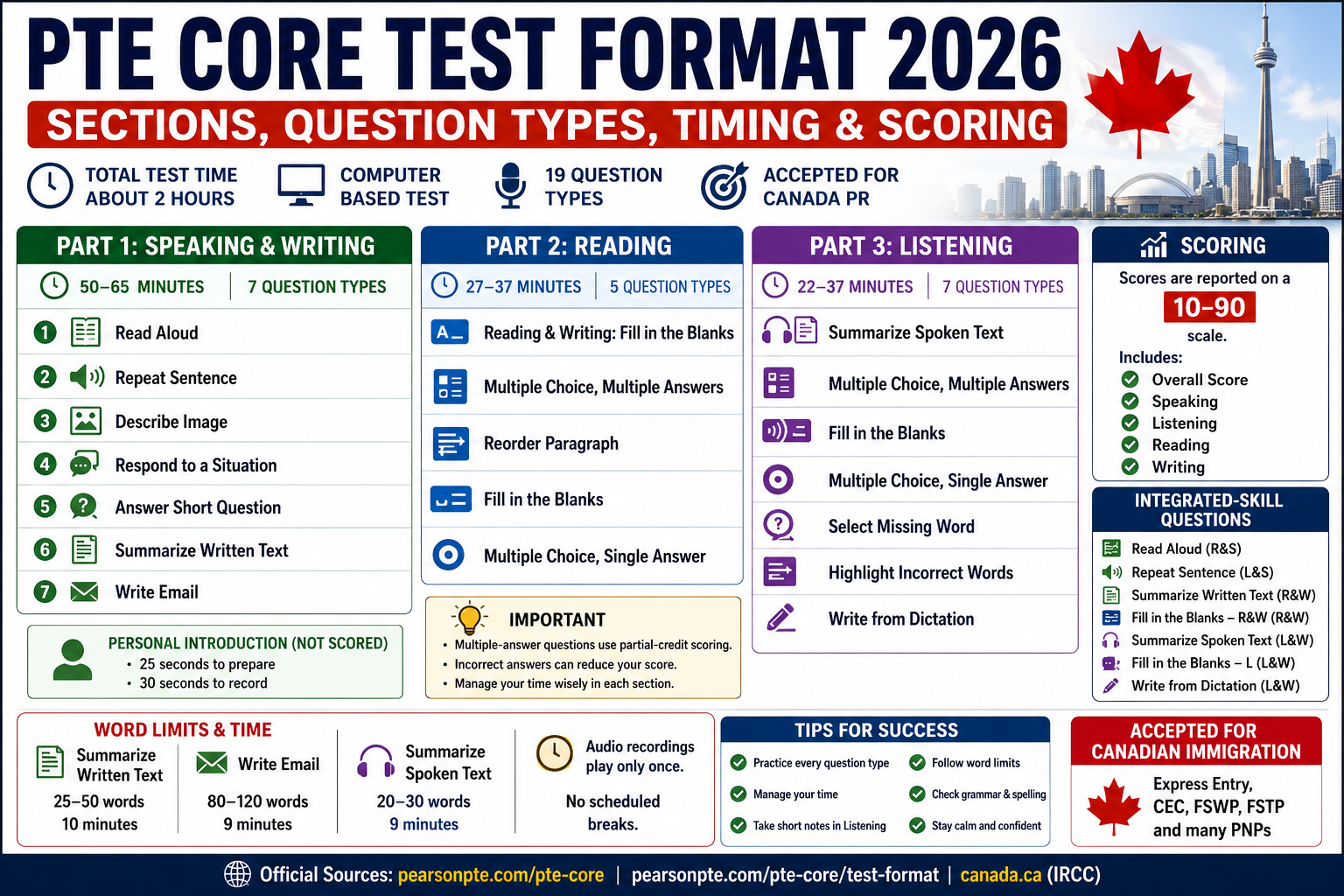
Quick answer: PTE Core is an approximately two-hour, computer-based general English test used for Canadian immigration and citizenship applications. It has three timed parts—Speaking & Writing, Reading, and Listening—with 19 question types in total.
The current PTE Core test format includes:
- Speaking & Writing: 50–65 minutes and 7 question types
- Reading: 27–37 minutes and 5 question types
- Listening: 22–37 minutes and 7 question types
This 2026 guide explains every task, section timing, scoring basics, word limits and practical preparation tips. Pearson can update test information, so confirm the latest details on the official PTE Core page before your exam.
PTE Core Test Format 2026 at a Glance
| Section | Time | Question Types |
|---|---|---|
| Speaking & Writing | 50–65 minutes | 7 |
| Reading | 27–37 minutes | 5 |
| Listening | 22–37 minutes | 7 |
| Total | About 2 hours | 19 question types |
You can always verify the current structure through Pearson’s official PTE Core test format page.
Important: 19 Question Types Does Not Mean Only 19 Questions
PTE Core has 19 types of questions.
You can receive multiple questions of the same type during the test.
For example, you may receive several Repeat Sentence, Read Aloud or Fill in the Blanks questions.
So do not prepare for only 19 individual questions.
You need to understand how to answer each of the 19 task types.
PTE Core Part 1: Speaking & Writing
The Speaking & Writing section is the longest part of PTE Core.
It currently takes approximately 50 to 65 minutes and contains seven scored question types.
The section begins with a Personal Introduction.
Your Personal Introduction does not contribute to your test score.
PTE Core Personal Introduction
The Personal Introduction helps you become familiar with the microphone and test system.
You currently receive:
- 25 seconds to prepare
- 30 seconds to record your introduction
You only record it once.
Because it is not scored, use this opportunity to become comfortable speaking into the microphone rather than worrying about giving a perfect response.
Speaking & Writing Question Type 1: Read Aloud
In Read Aloud, you see a written passage and read it into the microphone.
The text can currently contain up to approximately 60 words.
You normally receive around 30 to 40 seconds to prepare before the microphone opens.
This question assesses speaking and reading skills.
How to Approach Read Aloud
- Use the preparation time to understand the sentence structure.
- Notice commas, full stops and other punctuation.
- Speak at a natural pace.
- Do not rush simply to finish quickly.
- Pronounce words clearly.
- Use meaningful pauses.
- Maintain smooth oral fluency.
Your goal should be clear, natural speech rather than sounding like you are reading individual words separately.
Speaking & Writing Question Type 2: Repeat Sentence
In Repeat Sentence, you listen to a short sentence and then repeat what you heard.
The recording currently lasts approximately 3 to 9 seconds.
The audio plays only once.
When the recording finishes, the microphone opens and you repeat the sentence.
This task assesses listening and speaking.
Repeat Sentence Strategy
Instead of trying to remember every word as an isolated item, listen for meaningful groups of words.
For example:
The meeting / has been moved / to Monday morning.
Remembering chunks can make the sentence easier to reproduce.
Also try to imitate the speaker’s:
- Word stress
- Sentence rhythm
- Intonation
- Natural pauses
Speaking & Writing Question Type 3: Describe Image
In Describe Image, an image appears on the screen and you describe it aloud.
You currently receive approximately 25 seconds to study the image and prepare.
You then have up to approximately 40 seconds to speak.
The image might contain information such as:
- A graph
- A chart
- A map
- A photograph
- A diagram
- A process
- Other visual information
Simple Describe Image Structure
A practical structure is:
- Identify what the image shows.
- Mention the most important features.
- Compare noticeable differences where relevant.
- Give a short overall conclusion.
Do not try to describe every small detail.
A clear and fluent response covering the main information is generally more useful than rushing through a long list of numbers.
Speaking & Writing Question Type 4: Respond to a Situation
Respond to a Situation tests your ability to speak appropriately in an everyday situation.
You listen to and read a description of a situation and then explain what you would say.
The written prompt can contain up to approximately 60 words.
You currently receive:
- 20 seconds to prepare
- 40 seconds to speak
What Matters in Respond to a Situation?
You need to understand:
- Who you are speaking to
- Why you are speaking
- What information must be included
- Whether your tone should be formal or informal
For example, speaking to a close friend should sound different from speaking to a supervisor or customer.
Respond to a Situation Tip
During the 20-second preparation period, identify two or three points you must communicate.
Then speak directly to the imagined person rather than describing what you would do.
Speaking & Writing Question Type 5: Answer Short Question
In Answer Short Question, you hear a question and respond with one word or a few words.
The audio prompt currently lasts approximately 3 to 9 seconds.
You have up to approximately 10 seconds to answer.
There are no additional points for giving an unnecessarily long response.
Example
If the question asks:
What do we call a person who designs buildings?
A simple response such as:
Architect.
is sufficient.
Speaking & Writing Question Type 6: Summarize Written Text
Summarize Written Text assesses both reading and writing.
You read a passage and then write a short summary containing the most important information.
The reading text can currently be up to approximately 200 words.
Your summary must be:
25 to 50 words.
You currently have:
10 minutes to complete each Summarize Written Text task.
How to Write a Strong Summary
- Identify the main topic.
- Find the most important supporting ideas.
- Remove minor examples and unnecessary details.
- Write the ideas clearly in your own words where possible.
- Check grammar, spelling and punctuation.
- Check that your response is between 25 and 50 words.
Do not copy several unrelated sentences from the passage and join them together.
Your response should communicate the central meaning clearly.
Speaking & Writing Question Type 7: Write Email
Write Email is one of the main writing tasks in PTE Core.
You receive a situation and instructions and need to write an appropriate email.
The prompt can currently contain up to approximately 100 words.
Your email should contain:
80 to 120 words.
You currently have:
9 minutes to complete the task.
Simple PTE Core Email Structure
A practical structure is:
Greeting
Dear [Name],
Opening
Explain why you are writing.
Body
Address each point requested in the prompt.
Closing
Finish politely and appropriately.
Sign-off
Kind regards,
Your Name
Write Email Tips
- Answer every point in the prompt.
- Use an appropriate formal or informal tone.
- Keep your ideas organized.
- Use paragraphs.
- Stay within 80–120 words.
- Check grammar.
- Check spelling.
- Check punctuation.
PTE Core Part 2: Reading
The Reading section currently lasts approximately 27 to 37 minutes.
It contains five different question types.
Unlike tasks with an individual countdown timer, much of the Reading section requires you to manage your own time carefully.
Reading Question Type 1: Reading & Writing Fill in the Blanks
In Reading & Writing: Fill in the Blanks, you see a passage containing several gaps.
You select the appropriate word for each blank from a drop-down list.
This is an integrated task because it contributes to both:
- Reading
- Writing
How to Solve Reading & Writing Fill in the Blanks
Consider:
- Grammar
- Context
- Vocabulary
- Collocations
- Meaning of the full sentence
Read both before and after each blank before choosing your answer.
Reading Question Type 2: Multiple Choice, Multiple Answers
You read a passage and select more than one correct answer.
This task requires careful reading because multiple options may sound reasonable.
Important Scoring Warning
Multiple Choice, Multiple Answers uses partial-credit scoring.
Incorrect selections can reduce the points you receive for that item.
Therefore, randomly selecting every option is not a good strategy.
Select options only when you have evidence from the passage.
Reading Question Type 3: Reorder Paragraph
You receive several text boxes arranged in the wrong order.
Your job is to place them in the correct logical sequence.
How to Solve Reorder Paragraph
Look for:
- The topic sentence
- Pronouns such as it, they, this or these
- Connecting words
- Chronological order
- Cause-and-effect relationships
- Repeated keywords
- Logical introduction and conclusion
The first sentence usually needs to make sense independently without referring to information that has not yet been introduced.
Reading Question Type 4: Fill in the Blanks
In this task, a reading passage contains missing words.
You drag words from a list into the correct gaps.
There are usually more options available than the number of blanks.
Reading Fill in the Blanks Strategy
Ask yourself:
- What part of speech is needed?
- Does the word fit grammatically?
- Does it create a common collocation?
- Does it make sense within the full paragraph?
This task contributes to the Reading score.
Reading Question Type 5: Multiple Choice, Single Answer
You read a passage and answer a question by selecting one correct response.
Questions may focus on:
- Main idea
- Specific information
- Author’s purpose
- Inference
- Tone
Read the question first so you know what information you need to find.
PTE Core Part 3: Listening
The Listening section currently lasts approximately 22 to 37 minutes and contains seven question types.
Audio recordings generally play automatically and can normally be heard only once.
This makes note-taking and concentration especially important.
Listening Question Type 1: Summarize Spoken Text
You listen to an audio recording and write a short summary.
The recording currently lasts approximately 45 to 75 seconds.
Your response should contain:
20 to 30 words.
You receive:
8 minutes to listen and write your answer.
This task assesses listening and writing.
Summarize Spoken Text Strategy
While listening, note:
- Main topic
- Main argument or message
- Important supporting points
- Names, numbers or examples only when essential
Then create a concise 20–30 word summary.
Leave enough time to check grammar, vocabulary, spelling and punctuation.
Listening Question Type 2: Multiple Choice, Multiple Answers
You listen to a recording and select all correct responses.
The audio currently lasts approximately 50 to 90 seconds.
You can only listen once.
Listening Multiple Answers Tip
Read the question and options before the recording begins.
While listening, note the main idea and important supporting information.
Be careful with incorrect selections because this task uses partial-credit scoring.
Listening Question Type 3: Fill in the Blanks
You see a transcript with missing words while listening to an audio recording.
You type each missing word into the appropriate blank.
The recording currently lasts approximately 30 to 60 seconds.
This task can assess both listening and writing.
Listening Fill in the Blanks Tips
- Read the passage quickly before the audio begins.
- Follow the text as you listen.
- Type the missing words accurately.
- Check spelling.
- Use grammar to confirm your answer.
Listening Question Type 4: Multiple Choice, Single Answer
You listen to a recording and select the one correct response.
The recording currently lasts approximately 30 to 60 seconds.
You may need to identify:
- Main idea
- Supporting detail
- Speaker’s purpose
- Opinion
- Inference
Use the few seconds before the recording starts to understand the question and available answers.
Listening Question Type 5: Select Missing Word
You hear an audio recording in which the final part is replaced by a tone.
You then select the option that best completes the recording.
This task tests your ability to use context and meaning to predict how a speaker would logically finish the message.
Select Missing Word Tip
Do not focus only on the final sentence.
Understand the overall topic and direction of the recording because the correct ending should logically match the entire message.
Listening Question Type 6: Highlight Incorrect Words
You see a written transcript while listening to a recording.
Some words in the transcript are different from what the speaker actually says.
You click the words that do not match the recording.
Highlight Incorrect Words Strategy
- Follow the text with your eyes while listening.
- Stay at the same pace as the speaker.
- Click only when you clearly hear a difference.
- Do not keep looking back at earlier sentences.
Listening Question Type 7: Write from Dictation
Write from Dictation is an important integrated listening and writing task.
You hear a short sentence and type exactly what you heard.
The recording currently lasts approximately 3 to 5 seconds.
You only hear the sentence once.
Write from Dictation Strategy
While listening:
- Remember the sentence in meaningful chunks.
- Write quick keywords on your erasable noteboard if helpful.
- Type the complete sentence.
- Check grammar.
- Check spelling carefully.
- Check whether you missed small words such as a, the, to or of.
Correct words and spelling are especially important for this task.
Complete List of All 19 PTE Core Question Types
| Section | Question Type |
|---|---|
| Speaking & Writing | Read Aloud |
| Speaking & Writing | Repeat Sentence |
| Speaking & Writing | Describe Image |
| Speaking & Writing | Respond to a Situation |
| Speaking & Writing | Answer Short Question |
| Speaking & Writing | Summarize Written Text |
| Speaking & Writing | Write Email |
| Reading | Reading & Writing: Fill in the Blanks |
| Reading | Multiple Choice, Multiple Answers |
| Reading | Reorder Paragraph |
| Reading | Fill in the Blanks |
| Reading | Multiple Choice, Single Answer |
| Listening | Summarize Spoken Text |
| Listening | Multiple Choice, Multiple Answers |
| Listening | Fill in the Blanks |
| Listening | Multiple Choice, Single Answer |
| Listening | Select Missing Word |
| Listening | Highlight Incorrect Words |
| Listening | Write from Dictation |
How Is PTE Core Scored?
PTE Core is computer scored using Pearson’s automated scoring technology.
Your Score Report includes:
- An overall score
- Speaking score
- Listening score
- Reading score
- Writing score
The scores are reported on a scale from:
10 to 90.
Different question types use different scoring methods.
Some questions are simply:
- Correct
- Incorrect
Other questions use partial-credit scoring and may consider factors such as:
- Content
- Oral fluency
- Pronunciation
- Grammar
- Vocabulary
- Spelling
- Form
- Appropriacy
You can review Pearson’s official PTE Core scoring guide for detailed scoring information.
What Are Integrated-Skill Questions?
Some PTE Core tasks can contribute to more than one language skill.
Examples include:
- Read Aloud – reading and speaking
- Repeat Sentence – listening and speaking
- Summarize Written Text – reading and writing
- Reading & Writing Fill in the Blanks – reading and writing
- Summarize Spoken Text – listening and writing
- Listening Fill in the Blanks – listening and writing
- Write from Dictation – listening and writing
This means improving one important integrated task may help more than one communicative skill score.
PTE Core Overall Score vs Individual Skills
For Canadian immigration, do not focus only on your overall PTE Core score.
IRCC converts individual:
- Speaking
- Listening
- Reading
- Writing
scores into Canadian Language Benchmark levels.
Use our complete PTE Core Score Chart Canada 2026 to see the current PTE Core to CLB conversion.
What PTE Core Score Is CLB 9?
Under the current IRCC conversion, the minimum PTE Core scores for CLB 9 are:
- Speaking: 84
- Listening: 82
- Reading: 78
- Writing: 88
CLB 9 can be an important target for many Express Entry candidates because stronger language ability can increase CRS points and skill-transferability points.
Read our Express Entry Canada 2026 guide for more information.
PTE Core for Canadian Experience Class
PTE Core is currently accepted for Express Entry, including the Canadian Experience Class.
CEC language requirements depend on your TEER category.
Currently:
- TEER 0 or 1 generally requires at least CLB 7
- TEER 2 or 3 generally requires at least CLB 5
You can read our complete Canadian Experience Class 2026 guide.
Is PTE Core the Same as PTE Academic?
No.
PTE Core and PTE Academic are different tests.
PTE Core focuses on general and everyday English and is the Pearson test used for applicable Canadian immigration purposes.
PTE Academic is primarily designed for academic and study-related purposes.
If your goal is Canadian Express Entry immigration, make sure you register for PTE Core.
How Long Is the PTE Core Test?
Pearson currently describes PTE Core as approximately a two-hour test.
The section ranges are:
- Speaking & Writing: 50–65 minutes
- Reading: 27–37 minutes
- Listening: 22–37 minutes
Exact duration can vary slightly depending on the test version and number of items.
Does PTE Core Have a Scheduled Break?
There are currently no scheduled breaks during the standard PTE Core test.
You may request an unscheduled break from the Test Administrator, but Pearson states that the test clock does not stop during an unscheduled break.
For this reason, candidates should be prepared to complete the test continuously.
Can You Replay Audio in PTE Core?
For listening and audio-based speaking tasks, recordings normally play only once.
You therefore need to listen carefully the first time.
This makes concentration and short note-taking techniques especially useful.
Can You Record a Speaking Answer Again?
No.
Speaking responses are generally recorded once.
Once your recording is completed, you cannot simply start again because you made a small mistake.
If you make a minor error, continue speaking naturally instead of stopping for a long period.
Should You Memorize PTE Core Templates?
A simple structure can help you organize an answer.
However, relying on a long memorized response that does not fit the actual prompt can make your answer unnatural or irrelevant.
A better approach is to learn flexible structures and then adapt them to the question you receive.
Which PTE Core Tasks Should You Practice Most?
You should practice every question type, but give extra attention to tasks that:
- You consistently score poorly on
- Assess more than one skill
- Require strict word limits
- Require fast listening and memory
- Require smooth spoken responses
Common examples include:
- Repeat Sentence
- Read Aloud
- Summarize Written Text
- Write Email
- Reading & Writing Fill in the Blanks
- Summarize Spoken Text
- Write from Dictation
PTE Core Time Management Tips
- Learn the test interface before exam day.
- Do not spend excessive time on one reading question.
- Follow exact word limits for writing tasks.
- Use preparation time efficiently in speaking tasks.
- Take short notes during listening questions.
- Do not panic after one difficult question.
- Move forward and protect time for later questions.
PTE Core Speaking Tips
- Speak clearly.
- Maintain a natural pace.
- Avoid long pauses.
- Do not rush.
- Use natural sentence stress.
- Practice speaking into a microphone.
- Continue after small mistakes instead of repeatedly correcting yourself.
PTE Core Reading Tips
- Improve vocabulary and collocations.
- Practice identifying parts of speech.
- Read questions before searching for answers.
- Look for context around blanks.
- Learn paragraph connectors.
- Be careful with multiple-answer questions.
PTE Core Listening Tips
- Practice listening to different English accents.
- Take short notes instead of trying to write everything.
- Focus on keywords and meaning.
- Improve spelling for dictation tasks.
- Practice remembering short phrases.
- Stay focused because recordings normally play once.
PTE Core Writing Tips
- Learn the required word limits.
- Use clear paragraph structure.
- Check grammar.
- Check spelling.
- Avoid unnecessary complicated vocabulary.
- Address every part of the prompt.
- Leave a short period for proofreading.
Common PTE Core Test Format Mistakes
- Preparing for PTE Academic instead of PTE Core
- Thinking there are only 19 questions rather than 19 question types
- Ignoring integrated-skill questions
- Writing outside the required word limit
- Giving very long answers to Answer Short Question
- Randomly selecting multiple answers
- Not managing Reading section time
- Expecting to replay listening recordings
- Stopping for a long time during speaking
- Ignoring spelling in Write from Dictation
- Focusing only on the overall PTE score
PTE Core 2026 Test-Day Checklist
- I understand all 19 question types.
- I know the three section timings.
- I know Summarize Written Text requires 25–50 words.
- I know Write Email requires 80–120 words.
- I know Summarize Spoken Text requires 20–30 words.
- I have practiced with a microphone.
- I can take fast listening notes.
- I understand multiple-answer scoring risks.
- I know my target CLB level.
- I checked my PTE Core target scores.
- I am prepared to complete approximately two hours without a scheduled break.
Where to Check the Official PTE Core Format
Test formats and scoring rules can change.
Before your examination, always check Pearson’s official PTE Core test format guide.
You can also review Pearson’s official:
Final Thoughts
PTE Core in 2026 is approximately a two-hour computer-based English test containing 19 question types.
The Speaking & Writing section currently lasts approximately 50–65 minutes and contains seven question types.
The Reading section lasts approximately 27–37 minutes and contains five question types.
The Listening section lasts approximately 22–37 minutes and contains seven question types.
Understanding the test format before exam day can make preparation much easier because you know exactly what each task requires.
Pay particular attention to integrated-skill questions, strict writing word limits, listening tasks that play only once and speaking tasks that require immediate responses.
Do not prepare only for the overall PTE Core score.
For Canadian immigration, your speaking, listening, reading and writing scores are converted separately to CLB levels.
Use our PTE Core Score Chart Canada 2026 to understand the score you need for CLB 4 through CLB 10.
Always confirm the latest test format and scoring information directly with Pearson before your examination.
Practise the PTE Core email task
After reviewing the full format, practise a high-value writing task with our PTE Core email template 2026, including formal and informal examples, timing and common mistakes.
Explore All PTE Core Guides
Use our PTE Core Canada 2026 hub to find the test format, CLB score chart, templates, practice resources and task-by-task strategies in one place.
Leave a Reply