
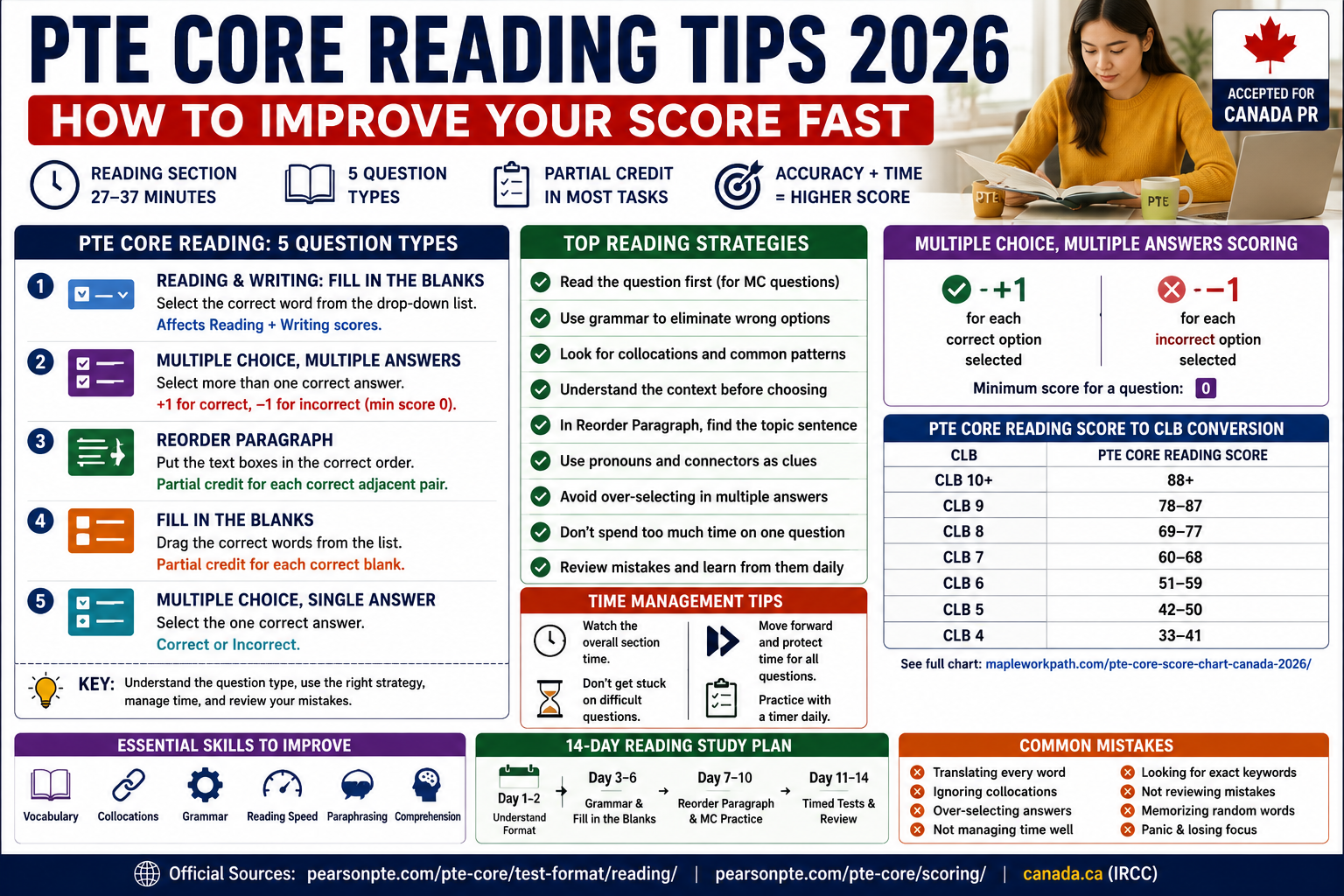
PTE Core Reading can feel difficult because you have limited time and several different question types testing vocabulary, grammar, comprehension and paragraph organization.
The good news is that improving your Reading score is not only about reading faster.
You need to understand how each question is scored, which tasks deserve more attention and when you should move on instead of wasting valuable time.
In 2026, the PTE Core Reading section takes approximately 27 to 37 minutes and contains five question types.
This guide explains practical PTE Core Reading tips for 2026, including Fill in the Blanks, Reorder Paragraph, Multiple Choice, vocabulary, collocations, grammar, time management, common mistakes and a practical study plan.
PTE Core Reading Format 2026
The PTE Core Reading section currently contains five question types:
- Reading & Writing: Fill in the Blanks
- Multiple Choice, Multiple Answers
- Reorder Paragraph
- Fill in the Blanks
- Multiple Choice, Single Answer
The complete Reading section currently lasts approximately 27 to 37 minutes.
You can also read our complete PTE Core Test Format 2026 guide for all 19 PTE Core question types.
How Many PTE Core Reading Questions Are There?
According to Pearson’s current PTE Core Score Guide, you can generally expect approximately:
| Question Type | Approximate Number |
|---|---|
| Reading & Writing: Fill in the Blanks | 5–6 |
| Multiple Choice, Multiple Answers | 1–2 |
| Reorder Paragraph | 2–3 |
| Fill in the Blanks | 4–5 |
| Multiple Choice, Single Answer | 1–2 |
The exact number of questions can vary between test forms.
Which PTE Core Reading Questions Are Most Important?
You should practice every question type, but some tasks offer several opportunities to earn partial credit.
These include:
- Reading & Writing Fill in the Blanks
- Reorder Paragraph
- Reading Fill in the Blanks
Reading & Writing Fill in the Blanks is particularly useful because it contributes to both your Reading and Writing scores.
This makes it an important task to understand well.
1. Reading & Writing: Fill in the Blanks
In Reading & Writing Fill in the Blanks, you see a passage containing missing words.
Each blank has a drop-down list containing possible answers.
Your task is to choose the word that correctly completes the sentence.
This question assesses:
- Vocabulary
- Grammar
- Context
- Collocations
- Overall meaning
How Reading & Writing Fill in the Blanks Is Scored
You receive partial credit.
Each correctly completed blank earns credit.
An incorrect blank does not automatically make the entire question wrong.
This task contributes to both your Reading and Writing scores.
Best Strategy for Reading & Writing Fill in the Blanks
Use this process for every blank:
- Read the complete sentence.
- Identify which part of speech is missing.
- Check the words immediately before and after the blank.
- Look for a familiar collocation.
- Remove grammatically impossible options.
- Compare the meanings of the remaining words.
- Read the completed sentence again.
Use Grammar Before Vocabulary
Sometimes you may not know every word in the options.
You can still eliminate choices using grammar.
Ask yourself whether the blank requires:
- A noun
- A verb
- An adjective
- An adverb
- A preposition
- A particular verb form
Example
Consider:
The company plans to _____ a new office next year.
After the word “to,” you normally need the base form of a verb.
This can immediately eliminate nouns and adjectives from the options.
Learn Collocations for PTE Core Reading
Collocations are words that commonly appear together.
Examples include:
- Make a decision
- Take responsibility
- Gain access
- Heavy traffic
- Strong evidence
- Highly recommended
- Play an important role
- Reach an agreement
- Conduct research
- Meet requirements
Knowing common collocations can make Fill in the Blanks much faster.
Do Not Look at Only One Side of the Blank
Always read words on both sides of the blank.
The word before the blank may tell you the grammar.
The words after the blank may tell you which collocation or meaning is required.
Reading the entire sentence often eliminates several options immediately.
2. Multiple Choice, Multiple Answers
In this task, you read a passage and select more than one correct answer.
You may be asked about:
- Main ideas
- Supporting details
- Author’s opinion
- Tone
- Meaning
- Inference
Does PTE Core Reading Have Negative Marking?
Multiple Choice, Multiple Answers uses scoring where:
- Each correct option selected gives you 1 point.
- Each incorrect option selected deducts 1 point.
The score for the question does not go below zero.
This means selecting every option because you are unsure is a poor strategy.
Best Multiple Choice, Multiple Answers Strategy
- Read the question first.
- Identify exactly what it asks.
- Quickly examine the answer choices.
- Read or scan the passage.
- Find evidence supporting each possible answer.
- Choose only answers you can justify from the passage.
Do not select an answer simply because it contains the same vocabulary as the passage.
The meaning must match.
Do Not Over-Select Answers
This is one of the biggest PTE Core Reading mistakes.
If you are confident that two answers are correct but unsure about a third, randomly adding the third option can cost you a point if it is wrong.
Accuracy is more important than selecting many choices.
Look for Paraphrasing
The correct answer may express the passage’s idea using different words.
For example, the passage may say:
Housing prices increased significantly.
An answer might say:
The cost of homes rose considerably.
The words are different, but the meaning is similar.
Learning to recognize paraphrasing is essential for reading comprehension.
3. Reorder Paragraph
In Reorder Paragraph, several text boxes appear in an incorrect order.
Your job is to arrange them into a logical paragraph.
This task tests your understanding of:
- Paragraph structure
- Cohesion
- Pronouns
- Connecting words
- Chronological order
- Cause and effect
How Reorder Paragraph Is Scored
Reorder Paragraph uses partial-credit scoring.
You earn credit for each pair of text boxes that you place together in the correct adjacent order.
This means you can still receive some points even if the entire paragraph is not perfectly ordered.
First Find the Topic Sentence
A strong opening sentence usually:
- Introduces the main subject
- Can stand alone
- Does not depend on information from another sentence
A sentence beginning with words such as:
- This
- These
- They
- He
- She
- However
- Therefore
- Consequently
is often not the first sentence because it may refer to something previously introduced.
Find Sentence Pairs Instead of Solving Everything at Once
This is one of the best Reorder Paragraph techniques.
Instead of trying to solve all boxes immediately, find strong pairs.
Example
Sentence A:
Researchers developed a new battery technology.
Sentence B:
This technology could significantly reduce charging times.
The phrase “This technology” clearly refers back to the technology introduced in Sentence A.
Therefore, A → B is a strong pair.
Use Pronouns as Clues
Pronouns usually refer to something already mentioned.
Look carefully at words such as:
- It
- They
- This
- These
- Those
- Such
If you understand what the pronoun refers to, you can often identify the previous sentence.
Use Connecting Words
Linking words reveal relationships between sentences.
Examples include:
- However – contrast
- Therefore – result
- Furthermore – additional information
- For example – example
- Consequently – result
- In contrast – comparison
- First – sequence
- Finally – conclusion or final step
Use Chronological Order
If the paragraph describes an event or process, look for time clues such as:
- Initially
- First
- Then
- Later
- Afterwards
- Eventually
- Finally
These can make the correct sequence much easier to identify.
4. Reading Fill in the Blanks
In this task, you see a passage with missing words and a list of possible words.
You drag words from the list into the appropriate blanks.
There are generally more available words than blanks.
This task contributes to your Reading score.
How Reading Fill in the Blanks Is Scored
Partial credit applies.
You receive credit for each blank completed correctly.
An incorrect blank does not erase credit earned from other correct blanks.
Best Reading Fill in the Blanks Strategy
For each blank:
- Determine the required part of speech.
- Check grammar.
- Look for collocations.
- Consider the meaning of the sentence.
- Check the broader paragraph context.
- Use remaining options to help solve difficult blanks.
Part of Speech Method
This strategy can save a lot of time.
For example:
The new policy was extremely _____.
After “extremely,” you normally expect an adjective.
Therefore, you can immediately remove most nouns and verbs from consideration.
Look for Preposition Patterns
Many English words naturally combine with particular prepositions.
Examples include:
- Interested in
- Responsible for
- Dependent on
- Related to
- Concerned about
- Associated with
- Capable of
Learning these combinations can help you solve blanks quickly.
5. Multiple Choice, Single Answer
This task gives you a reading passage followed by one question and several possible answers.
Only one answer is correct.
This question is scored as either correct or incorrect.
An incorrect answer does not deduct points from other questions.
Best Multiple Choice, Single Answer Strategy
- Read the question before reading the full passage.
- Identify keywords in the question.
- Scan for the relevant section.
- Understand the meaning rather than matching individual words.
- Eliminate clearly wrong options.
- Select the option most strongly supported by the passage.
Do Not Spend Too Long on Single-Answer Questions
Because Reading has a shared section time, spending several minutes on one question can create problems later.
If you cannot find the answer after a reasonable attempt, choose the option you think is best and move forward.
PTE Core Reading Time Management
Time management is one of the most important Reading skills.
You have approximately 27–37 minutes for the entire Reading section.
You should avoid letting one difficult question consume a large portion of that time.
Practical Reading Time Strategy
You do not need to follow exact seconds for every question, but a useful approach is:
- Fill in the Blanks: work carefully but efficiently
- Multiple Choice Multiple Answers: avoid excessive rereading
- Reorder Paragraph: build strong sentence pairs
- Multiple Choice Single Answer: make a decision and move on
Protect enough time to reach every question.
Should You Read the Entire Passage First?
Not always.
Your approach should depend on the task.
For Fill in the Blanks
Quickly understand the general topic and then focus closely around each blank.
For Multiple Choice
Read the question first so you know what information you need.
For Reorder Paragraph
Read all boxes quickly to understand the overall topic before looking for sentence connections.
How to Improve PTE Core Reading Vocabulary
Do not try to memorize thousands of random English words.
Instead, learn vocabulary in context.
For each useful new word, learn:
- Meaning
- Part of speech
- Common collocations
- Synonyms
- Antonyms
- Example sentence
Example
Significant
- Part of speech: adjective
- Meaning: important or noticeable
- Collocations: significant change, significant increase, significant impact
- Synonym: considerable
This method is much more useful for Fill in the Blanks than memorizing only the dictionary definition.
Build a Collocation Notebook
Create a small notebook or digital list of combinations you regularly see during practice.
Organize them into groups such as:
- Verb + noun
- Adjective + noun
- Noun + noun
- Adverb + adjective
- Verb + preposition
Verb + Noun Examples
- Make progress
- Take action
- Raise awareness
- Conduct research
- Reach a conclusion
Adjective + Noun Examples
- Strong evidence
- Major issue
- Significant improvement
- Economic growth
- Public opinion
Grammar Topics That Help PTE Core Reading
You do not need to become a grammar professor, but certain areas are extremely useful for Fill in the Blanks.
Focus on:
- Parts of speech
- Subject-verb agreement
- Verb tense
- Articles
- Prepositions
- Gerunds and infinitives
- Adjective and adverb forms
- Relative clauses
- Singular and plural nouns
- Sentence connectors
Understand Prefixes and Suffixes
Prefixes and suffixes can help you identify unfamiliar vocabulary.
Common Prefixes
- Un- = not
- Re- = again
- Pre- = before
- Mis- = wrongly
- Inter- = between
Common Suffixes
- -tion often creates nouns
- -ment often creates nouns
- -ous often creates adjectives
- -ive often creates adjectives
- -ly often creates adverbs
This can help you determine which option grammatically fits a blank.
How to Read Faster Without Losing Understanding
Reading faster does not mean rushing through every word.
Improve efficiency by learning two techniques:
Skimming
Skimming means reading quickly to understand the overall idea.
Focus on:
- First sentence
- Topic words
- Repeated concepts
- Final sentence
Scanning
Scanning means looking for specific information.
You might scan for:
- A name
- A date
- A keyword
- A number
- A particular idea
Do Not Translate Every Sentence
If English is not your first language, translating everything into your native language can slow you down significantly.
Practice understanding English directly.
Start with simple material and gradually increase difficulty.
Read English Every Day
Daily reading can improve:
- Vocabulary
- Reading speed
- Grammar awareness
- Collocations
- Sentence structure
- General comprehension
Useful materials include:
- News articles
- Government information
- Business articles
- Science articles
- Workplace communication
- Short educational texts
How Much Should You Read Every Day?
Even 20 to 30 focused minutes can be useful if you actively learn from what you read.
Do not only read passively.
After reading an article:
- Identify the main idea.
- Write down five useful words.
- Find two or three collocations.
- Summarize the article in one or two sentences.
Best Way to Review PTE Core Reading Mistakes
Simply checking your score after practice is not enough.
For every wrong answer, ask:
- Did I misunderstand the vocabulary?
- Did I miss a collocation?
- Was my grammar wrong?
- Did I misunderstand the passage?
- Did I rush?
- Did I spend too much time?
- Did I select an answer without evidence?
Then write down the lesson from the mistake.
Create an Error Notebook
Your error notebook can have four columns:
| Question | My Mistake | Correct Rule | Example |
|---|---|---|---|
| Fill in the Blank | Wrong preposition | Responsible for | She is responsible for training. |
| Reorder Paragraph | Missed pronoun link | “This” refers backward | Technology → This technology |
Review the notebook every few days.
14-Day PTE Core Reading Improvement Plan
If you have limited preparation time, use this focused two-week plan.
Days 1–2: Understand the Format
- Learn all five Reading question types.
- Understand how each one is scored.
- Complete a short diagnostic practice test.
- Identify your weakest two question types.
Days 3–4: Grammar and Collocations
- Review parts of speech.
- Practice prepositions.
- Study common collocations.
- Complete Fill in the Blanks exercises.
Days 5–6: Reading & Writing Fill in the Blanks
- Practice multiple sets.
- Review every incorrect blank.
- Record new vocabulary and collocations.
Days 7–8: Reorder Paragraph
- Practice identifying topic sentences.
- Find pronoun references.
- Build sentence pairs.
- Practice connectors.
Day 9: Multiple Choice
- Practice both Multiple Answer and Single Answer.
- Focus on evidence rather than keyword matching.
- Avoid unnecessary selections in Multiple Answer.
Day 10: Reading Fill in the Blanks
- Practice grammar elimination.
- Practice collocations.
- Review common prepositions.
Days 11–12: Timed Reading Practice
- Complete full Reading sections.
- Use realistic time limits.
- Track where you waste time.
Day 13: Weak Areas
- Review your error notebook.
- Repeat difficult question types.
- Review vocabulary and collocations.
Day 14: Final Mock Practice
- Complete one full Reading section.
- Do not pause.
- Use exam-style timing.
- Review mistakes after finishing.
What If Your PTE Core Reading Score Is Very Low?
If Reading is your weakest skill, do not only complete endless mock tests.
Identify the reason.
A low Reading score can come from:
- Weak vocabulary
- Weak grammar
- Limited collocation knowledge
- Slow reading speed
- Poor time management
- Difficulty understanding paragraph structure
- Over-selecting multiple-answer choices
Once you know the cause, your preparation becomes much more focused.
How Your PTE Core Reading Score Converts to CLB
For Canadian immigration, your PTE Core Reading result is converted to a Canadian Language Benchmark level.
Current important Reading thresholds include:
| CLB | PTE Core Reading |
|---|---|
| CLB 10+ | 88+ |
| CLB 9 | 78–87 |
| CLB 8 | 69–77 |
| CLB 7 | 60–68 |
| CLB 6 | 51–59 |
| CLB 5 | 42–50 |
| CLB 4 | 33–41 |
Use our complete PTE Core Score Chart Canada 2026 to compare Speaking, Listening, Reading and Writing.
What Reading Score Do You Need for CLB 9?
The current PTE Core Reading range for CLB 9 is:
78–87.
A Reading score of 88 or higher currently falls within CLB 10 or above.
Why CLB 9 Can Matter for Express Entry
For many Express Entry candidates, reaching CLB 9 across all four language abilities can be valuable because of the way language and skill-transferability points work.
However, your exact CRS benefit depends on your complete immigration profile.
Read our Express Entry Canada 2026 guide for more details.
PTE Core Reading for Canadian Experience Class
Canadian Experience Class language requirements depend on your qualifying occupation’s TEER category.
CEC currently requires:
- CLB 7 for TEER 0 or 1 occupations
- CLB 5 for TEER 2 or 3 occupations
That means the current minimum PTE Core Reading scores are:
- TEER 0 or 1: Reading 60
- TEER 2 or 3: Reading 42
Read our Canadian Experience Class 2026 guide for the complete requirements.
Do Not Aim Only for the Minimum
Meeting the minimum language requirement may make you eligible for a particular immigration program.
It does not necessarily make your Express Entry profile competitive.
If possible, consider whether improving to a higher CLB level could improve your CRS score.
PTE Core Reading Test-Day Tips
- Read instructions carefully.
- Watch your section time.
- Do not panic after one difficult question.
- Use grammar to eliminate Fill in the Blanks options.
- Look for collocations.
- Build sentence pairs in Reorder Paragraph.
- Do not randomly select Multiple Choice Multiple Answers options.
- Read Multiple Choice questions before searching the passage.
- Move on when a question is consuming too much time.
Common PTE Core Reading Mistakes
- Trying to translate every sentence
- Memorizing random vocabulary without context
- Ignoring collocations
- Ignoring grammar in Fill in the Blanks
- Selecting too many answers in Multiple Choice Multiple Answers
- Looking only for identical keywords
- Trying to solve Reorder Paragraph without finding sentence pairs
- Spending too much time on one question
- Completing practice tests without reviewing mistakes
- Ignoring the Reading & Writing integrated task
Daily PTE Core Reading Routine
A simple daily session can look like this:
- 10 minutes vocabulary and collocations
- 10 minutes grammar review
- 20 minutes Fill in the Blanks
- 15 minutes Reorder Paragraph
- 10 minutes Multiple Choice
- 15 minutes reviewing mistakes
If you have less time, shorten each section while keeping mistake review in your routine.
Should You Use Templates for PTE Core Reading?
Reading is different from speaking and writing because there is very little value in memorizing answer templates.
Instead, memorize useful methods:
- Part-of-speech method
- Collocation method
- Sentence-pair method
- Pronoun-reference method
- Keyword and paraphrase identification
How to Know If Your Reading Is Improving
Track three things:
- Accuracy
- Time
- Type of mistakes
For example, if your Fill in the Blanks accuracy improves from 50% to 75% but you are taking twice as long, you still need to improve efficiency.
Your goal is to become both accurate and reasonably fast.
Official PTE Core Reading Resources
Pearson provides official information and practice guidance for each Reading question type.
Use Pearson’s official PTE Core Reading format page.
You can also review Pearson’s official PTE Core scoring information.
PTE Core Reading 2026 Checklist
- I know all five Reading question types.
- I understand which task also affects Writing.
- I understand Multiple Choice Multiple Answers scoring.
- I know how Reorder Paragraph partial credit works.
- I practice collocations regularly.
- I understand parts of speech.
- I review every important mistake.
- I practice using a timer.
- I know my target PTE Core Reading score.
- I know the CLB level required for my immigration pathway.
Final Thoughts
Improving your PTE Core Reading score requires more than simply reading more passages.
You need to understand the five Reading question types and use a different strategy for each one.
Reading & Writing Fill in the Blanks is particularly important because it can contribute to both Reading and Writing scores.
For Fill in the Blanks, focus on grammar, vocabulary and collocations.
For Reorder Paragraph, identify the topic sentence and build strong sentence pairs using pronouns, connectors and logical relationships.
For Multiple Choice Multiple Answers, remember that incorrect selections can cost points, so avoid selecting options without evidence.
Most importantly, review your mistakes instead of simply completing more practice questions.
With consistent practice, better vocabulary, stronger collocations, improved grammar and smarter time management, you can build a stronger PTE Core Reading performance.
Before your exam, always verify the latest format and scoring rules directly through Pearson.
Leave a Reply