
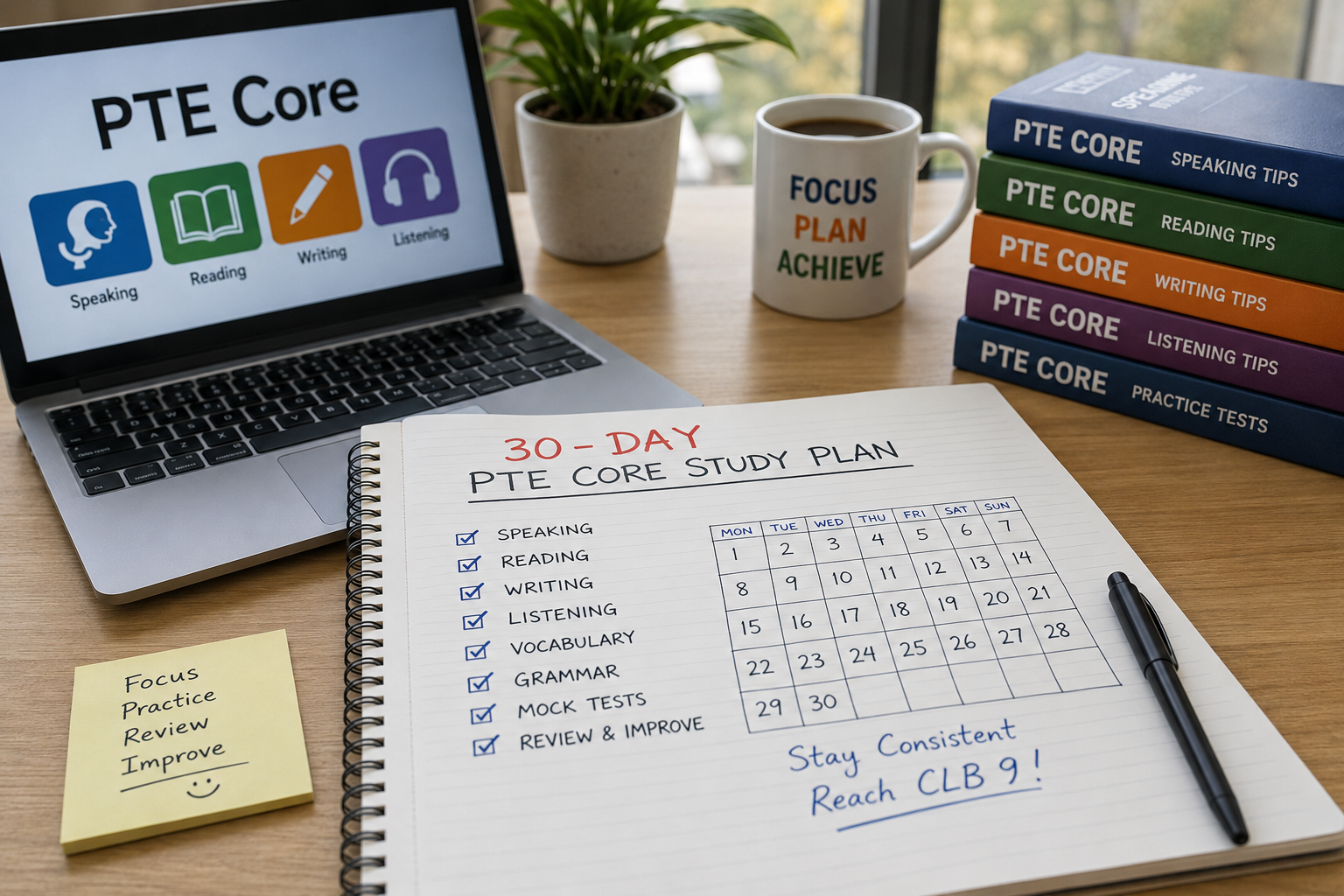
Preparing for PTE Core becomes much easier when you stop studying randomly and follow a clear daily plan.
If your goal is CLB 9 for Canadian immigration, you need strong performance across all four language abilities: Speaking, Listening, Reading and Writing.
This 30-day PTE Core study plan for 2026 gives you a structured daily preparation schedule covering the complete test, including question types, vocabulary, grammar, pronunciation, listening, mock tests, mistake review and final exam preparation.
The plan is designed as a practical framework. It can help you organize your preparation, but it does not guarantee a particular PTE Core or CLB score.
PTE Core CLB 9 Score Targets for 2026
Before starting your study plan, know exactly what scores you are working toward.
According to the current IRCC PTE Core conversion table, CLB 9 corresponds to:
| Ability | PTE Core CLB 9 Range | Minimum Score to Reach CLB 9 |
|---|---|---|
| Speaking | 84–88 | 84 |
| Listening | 82–88 | 82 |
| Reading | 78–87 | 78 |
| Writing | 88–89 | 88 |
If you score above these ranges, you may reach CLB 10 or higher for that ability.
For example, the current CLB 10 thresholds begin at Speaking 89, Listening 89, Reading 88 and Writing 90.
You can see the full conversion table in our PTE Core Score Chart Canada 2026.
Important: CLB 9 Is Not One Overall PTE Score
This is a common misunderstanding.
For Canadian immigration programs that use CLB levels, IRCC evaluates your individual scores in:
- Speaking
- Listening
- Reading
- Writing
Therefore, getting a strong overall PTE score does not automatically mean that you have CLB 9 in every ability.
If your target is CLB 9 across all four abilities, each individual score needs to meet the relevant threshold.
Understand the PTE Core Test Before Starting
PTE Core currently has three main parts:
- Speaking & Writing
- Reading
- Listening
The Speaking & Writing section currently takes approximately 50–65 minutes and contains seven question types.
Reading and Listening contain their own sets of question types testing comprehension, vocabulary, grammar, memory and written accuracy.
Before beginning your 30-day plan, read our PTE Core Test Format 2026 guide so you understand every task.
Which Skills Should You Practice?
Your 30-day preparation should develop six areas at the same time:
- Speaking fluency and pronunciation
- Listening comprehension and memory
- Reading vocabulary and grammar
- Writing grammar and organization
- Typing and spelling accuracy
- Test strategy and time management
Practicing only one area is usually not enough because several PTE Core question types are integrated.
For example, some tasks can contribute to more than one communicative skill.
How Much Time Should You Study Every Day?
Your schedule depends on your current English level and available time.
A useful daily target for serious preparation is approximately:
- 60 minutes: minimum focused routine
- 90 minutes: balanced routine
- 120 minutes: intensive routine
Quality is more important than simply studying for many hours.
One focused hour with detailed mistake review can be more useful than three hours of completing questions without understanding why your answers were wrong.
Recommended Daily Study Structure
If you have about two hours, you can divide your session like this:
| Activity | Approximate Time |
|---|---|
| Vocabulary and grammar | 15 minutes |
| Speaking | 25 minutes |
| Reading | 20 minutes |
| Listening | 25 minutes |
| Writing | 20 minutes |
| Mistake review | 15 minutes |
You do not need to follow these exact times every day.
During the 30-day plan, some days will focus more heavily on a particular skill.
Before Day 1: Prepare Your Study System
Create four things before you begin:
1. Error Notebook
Record important mistakes from practice.
For every error, write:
- Question type
- Your answer
- Correct answer
- Why you were wrong
- Rule or lesson
2. Vocabulary List
Record useful:
- Words
- Collocations
- Synonyms
- Prepositions
- Common phrases
3. Speaking Recordings Folder
Save your Read Aloud, Describe Image and other speaking practice recordings so you can compare your progress.
4. Score Tracker
Create a simple table where you record your practice accuracy and mock-test performance every few days.
30-Day PTE Core Study Plan 2026
Day 1: Learn the Complete Test Format
Your first day should focus on understanding exactly what you will face on test day.
Review all three sections:
- Speaking & Writing
- Reading
- Listening
Learn every question type and understand which tasks use partial credit or negative marking.
Do not worry about achieving a high score today.
Your objective is understanding the exam.
Use our PTE Core Test Format 2026 guide.
Day 2: Take a Diagnostic Test
Complete a realistic practice session covering all four abilities.
Record:
- Speaking weaknesses
- Reading accuracy
- Listening mistakes
- Writing grammar errors
- Questions that consume too much time
Do not become discouraged by your first result.
The diagnostic test is simply your starting point.
Day 3: Build Grammar Foundations
Review grammar that frequently affects PTE performance.
Focus on:
- Parts of speech
- Subject-verb agreement
- Verb tense
- Articles
- Prepositions
- Singular and plural nouns
- Adjectives and adverbs
- Sentence structure
Then complete Reading Fill in the Blanks and short writing exercises using these rules.
Day 4: Vocabulary and Collocations
Start building a useful vocabulary system.
Do not memorize random difficult words.
Learn words together with:
- Meaning
- Part of speech
- Common collocations
- Example sentence
- Synonyms
Useful collocations include:
- Make a decision
- Take responsibility
- Conduct research
- Strong evidence
- Economic growth
- Meet requirements
- Reach an agreement
- Play an important role
Day 5: Read Aloud
Focus primarily on PTE Core Read Aloud.
Practice:
- Natural speaking speed
- Clear pronunciation
- Phrase grouping
- Word stress
- Sentence rhythm
- Minimal hesitation
Record every response.
Listen to yourself and identify words that are difficult to understand.
Use our PTE Core Speaking Tips 2026 guide for the complete strategy.
Day 6: Repeat Sentence
Today, focus on short-term listening memory.
Practice hearing sentences once and repeating them immediately.
Use chunking rather than trying to memorize individual words.
Example:
The training session / has been moved / to Friday afternoon.
Practice maintaining fluency even if you forget a small part.
Day 7: Describe Image
Practice different visuals:
- Bar charts
- Line graphs
- Photographs
- Maps
- Diagrams
- Processes
Use a flexible structure:
- Introduce the image.
- Identify the main feature.
- Give two or three important details.
- Give an overall conclusion.
Avoid memorizing a long script that does not match the image.
Day 8: Respond to a Situation and Answer Short Question
For Respond to a Situation, practice identifying:
- Who you are speaking to
- Purpose
- Formal or informal tone
- Important prompt details
- Appropriate request or response
For Answer Short Question, focus on short and accurate answers.
Do not give unnecessary long responses.
Day 9: Speaking Review Day
Complete a mixed speaking session:
- Read Aloud
- Repeat Sentence
- Describe Image
- Respond to a Situation
- Answer Short Question
Record your responses.
Compare them with your Day 2 diagnostic.
Identify your two weakest speaking tasks.
Day 10: Reading & Writing Fill in the Blanks
Focus on one of the most useful Reading tasks.
Practice:
- Grammar
- Vocabulary
- Collocations
- Context
- Part-of-speech elimination
Do not choose an answer based only on meaning.
The word should fit both grammar and context.
Use our PTE Core Reading Tips 2026 guide.
Day 11: Reading Fill in the Blanks
Continue improving vocabulary and grammar.
For each blank:
- Determine the required part of speech.
- Check the sentence meaning.
- Look for collocations.
- Check the surrounding paragraph.
- Eliminate impossible choices.
Add every useful unfamiliar collocation to your vocabulary notebook.
Day 12: Reorder Paragraph
Practice paragraph organization.
Focus on:
- Topic sentences
- Pronoun references
- Linking words
- Chronological order
- Cause and effect
- Sentence pairs
Instead of trying to solve the entire paragraph immediately, look for strong sentence pairs first.
Day 13: Reading Multiple Choice
Practice both:
- Multiple Choice, Multiple Answers
- Multiple Choice, Single Answer
For Multiple Answers, remember that incorrect selections can deduct points.
Do not select extra choices without evidence.
Practice identifying paraphrases instead of searching only for identical words.
Day 14: Full Reading Practice
Complete a timed Reading section.
Focus on:
- Accuracy
- Time management
- Reaching every question
- Avoiding over-selection
- Using grammar efficiently
After finishing, spend at least 20 minutes reviewing mistakes.
Day 15: Halfway Progress Check
You are halfway through the study plan.
Complete another mixed practice test.
Compare your results with Day 2.
Ask:
- Has my speaking become smoother?
- Is Reading accuracy improving?
- Am I making fewer spelling mistakes?
- Is Listening memory improving?
- Is Writing becoming more organized?
Choose your weakest skill for additional practice during the second half of the plan.
Day 16: Summarize Written Text
Practice identifying:
- Main idea
- Essential supporting points
- Unnecessary examples
- Logical relationships
Pearson currently instructs candidates to write 25–50 words for this task.
Practice staying within the word range while maintaining correct grammar and vocabulary.
Use our PTE Core Writing Tips 2026 guide.
Day 17: Write Email
Practice formal and informal emails.
Analyze each prompt by identifying:
- Recipient
- Reason for writing
- Required points
- Correct tone
Pearson currently instructs candidates to write 80–120 words in this task.
Use a clear structure:
- Greeting
- Opening
- Main points
- Closing
- Sign-off
Day 18: Writing Grammar and Proofreading
Today is not about writing many responses.
Instead, review your previous writing and find repeated errors.
Focus on:
- Verb tense
- Subject-verb agreement
- Articles
- Prepositions
- Punctuation
- Sentence fragments
- Spelling
Rewrite your weakest responses correctly.
Day 19: Timed Writing Practice
Complete:
- Summarize Written Text under the official time limit
- Write Email under the official time limit
Do not pause the timer.
Always leave time at the end to proofread.
Day 20: Write from Dictation
Focus heavily on Listening and Writing integration.
Practice hearing a sentence once and typing exactly what you remember.
Check:
- Word order
- Articles
- Prepositions
- Singular and plural endings
- Spelling
Remember sentences in meaningful chunks.
Use our PTE Core Listening Tips 2026 guide for detailed strategies.
Day 21: Listening Fill in the Blanks
Practice following a transcript while listening.
If you miss one blank, do not stop.
Continue following the recording so you do not lose the next answers.
After the audio finishes, check:
- Spelling
- Grammar
- Word form
- Context
Day 22: Summarize Spoken Text
Practice concise note-taking.
Record only:
- Main topic
- Important points
- Cause and effect
- Major conclusion
Pearson currently instructs candidates to write a 20–30 word response for this task.
Practice listening once without replaying the audio.
Day 23: Listening Multiple Choice
Practice:
- Main ideas
- Speaker opinion
- Details
- Purpose
- Paraphrasing
For Multiple Choice Multiple Answers, avoid aggressive guessing because incorrect selections can deduct points.
Day 24: Highlight Incorrect Words and Select Missing Word
For Highlight Incorrect Words:
- Follow the transcript carefully.
- Click only when you clearly hear a difference.
- Do not keep looking backward.
For Select Missing Word:
- Understand the overall recording.
- Predict the logical ending.
- Listen for signal words.
- Use grammar and context.
Day 25: Full Listening Practice
Complete a timed Listening section.
Use realistic conditions:
- No replaying recordings
- No pausing
- Short notes only
- Careful spelling
- Realistic timing
Review every important mistake afterwards.
Day 26: Weakest Skill Intensive Day
Review your results from Days 2, 15 and recent practice.
Choose your weakest ability:
- Speaking
- Listening
- Reading
- Writing
Spend most of today’s session improving that area.
Do not practice your strongest skill simply because it feels more comfortable.
Day 27: Full PTE Core Mock Test
Complete a full exam-style mock test if you have access to one.
Treat it like the real exam:
- No phone
- No unnecessary breaks
- No checking answers online during the test
- No pausing recordings
- Use a headset and microphone
After finishing, record your scores and major weaknesses.
Day 28: Mock Test Review
Do not immediately complete another full mock test.
Spend today understanding yesterday’s mistakes.
Divide errors into categories:
- Knowledge problem
- Vocabulary problem
- Grammar problem
- Spelling problem
- Time-management problem
- Concentration problem
- Strategy problem
Correct the cause of the mistake rather than only memorizing the answer.
Day 29: Final Targeted Practice
Practice only the question types that still cause problems.
Avoid trying to learn dozens of new strategies one day before your final preparation day.
Review:
- Common vocabulary
- Collocations
- Speaking structure
- Email structure
- Summary structure
- Negative-marking tasks
- Spelling mistakes
Day 30: Light Review and Exam Preparation
Your final day should not be an exhausting eight-hour study session.
Complete a short review of:
- PTE Core format
- Your strongest strategies
- Your common mistakes
- CLB target scores
- Speaking fluency
- Spelling
- Time-management rules
If your exam is the next day, prioritize proper sleep and arriving prepared rather than doing a late-night marathon study session.
Weekly Overview of the 30-Day Plan
| Period | Main Focus |
|---|---|
| Days 1–4 | Format, diagnostic test, grammar and vocabulary |
| Days 5–9 | Speaking |
| Days 10–15 | Reading and progress review |
| Days 16–19 | Writing |
| Days 20–25 | Listening |
| Days 26–30 | Weak areas, mock tests and final review |
What to Do If You Only Have 60 Minutes Per Day
You can still use this plan.
On skill-specific days, divide your hour like this:
- 40 minutes: main task of the day
- 10 minutes: vocabulary or grammar
- 10 minutes: mistake review
Do not try to practice every PTE question type every single day.
Follow the focus of the schedule.
What to Do If You Have 2 Hours Per Day
Use:
- 70 minutes for the main skill
- 20 minutes for vocabulary and grammar
- 15 minutes for a secondary skill
- 15 minutes for mistake review
This gives you enough time for focused practice without making every session identical.
What to Do If Your Reading Score Is Low
Focus on:
- Collocations
- Parts of speech
- Grammar
- Fill in the Blanks
- Reorder Paragraph
- Reading speed
- Paraphrasing
Read our complete PTE Core Reading Tips 2026.
What to Do If Your Speaking Score Is Low
Focus on:
- Recording yourself
- Natural speaking speed
- Pronunciation
- Phrase grouping
- Short-term memory
- Reducing long pauses
- Speaking without restarting
Read our PTE Core Speaking Tips 2026.
What to Do If Your Writing Score Is Low
Focus on:
- Grammar
- Spelling
- Email organization
- Summary accuracy
- Word limits
- Proofreading
- Integrated writing tasks
Read our PTE Core Writing Tips 2026.
What to Do If Your Listening Score Is Low
Focus on:
- Write from Dictation
- Listening Fill in the Blanks
- Short-term memory
- Spelling
- Different English accents
- Note-taking
- Understanding paraphrases
Read our PTE Core Listening Tips 2026.
Build an Error Notebook Instead of Only Doing Mock Tests
Mock tests are useful, but simply completing one mock test after another does not automatically improve your English.
Your biggest improvement often comes from reviewing why you lost points.
For example:
| Question | Mistake | Reason | Correction |
|---|---|---|---|
| Reading Fill in Blank | Wrong word | Did not know collocation | Learn full phrase |
| Write from Dictation | Missed plural | Did not hear final sound | Practice endings |
| Read Aloud | Long pauses | Reading word by word | Practice phrase groups |
| Write Email | Missing task point | Did not plan | Check prompt before writing |
Track Accuracy, Not Only Practice Hours
Instead of saying:
I studied PTE for three hours.
Ask:
- How many questions did I answer correctly?
- Which errors repeated?
- Did my timing improve?
- Did my pronunciation become clearer?
- Did my spelling accuracy improve?
This gives you a better picture of progress.
Should You Memorize PTE Templates?
Simple structures can help you organize responses.
However, avoid relying on long memorized scripts that do not match the actual question.
Instead, learn flexible structures for:
- Describe Image
- Respond to a Situation
- Summarize Written Text
- Write Email
- Summarize Spoken Text
Your response still needs to be relevant to the prompt.
Practice Typing Every Day
PTE Core is computer-based.
Practice typing English regularly so that slow typing does not create unnecessary pressure.
Focus first on accuracy.
Then gradually improve speed.
Pay particular attention to:
- Capitalization
- Spelling
- Punctuation
- Spaces
- Plural endings
Practice Speaking Into a Microphone
Do not practice speaking only in your head.
Use a headset or microphone regularly.
Recording yourself helps you notice:
- Unclear words
- Long pauses
- Filler words
- Very fast speech
- Very slow speech
- Repeated words
Do You Need a Perfect Accent for PTE Core?
No.
Pearson’s speaking guidance focuses on whether your pronunciation is understandable to regular English speakers.
Regional and national varieties of English pronunciation are recognized when they remain understandable.
Focus on clarity rather than trying to copy a specific accent.
How to Practice English Outside PTE Questions
Your preparation should include general English exposure.
Try:
- Reading English news
- Listening to podcasts
- Watching educational videos
- Speaking English daily
- Writing short emails
- Summarizing articles
- Learning workplace vocabulary
General English improvement supports your PTE strategies.
When Should You Start Doing Full Mock Tests?
Do not spend all 30 days taking full mock tests.
A useful approach is:
- Diagnostic test near the beginning
- Progress test around the middle
- Full mock during the final week
- Another mock only when you have reviewed the previous one
Mock tests should measure your progress, not replace learning.
What If You Are Still Below CLB 9 After 30 Days?
Do not assume that another random month of practice will automatically fix the problem.
Use your results to identify the weakest ability and question types.
For example:
- If Reading is below target, focus on grammar, collocations and Fill in the Blanks.
- If Speaking is below target, focus on fluency, pronunciation and recording review.
- If Writing is below target, focus on grammar, spelling and task completion.
- If Listening is below target, focus on dictation, memory and spelling.
Some learners may require more than 30 days depending on their starting level.
CLB 9 and Canadian Immigration
PTE Core is an approved English language test for Express Entry.
Higher language results can affect immigration points, but the exact impact depends on your full immigration profile and program.
CLB 9 may be particularly valuable in some Express Entry scoring situations because of language and skill-transferability factors.
However, reaching CLB 9 does not guarantee an invitation for permanent residence.
Read our Express Entry Canada 2026 guide for more information.
PTE Core 30-Day CLB 9 Checklist
- I know the complete PTE Core format.
- I know my individual CLB 9 score targets.
- I completed a diagnostic test.
- I keep an error notebook.
- I review vocabulary and collocations.
- I practice grammar regularly.
- I record my speaking responses.
- I practice Reading Fill in the Blanks.
- I practice Write from Dictation.
- I practice summaries and emails under time limits.
- I practice Listening without replaying recordings.
- I review negative-marking tasks carefully.
- I complete timed sections.
- I review mock-test mistakes.
- I know my weakest skill.
- I reduce study intensity immediately before the exam.
Official PTE Core and IRCC Resources
Always verify the latest test information before your exam.
Use Pearson’s official PTE Core test format guide.
Review Pearson’s official PTE Core scoring information.
For Canadian immigration language conversions, use IRCC’s official Express Entry language test results page.
Related PTE Core Guides
- PTE Core Score Chart Canada 2026
- PTE Core Test Format 2026
- PTE Core Speaking Tips 2026
- PTE Core Reading Tips 2026
- PTE Core Writing Tips 2026
- PTE Core Listening Tips 2026
Final Thoughts
A good PTE Core study plan should give every practice session a clear purpose.
During the first part of this 30-day plan, learn the format, identify your weaknesses and strengthen grammar and vocabulary.
Then spend focused days improving Speaking, Reading, Writing and Listening before moving into timed practice and mock tests.
If CLB 9 is your target, remember that the current minimum PTE Core scores to enter CLB 9 are Speaking 84, Listening 82, Reading 78 and Writing 88.
Do not simply complete hundreds of questions.
Review your mistakes, record your progress and continue focusing on the areas that cost you the most points.
Most importantly, remember that a 30-day study plan is a preparation framework rather than a score guarantee.
Your starting English level, consistency, practice quality and test-day performance all affect your final result.
Before booking or taking your exam, always verify the latest PTE Core test format and Canadian immigration language requirements through Pearson and IRCC.
Explore All PTE Core Guides
Use our PTE Core Canada 2026 hub to find the test format, CLB score chart, templates, practice resources and task-by-task strategies in one place.
Leave a Reply