
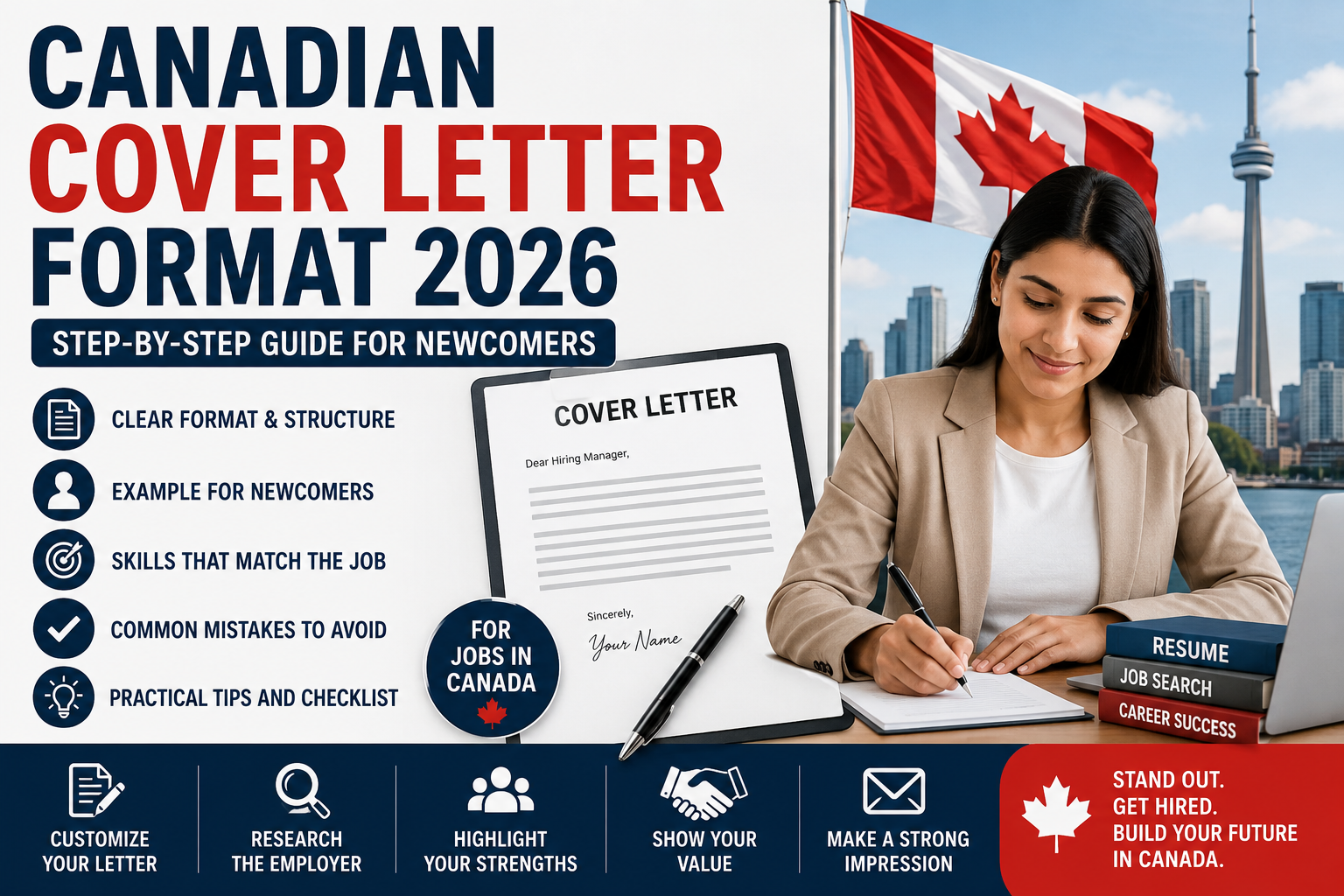
Canadian Cover Letter Format 2026: What Newcomers Need to Know
A strong resume shows an employer your skills, education and work experience. A cover letter gives you the opportunity to explain why those qualifications make you a good fit for a specific position.
For newcomers to Canada, a cover letter can also help connect international experience with the needs of a Canadian employer.
The goal is not to repeat everything from your resume. Instead, your cover letter should briefly introduce you, show that you understand the position and explain how your experience can help the employer.
There is no single mandatory Canadian cover letter template for every industry, but a simple professional structure works well for most applications.
Canadian Cover Letter Format at a Glance
| Section | What to include |
|---|---|
| Header | Your name, phone, email, city and province |
| Employer details | Date, hiring manager, company and location |
| Opening | Job title, interest and strongest relevant qualification |
| Body | One or two examples connecting your experience to the posting |
| Closing | Interest in an interview, thanks and professional sign-off |
Canadian Cover Letter Template
Copy this framework and replace every bracketed item with truthful details that match the job posting.
[Your Full Name]
[City, Province] · [Phone] · [Professional Email][Date]
[Hiring Manager’s Name]
[Job Title]
[Company Name]
[City, Province]Dear [Hiring Manager’s Name or Hiring Manager],
I am writing to apply for the [position title] role at [company]. With experience in [relevant field or skill], I have developed [two relevant skills] that match the requirements in your job posting.
In my previous role at [employer or type of workplace], I [describe one relevant responsibility or accomplishment]. This experience strengthened my ability to [connect the example to the employer’s need].
I am interested in joining [company] because [specific, honest reason]. Thank you for considering my application. I would welcome the opportunity to discuss how my experience could contribute to your team.
Sincerely,
[Your Full Name]
Customize before sending: use the real job title and company name, select evidence from your own experience, and remove every bracket. Never submit the example unchanged.
1. Keep Your Cover Letter Clear and Professional
A Canadian-style cover letter should normally be concise and easy to scan.
Avoid writing a long personal story. Employers are mainly interested in understanding:
Why you are applying for the position, what relevant skills and experience you have, how those qualifications match the job and why you are interested in the employer.
Try to keep the letter focused on the position you are applying for.
One page is usually enough for most job applications.
2. Add Your Contact Information
At the top of the cover letter, include your basic contact details.
You can include:
Your full name, phone number, professional email address, city and province, and LinkedIn profile if it is professional and up to date.
You normally do not need to include unnecessary personal information such as your age, marital status, religion or photograph.
Keep the contact section clean and easy to read.
3. Add the Date and Employer Information
Below your contact information, add the date.
Then include the hiring manager’s name if you know it, their job title, the company name and company location.
For example:
August 29, 2026
Sarah Wilson
Hiring Manager
ABC Services Inc.
Toronto, Ontario
If you cannot find the hiring manager’s name, you can still address the letter professionally.
4. Use a Professional Greeting
Whenever possible, address the person responsible for hiring.
For example:
Dear Ms. Wilson,
or
Dear Hiring Manager,
Avoid very casual greetings.
If the job posting includes a recruiter’s or manager’s name, use it correctly rather than using a generic greeting.
5. Write a Strong Opening Paragraph
Your first paragraph should quickly tell the employer:
Which position you are applying for, why you are interested and one or two reasons you may be a good fit.
For example:
I am writing to apply for the Customer Service Representative position at ABC Services. With three years of experience assisting customers in fast-paced environments and strong communication and problem-solving skills, I believe I can make a positive contribution to your team.
This opening is stronger than simply writing:
I saw your job advertisement and would like to apply.
The employer should immediately understand what you can offer.
6. Match Your Skills to the Job Posting
Before writing the main part of your cover letter, carefully read the job advertisement.
Look for important requirements such as customer service, Microsoft Office, teamwork, inventory management, communication, leadership, problem solving or specific technical skills.
Then identify which of those requirements genuinely match your own experience.
For example, if the employer wants someone with customer-service and conflict-resolution skills, you could write:
In my previous customer-service role, I regularly assisted customers with questions and concerns while maintaining professional and friendly communication. This experience strengthened my ability to remain calm, understand customer needs and resolve problems efficiently.
This is more effective than simply saying:
I have good communication skills.
Whenever possible, show how you used the skill.
7. Include One or Two Accomplishments
A strong cover letter should not only list responsibilities.
Give the employer evidence that you can produce results.
For example:
In my previous administrative position, I helped organize appointment schedules and maintained accurate records for a busy office, which improved communication between team members and customers.
Or:
While working in retail, I regularly assisted customers during busy periods and helped train new team members on store procedures and customer-service standards.
Use examples that are truthful and relevant to the position.
If you have numbers that genuinely show your results, you can include them.
8. Explain International Experience Clearly
Newcomers should not assume that international experience has no value in Canada.
Experience gained outside Canada can demonstrate important skills such as leadership, customer service, technical knowledge, teamwork, organization and problem solving.
The key is to explain your experience in language that Canadian employers can easily understand.
Avoid assuming the employer knows the reputation of every company, institution or job title from another country.
Instead of focusing heavily on where the experience was gained, explain what you did and what skills you developed.
For example:
My previous experience in India included supporting customers, maintaining records and coordinating daily administrative tasks in a fast-paced office environment. These responsibilities strengthened my organization, communication and time-management skills.
9. Research the Employer Before Writing
Do not send exactly the same cover letter to every company.
Before applying, spend a few minutes researching the employer.
Look at the company’s website, the job description, its products or services and any information about its workplace or values.
Then mention something specific that explains why you are interested.
For example:
I am particularly interested in joining ABC Services because of the company’s focus on providing accessible and reliable support to customers across Canada.
Keep it genuine. Do not write exaggerated praise just to impress the employer.
10. Write a Strong Closing Paragraph
Your final paragraph should confirm your interest and end professionally.
For example:
Thank you for considering my application. I would welcome the opportunity to discuss how my customer-service experience and communication skills could contribute to your team. I look forward to the possibility of speaking with you.
Then use a professional closing such as:
Sincerely,
Your Name
or
Best regards,
Your Name
Canadian Cover Letter Example for Newcomers
Below is a simple example you can adapt.
Ajay Example
Brampton, Ontario
555-555-5555
example@email.com
August 29, 2026
Hiring Manager
ABC Customer Solutions
Brampton, Ontario
Dear Hiring Manager,
I am writing to apply for the Customer Service Representative position at ABC Customer Solutions. With experience working in customer-focused and fast-paced environments, I have developed strong communication, teamwork and problem-solving skills that I believe would allow me to contribute effectively to your team.
In my previous roles, I regularly interacted with customers and team members, completed assigned responsibilities efficiently and maintained professional communication during busy periods. These experiences strengthened my ability to organize my work, respond calmly to problems and provide dependable service.
I am particularly interested in this position because it provides an opportunity to use my communication and customer-service skills while continuing to grow professionally in Canada. I am comfortable learning new systems and procedures and working collaboratively with others to meet workplace goals.
Thank you for considering my application. I would welcome the opportunity to discuss how my experience and skills could contribute to ABC Customer Solutions.
Sincerely,
Ajay Example
Common Cover Letter Mistakes to Avoid
One common mistake is sending exactly the same generic letter to every employer.
Another is repeating the entire resume instead of selecting the most relevant qualifications.
Avoid extremely long paragraphs, complicated language and claims that you cannot support.
Proofread carefully before submitting the letter. Spelling mistakes, incorrect company names and using the wrong job title can create a poor first impression.
Also avoid adding unnecessary private information.
Your cover letter should remain focused on your professional qualifications and the position.
Should You Include a Cover Letter If It Is Optional?
Not every Canadian job posting requires a cover letter.
If an employer specifically asks for one, include it and follow any instructions provided in the job advertisement.
If it is optional, a well-written and customized cover letter can still give you another opportunity to explain your suitability for the position.
However, a weak generic cover letter is unlikely to help your application.
If you decide to include one, make it relevant.
Cover Letter and Resume Should Work Together
Your resume and cover letter should support each other.
The resume provides the employer with a structured overview of your work experience, education, skills and accomplishments.
The cover letter explains why selected parts of that experience are particularly relevant to the position.
Do not copy entire sections of your resume into your cover letter.
Instead, use the cover letter to highlight two or three important qualifications and give context to them.
Canadian Cover Letter Checklist
Before submitting your application, check that your cover letter includes the correct company and job title.
Make sure your contact information is accurate, the letter is customized to the employer, your strongest relevant skills are easy to find and you included at least one specific example where possible.
Check your spelling and grammar.
Make sure the tone is professional and remove unnecessary personal information.
Finally, read the job posting one more time to ensure you followed all application instructions.
Where to Find Reliable Job-Application Guidance
The Government of Canada’s Job Bank provides information about preparing resumes, cover letters, job searches and interviews.
Newcomers can also use settlement services in Canada for employment support. Depending on eligibility and location, these organizations may help with resumes, cover letters, interview preparation, language training and understanding the Canadian labour market.
Always verify current employment information through official or reputable sources.
Final Thoughts
A Canadian cover letter does not need to use complicated language or an elaborate design.
The strongest cover letters are clear, professional and written specifically for the position.
Show the employer that you understand what they need, connect those needs with your real experience and provide a few specific examples that demonstrate your value.
For newcomers, international education and work experience can be valuable. The goal is to present those qualifications in a way that makes their relevance clear to Canadian employers.
Combine a customized cover letter with a strong Canadian-style resume, research the employer before applying and carefully follow the instructions in each job posting.
Canadian Cover Letter Examples for 2026
Use these examples as a starting point only. Replace the role, employer, skills and achievement with truthful details from your own experience and the job posting.
Example: Customer Service Cover Letter Opening
Dear Hiring Manager,
I am applying for the Customer Service Representative position at [Company Name]. Through my experience supporting customers in busy environments, I have developed clear communication, problem-solving and teamwork skills. I am confident I can provide friendly, reliable service while learning your company’s systems and procedures.
Example: Security Guard Cover Letter Opening
Dear Hiring Manager,
I am writing to apply for the Security Guard position at [Company Name]. I bring a professional approach to customer service, observation, incident reporting and following site procedures. I am comfortable working independently or with a team and understand the importance of remaining calm, respectful and alert in a public-facing role.
Frequently Asked Questions About Canadian Cover Letters
How long should a cover letter be in Canada?
For most applications, keep it to one page. Use short paragraphs and focus on the two or three qualifications that best match the role.
Can I apply without Canadian work experience?
Yes. Explain transferable skills from international work, education, volunteering or customer-facing responsibilities. Be specific about what you did and how it relates to the employer’s needs.
Should I use the same cover letter for every job?
No. Keep your basic structure, but tailor the job title, company name, opening paragraph and examples to each job posting. Always check the employer name before sending.
Should I include a photo or personal details?
Usually no. Your name, city and province, phone number and professional email are enough. Leave out unnecessary personal information unless an employer specifically asks for it.
Next Steps for Your Job Application
Use this letter with a tailored Canadian resume summary, then search for suitable openings through the best job websites in Canada. Before applying, compare every requirement in the posting with the evidence you include in your resume and cover letter.
Leave a Reply