
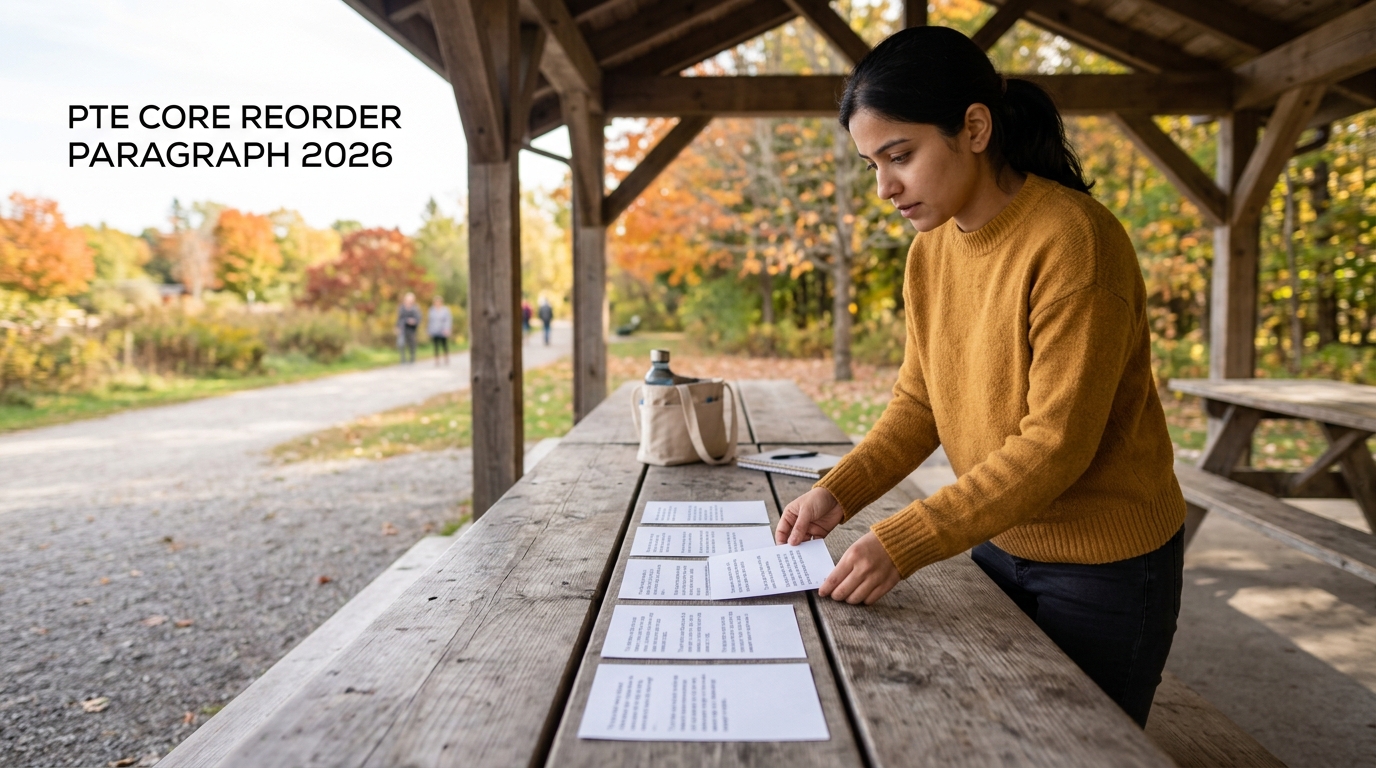
PTE Core Reorder Paragraph tests whether you can recognize how sentences connect to form one logical and coherent text.
You see several text boxes in random order and need to arrange them correctly.
This PTE Core Reorder Paragraph Tips 2026 guide explains the current scoring system, topic sentences, pronouns, linking words, chronological order, sentence pairs and practical solving strategies.
Current Format
Pearson currently states that Reorder Paragraph texts can contain up to 110 words.
The January 2026 Score Guide lists approximately 2–3 questions.
This task affects only Reading.
How Is Reorder Paragraph Scored?
Partial credit applies.
You currently receive:
1 point for each correctly ordered adjacent pair of text boxes.
This is extremely important because you can still earn points even when the entire sequence is not perfect.
What Is an Adjacent Pair?
Imagine the correct order is:
A → B → C → D
The correct adjacent pairs are:
- A-B
- B-C
- C-D
If you arrange A-B-D-C, you may still preserve one correct pair even though the full order is wrong.
Best Strategy
- Read all boxes quickly.
- Identify the overall topic.
- Find the strongest opening sentence.
- Find obvious sentence pairs.
- Track pronouns and references.
- Track linking words.
- Use chronological or cause-effect logic.
- Build small pairs first.
- Join the pairs into the final sequence.
Find the Topic Sentence
Pearson recommends identifying the topic sentence first.
A strong opening sentence normally:
- Introduces the subject clearly
- Can stand alone
- Does not depend on a previous pronoun reference
- Usually does not begin with a contrast linker
Weak Opening Candidates
Sentences beginning with words such as these often require earlier information:
- However
- Therefore
- This
- These
- Such
- He
- She
- They
- For this reason
Pronoun Strategy
If one sentence says:
A new training program was introduced last month.
and another says:
It provides employees with practical computer skills.
the second sentence likely follows the first because it refers to the program.
Article Strategy
A noun may first appear with a/an, then later appear with the.
Example:
A new policy was announced.
The policy will take effect in October.
This creates a strong pair.
Linking Words
Use connectors to identify relationships:
- However → contrast
- Therefore → result
- For example → example
- Additionally → added information
- As a result → consequence
- First/Next/Finally → sequence
Chronological Order
Dates and sequence words can make ordering easier.
Example:
- First, applications opened.
- Applicants were then interviewed.
- Successful candidates began training the following month.
Cause and Effect
A cause generally needs to appear before its result.
Example:
Heavy snow closed several roads.
As a result, buses experienced major delays.
General to Specific
Many paragraphs introduce a broad idea and then provide:
- Explanation
- Evidence
- Examples
- Results
- Conclusion
Build Pairs Instead of Solving Everything at Once
Suppose you are sure B must be followed by D.
Treat B-D as one unit.
Then determine where that pair belongs.
This pair-building method works especially well because Pearson awards credit for correct adjacent pairs.
Common Traps
- Choosing a sentence as the opener because it sounds interesting
- Ignoring pronoun references
- Ignoring articles such as a/the
- Putting “however” first
- Ignoring time sequence
- Trying to order every sentence simultaneously
Daily Practice
Take short paragraphs from articles, separate every sentence and rearrange them randomly.
Then solve them by identifying:
- Opening sentence
- Pronoun pairs
- Article pairs
- Linking words
- Chronology
Related Guides
Official Resource
Pearson PTE Core Reading Format
Final Thoughts
Reorder Paragraph becomes easier when you stop trying to guess the entire order and instead look for strong connections between sentences.
Find the topic sentence, build reliable adjacent pairs, follow references and connectors, then combine those pairs into a logical paragraph.
Leave a Reply