
PTE Core Speaking can feel stressful because you have to listen, think and respond into a microphone while the test continues automatically.
However, improving your speaking score is not about developing a perfect accent or speaking as quickly as possible.
You need clear pronunciation, natural oral fluency, accurate content and the right strategy for each question type.
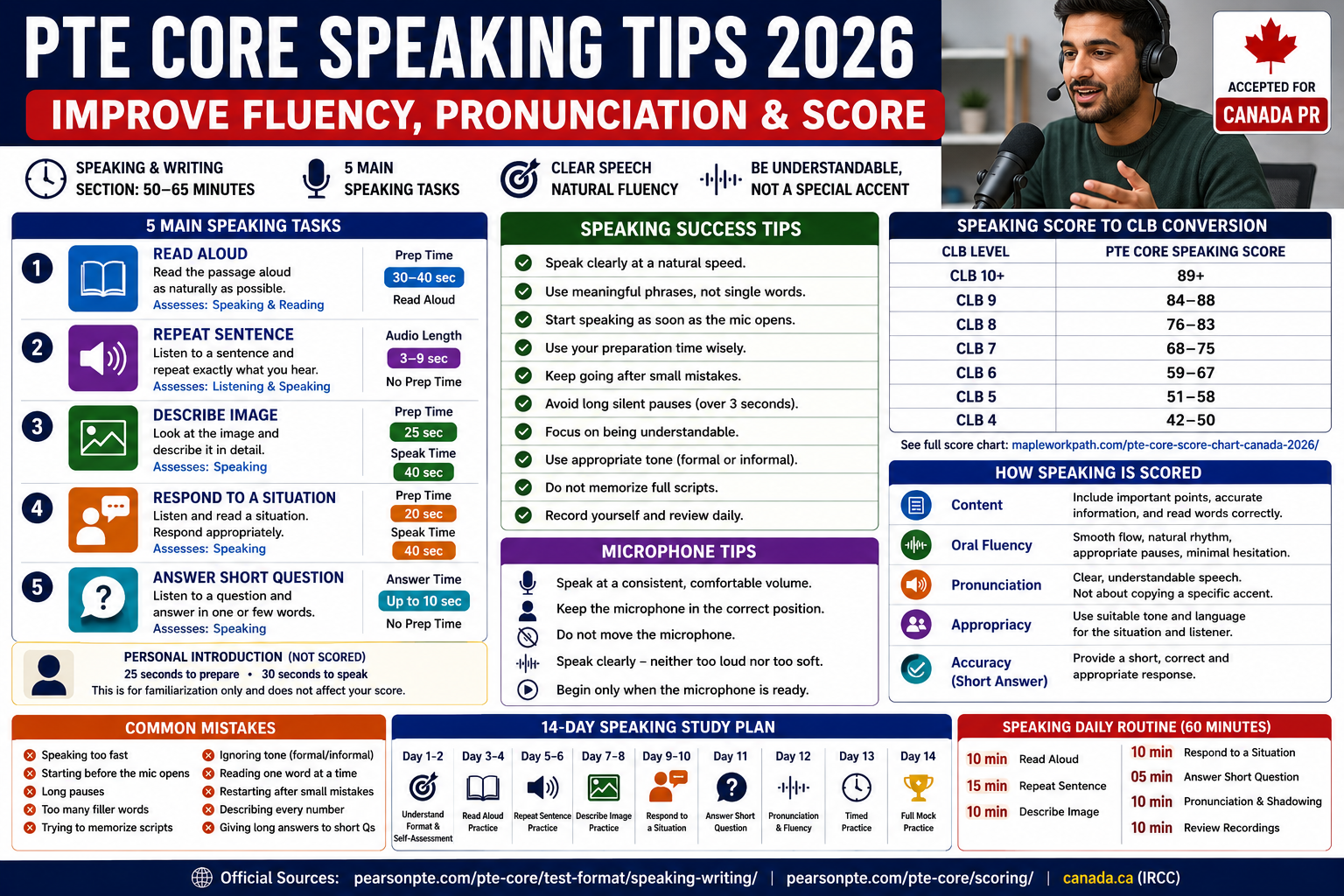
In PTE Core, the main speaking tasks are Read Aloud, Repeat Sentence, Describe Image, Respond to a Situation and Answer Short Question.
This guide explains practical PTE Core Speaking tips for 2026, including pronunciation, oral fluency, microphone technique, preparation time, each speaking question type, common mistakes and a practical 14-day improvement plan.
PTE Core Speaking Format 2026
PTE Core combines Speaking and Writing into the first section of the test.
The complete Speaking & Writing section currently lasts approximately 50 to 65 minutes and contains seven scored question types.
The five main speaking tasks are:
- Read Aloud
- Repeat Sentence
- Describe Image
- Respond to a Situation
- Answer Short Question
The section also contains:
- Summarize Written Text
- Write Email
You can see the full structure in our PTE Core Test Format 2026 guide.
Does the Personal Introduction Affect Your PTE Core Score?
No.
The Personal Introduction at the beginning of the Speaking & Writing section does not contribute to your PTE Core score.
You currently receive:
- 25 seconds to prepare
- 30 seconds to record
Use this opportunity to become comfortable with the microphone and speaking interface.
Do not waste energy trying to give a perfect introduction because it is for familiarization rather than scoring.
What Does PTE Core Measure in Speaking?
Different speaking tasks use different scoring factors.
Depending on the task, Pearson may assess areas such as:
- Content
- Oral fluency
- Pronunciation
- Appropriacy
- Accuracy of your short answer
This is why using the same strategy for every speaking question is not effective.
What Is Oral Fluency in PTE Core?
Oral fluency refers to how smoothly and naturally you speak.
Strong oral fluency generally includes:
- A natural speaking rate
- Appropriate phrasing
- Natural rhythm
- Useful pauses
- Minimal hesitation
- Minimal unnecessary repetition
- Few false starts
Fluency does not mean speaking extremely fast.
If you speak too quickly, your words may become unclear and pronunciation can suffer.
What Does PTE Core Mean by Pronunciation?
Pearson evaluates whether your speech is understandable to regular English speakers.
You do not need to sound Canadian, British, American or Australian.
PTE recognizes regional and national varieties of English pronunciation when the speech remains understandable.
Your goal should therefore be:
- Clear vowels
- Clear consonants
- Correct word stress
- Understandable sentence stress
- Natural phrasing
Trying to imitate an artificial accent can actually make your speech less natural.
1. PTE Core Read Aloud
In Read Aloud, you see a written passage and read it into the microphone.
The text can currently contain up to approximately 60 words.
You generally receive around 30 to 40 seconds to read and prepare before recording begins.
This task assesses both:
- Speaking
- Reading
How Read Aloud Is Scored
Pearson currently evaluates Read Aloud using three important areas:
- Content
- Oral fluency
- Pronunciation
For content, you should read the words that appear in the passage accurately.
Replacing, adding or omitting words can negatively affect content scoring.
Best Read Aloud Strategy
During your preparation time:
- Read the passage once silently.
- Identify difficult words.
- Notice punctuation.
- Divide the passage into meaningful phrases.
- Decide where natural pauses should occur.
- Prepare to begin immediately after the microphone opens.
Use Meaningful Phrases in Read Aloud
Do not read one word at a time.
For example:
Canadian employers / continue to invest in technology / because digital skills / are increasingly important.
Thinking in phrases can make your speech sound much more natural.
Do Not Rush Read Aloud
Speaking extremely fast does not automatically improve fluency.
A good speaking speed should allow you to:
- Pronounce each word clearly
- Use natural stress
- Pause at meaningful points
- Maintain control
A slightly slower but smooth response is usually better than rushing and making frequent pronunciation errors.
Read Aloud Pronunciation Practice
Choose a short English paragraph every day.
Then:
- Read it silently.
- Mark important words.
- Record yourself reading it aloud.
- Listen to your recording.
- Identify unclear words.
- Repeat the passage again.
Compare your second recording with your first.
2. PTE Core Repeat Sentence
In Repeat Sentence, you hear a short sentence and repeat what you heard.
The audio prompt currently lasts approximately 3 to 9 seconds.
The recording plays automatically and only once.
When the audio finishes, the microphone opens.
There is no extra replay.
How Repeat Sentence Is Scored
Pearson assesses Repeat Sentence using:
- Content
- Oral fluency
- Pronunciation
The task contributes to both listening and speaking performance.
This makes Repeat Sentence an important integrated-skill task.
Best Repeat Sentence Strategy
Do not try to memorize every individual word separately.
Listen in meaningful chunks.
Example
If you hear:
The training session has been moved to Friday afternoon.
Think:
The training session / has been moved / to Friday afternoon.
Remembering three chunks is easier than memorizing ten individual words.
Focus on Meaning in Repeat Sentence
Understanding the meaning helps your memory.
While listening, quickly identify:
- Who or what is being discussed?
- What happened?
- When or where did it happen?
If you understand the sentence, you are more likely to reproduce it accurately.
Should You Take Notes for Repeat Sentence?
For very short sentences, writing too much can distract you from listening.
Instead, train your short-term memory.
If a sentence is difficult, you may use extremely short symbols or keywords when useful, but your main focus should remain on listening.
What If You Forget Part of the Sentence?
Do not remain silent trying to remember everything.
Repeat as much accurate content as you can while maintaining natural fluency.
A response containing accurate remembered content is more useful than freezing completely.
Repeat Sentence Daily Exercise
Practice with short English sentences.
Use this method:
- Play one sentence once.
- Do not pause or replay it.
- Repeat it immediately.
- Record your response.
- Compare your response with the original.
- Identify missing or changed words.
Start with short sentences and gradually increase the length.
3. PTE Core Describe Image
In Describe Image, you see a visual and explain what it shows.
You currently receive:
- 25 seconds to study and prepare
- 40 seconds to speak
The image might include:
- A graph
- A chart
- A photograph
- A map
- A diagram
- A process
- Another visual representation
How Describe Image Is Scored
Pearson evaluates:
- Content
- Oral fluency
- Pronunciation
Your description should accurately communicate the main information in the image.
Simply mentioning several disconnected words or numbers is not enough.
Simple Describe Image Structure
Use a flexible four-part structure:
- Introduce the image.
- State the main feature.
- Mention two or three important details.
- Give an overall conclusion.
Example Structure
Introduction: The image shows a bar chart comparing employment across several industries.
Main point: Overall, healthcare has the highest employment level.
Details: Technology is the second-largest sector, while agriculture has the lowest figure.
Conclusion: Overall, the chart shows significant differences between the sectors.
Do Not Memorize One Describe Image Script
A basic structure is useful.
But forcing the same memorized sentences onto every image can create irrelevant responses.
Instead, memorize flexible language such as:
- The image illustrates…
- The most noticeable feature is…
- Another important point is…
- In comparison…
- Overall, the image suggests…
Then adapt these phrases to the actual image.
How to Use the 25 Seconds in Describe Image
Do not try to understand every detail.
During your preparation time, identify:
- Type of image
- Main topic
- Highest or most important feature
- Lowest or contrasting feature
- Two useful details
Write only short keywords on your erasable noteboard if needed.
Do You Need to Mention Every Number?
No.
Trying to read every number from a complicated chart can destroy your fluency.
Prioritize the information that best explains the image.
Choose major trends and comparisons.
4. PTE Core Respond to a Situation
Respond to a Situation tests whether you can communicate appropriately in an everyday situation.
You both hear and read a description of the situation.
You currently receive:
- 20 seconds to prepare
- 40 seconds to speak
The prompt can contain up to approximately 60 words.
How Respond to a Situation Is Scored
This task focuses on:
- Appropriacy
- Oral fluency
- Pronunciation
Appropriacy means your response should fit the person, situation and purpose.
Formal vs Informal Speaking
You need to understand who you are talking to.
Formal Situation
If you are speaking to a manager, teacher, customer or unfamiliar person, you might say:
Hello, I’m sorry to disturb you. I’m calling because I need to discuss…
Informal Situation
If you are speaking to a friend, you might say:
Hi, I just wanted to ask if you could…
The information can be similar, but your language should suit the relationship.
Best Respond to a Situation Structure
Use this simple structure:
- Appropriate greeting
- Reason for speaking
- Important information from the prompt
- Your request, solution or response
- Polite closing
Example
Imagine you need to tell your supervisor that you will arrive late because of a transportation problem.
A response could follow this structure:
Hello, I’m calling to let you know that my bus has been delayed and I may arrive about twenty minutes late for my shift. I apologize for the inconvenience. I’m already on my way and I’ll get there as soon as possible. Thank you for understanding.
Do Not Describe What You Would Say
A common mistake is saying:
I would tell my manager that I will be late.
Instead, speak directly as though you are actually talking to the person:
Hello, I wanted to let you know that I may be late today…
This makes your response more appropriate to the task.
Use All Important Prompt Information
During your 20 seconds of preparation, identify the essential points.
For example:
- Who am I speaking to?
- Why am I contacting them?
- What happened?
- What do I need from them?
- Should my tone be formal or informal?
Missing an important prompt requirement can weaken the response.
5. PTE Core Answer Short Question
In Answer Short Question, you listen to a simple question and answer with one word or a few words.
The audio prompt currently lasts approximately 3 to 9 seconds.
You have up to approximately 10 seconds to answer.
Your answer should be short and accurate.
How Answer Short Question Is Scored
This question is scored as correct or incorrect based on the appropriateness and accuracy of your answer.
There are no extra points for giving a long response.
Example
Question:
What do we call the person who flies an airplane?
Good answer:
Pilot.
You do not need to give a complete speech.
Start Answer Short Question Quickly
When the audio finishes, the microphone opens immediately.
You should begin answering promptly.
Pearson warns that a long silence of around three seconds can cause the recording to stop.
This is another reason to keep your answer short.
How to Practice Answer Short Question
Build everyday general vocabulary around topics such as:
- Jobs
- Transportation
- Weather
- Food
- Health
- Education
- Technology
- Places
- Common objects
- Measurements
- Daily life
Practice answering immediately instead of translating the question into another language first.
PTE Core Speaking Microphone Tips
Your microphone technique matters because the test needs to capture your speech clearly.
On test day:
- Position the microphone according to the test-center instructions.
- Do not constantly move the microphone.
- Speak at a consistent volume.
- Do not shout.
- Do not whisper.
- Begin only when the microphone is recording.
- Continue speaking without unnecessary long pauses.
Do Not Start Before the Microphone Opens
For tasks such as Read Aloud and Describe Image, starting too early can cause the beginning of your response not to be recorded.
Watch the recording status carefully.
Begin when the microphone is ready.
How Loud Should You Speak?
Use a comfortable conversational volume.
Imagine you are speaking to someone sitting across a small table from you.
Your voice should be:
- Clear
- Steady
- Natural
- Easy to understand
How to Improve PTE Core Pronunciation
Do not attempt to change your entire accent.
Instead, work on intelligibility.
Focus on:
- Ending consonants
- Long and short vowel differences
- Word stress
- Plural endings
- Past-tense endings
- Common difficult sounds
Use Shadowing to Improve Pronunciation
Shadowing means listening to a native or proficient speaker and repeating immediately after them.
Use short recordings.
Practice this sequence:
- Listen to one sentence.
- Repeat it.
- Imitate the rhythm.
- Imitate word stress.
- Record yourself.
- Compare the two versions.
Ten minutes of focused shadowing every day can improve your awareness of natural English rhythm.
How to Improve Oral Fluency
One of the biggest fluency problems is repeatedly stopping to correct yourself.
If you make a minor mistake, continue.
Constantly saying:
Sorry… I mean… actually… let me start again…
breaks your flow.
Instead, keep communicating the idea.
Reduce Filler Words
Common filler words include:
- Um
- Uh
- You know
- Like
- Actually
- Basically
A few natural fillers are not the end of the world, but excessive use can make your speech sound hesitant.
Use short natural pauses instead.
Do Not Pause After Every Word
Compare:
Weak rhythm:
The / graph / shows / information / about / employment.
Better rhythm:
The graph shows information / about employment across different industries.
Speaking in meaningful groups improves fluency.
Practice Speaking Without Restarting
Set a timer for 40 seconds.
Choose a simple topic such as:
- Your hometown
- A workplace problem
- A photograph
- Transportation
- Education
Speak continuously for the full period.
If you make a mistake, continue rather than restarting.
Should You Memorize PTE Core Speaking Templates?
Templates can help you organize your thoughts.
But memorizing a long script word-for-word can be risky.
The response must still match the actual prompt.
A better strategy is to memorize flexible structures.
Describe Image Flexible Structure
The image illustrates ____. The most noticeable feature is ____. Another important point is ____. In comparison, ____. Overall, the image shows ____.
Respond to a Situation Flexible Structure
Hello ____. I’m contacting you because ____. The situation is ____. I would like to ____. I would appreciate your help. Thank you for understanding.
Change the wording naturally according to the actual situation.
Do Not Use a Template That Does Not Match
If the question asks you to apologize to your manager, your answer should sound like an apology.
If it asks you to invite a friend, your answer should sound like an invitation.
A memorized response that ignores the situation can hurt appropriacy and content.
How PTE Core Speaking Scores Convert to CLB
For Canadian immigration, your PTE Core Speaking score is converted to a Canadian Language Benchmark level.
Current important Speaking ranges include:
| CLB Level | PTE Core Speaking |
|---|---|
| CLB 10+ | 89+ |
| CLB 9 | 84–88 |
| CLB 8 | 76–83 |
| CLB 7 | 68–75 |
| CLB 6 | 59–67 |
| CLB 5 | 51–58 |
| CLB 4 | 42–50 |
Use our complete PTE Core Score Chart Canada 2026 to compare Speaking, Listening, Reading and Writing.
What PTE Core Speaking Score Is CLB 9?
The current PTE Core Speaking range for CLB 9 is:
84–88.
A Speaking score of 89 or higher currently falls within CLB 10 or above.
Why CLB 9 Matters for Express Entry
For many Express Entry candidates, CLB 9 can be valuable because stronger language ability can increase core language points and skill-transferability points.
Your exact CRS benefit depends on your complete profile.
Read our Express Entry Canada 2026 guide for more information.
PTE Core Speaking for Canadian Experience Class
Canadian Experience Class language requirements depend on the TEER category of your qualifying occupation.
CEC currently requires:
- CLB 7 for TEER 0 or TEER 1
- CLB 5 for TEER 2 or TEER 3
That means the current minimum PTE Core Speaking scores are:
- TEER 0 or 1: Speaking 68
- TEER 2 or 3: Speaking 51
Read our Canadian Experience Class 2026 guide for the complete program requirements.
What If Speaking Is Your Weakest PTE Core Skill?
First identify the reason.
A low speaking score may come from:
- Unclear pronunciation
- Frequent hesitation
- Speaking too quickly
- Speaking too slowly
- Weak short-term listening memory
- Difficulty organizing Describe Image
- Missing prompt information in Respond to a Situation
- Long pauses
- Poor microphone habits
Your preparation should target the actual weakness rather than simply completing more full mock tests.
Record Yourself Every Day
This is one of the easiest ways to find speaking problems.
Record one or two minutes of yourself speaking English.
Then listen for:
- Long pauses
- Repeated words
- Unclear pronunciation
- Very fast sections
- Very slow sections
- Frequent filler words
Pick one weakness and improve it during the next recording.
14-Day PTE Core Speaking Improvement Plan
Days 1–2: Understand the Speaking Format
- Learn all five speaking tasks.
- Understand preparation and response times.
- Record a speaking diagnostic.
- Identify your weakest tasks.
Days 3–4: Read Aloud
- Practice phrase grouping.
- Practice word stress.
- Record 10–15 short passages.
- Focus on smooth, natural reading.
Days 5–6: Repeat Sentence
- Practice listening in chunks.
- Use short-term memory exercises.
- Repeat sentences after hearing them only once.
- Review omitted words.
Days 7–8: Describe Image
- Practice charts.
- Practice photographs.
- Practice maps and diagrams.
- Use a flexible structure rather than a rigid script.
- Practice speaking for approximately 40 seconds.
Days 9–10: Respond to a Situation
- Practice formal situations.
- Practice informal situations.
- Identify the purpose quickly.
- Cover every important prompt point.
Day 11: Answer Short Question
- Practice everyday vocabulary.
- Answer immediately.
- Keep responses short.
Day 12: Pronunciation & Fluency
- Practice shadowing.
- Practice sentence stress.
- Reduce filler words.
- Practice speaking without restarting.
Day 13: Timed Speaking Practice
- Complete all speaking task types.
- Use real preparation times.
- Record every response.
- Review your biggest mistakes.
Day 14: Full Mock Practice
- Complete an exam-style session.
- Do not pause or restart tasks.
- Use your microphone correctly.
- Review pronunciation and fluency afterwards.
Daily PTE Core Speaking Routine
A practical daily routine can look like this:
- 10 minutes Read Aloud
- 15 minutes Repeat Sentence
- 10 minutes Describe Image
- 10 minutes Respond to a Situation
- 5 minutes Answer Short Question
- 10 minutes pronunciation and shadowing
- 10 minutes reviewing your recordings
If you have less time, shorten each section but continue recording and reviewing your speech.
Common PTE Core Speaking Mistakes
- Trying to speak extremely fast
- Stopping after every word
- Restarting after small mistakes
- Using too many filler words
- Trying to imitate an unnatural accent
- Starting before the microphone opens
- Leaving long silent pauses
- Reading words incorrectly in Read Aloud
- Trying to memorize Repeat Sentence word by word
- Describing every small number in Describe Image
- Using a rigid memorized template for every image
- Ignoring formal and informal tone in Respond to a Situation
- Describing what you would say rather than speaking directly
- Giving a long response to Answer Short Question
- Never listening to your own practice recordings
PTE Core Speaking Test-Day Tips
- Stay calm during the microphone check.
- Use the Personal Introduction to become comfortable.
- Watch when the microphone opens.
- Start speaking promptly.
- Speak clearly at a natural speed.
- Use meaningful pauses.
- Keep going after small mistakes.
- Use all preparation time efficiently.
- Do not compare your voice with other test takers.
- Focus only on the question on your screen.
Do Other People Speak During the Test?
PTE is completed in a test-center environment where other candidates may also be speaking.
Practice while there is some background noise so that you can maintain concentration.
During the test, focus on your headset, microphone and screen rather than listening to other candidates.
Should You Shout to Make the Computer Hear You?
No.
A normal, clear speaking volume is enough.
Speaking too loudly can make you uncomfortable and may reduce natural pronunciation.
Use the microphone setup provided at the test center correctly.
Can You Replay Your PTE Core Speaking Answer?
No.
Speaking responses are generally recorded once.
You cannot finish a response and then decide to record a better version.
This is why realistic one-attempt practice is important.
Can You Replay Repeat Sentence Audio?
No.
The recording plays once.
You need to listen carefully the first time and respond when the microphone opens.
Official PTE Core Speaking Resources
Pearson provides official instructions, examples and scoring explanations for all PTE Core speaking question types.
Use Pearson’s official PTE Core Speaking & Writing format page.
You can also review Pearson’s official PTE Core scoring information.
PTE Core Speaking 2026 Checklist
- I know all five main speaking question types.
- I understand oral fluency.
- I understand that a special accent is not required.
- I know how to use Read Aloud preparation time.
- I practice Repeat Sentence using chunks.
- I have a flexible Describe Image structure.
- I can identify formal and informal situations.
- I keep Answer Short Question responses short.
- I practice speaking into a microphone.
- I avoid long pauses.
- I record and review my practice responses.
- I know my target PTE Core Speaking score.
- I know which CLB level I need for my immigration pathway.
Final Thoughts
Improving your PTE Core Speaking score requires clear pronunciation, natural fluency and an appropriate strategy for each task.
Read Aloud rewards accurate reading, oral fluency and pronunciation.
Repeat Sentence tests your ability to listen, remember and reproduce spoken English smoothly.
Describe Image requires you to organize the most important visual information and communicate it clearly.
Respond to a Situation requires you to understand the context and speak appropriately to the person in the prompt.
Answer Short Question rewards short and accurate responses rather than unnecessary long answers.
You do not need a perfect accent.
Your priority should be speaking clearly enough to be understood, maintaining natural rhythm and reducing unnecessary hesitation.
Practice every day, record yourself and review your mistakes instead of simply repeating hundreds of questions without analysis.
If CLB 9 is your immigration target, the current PTE Core Speaking range is 84–88.
Use our PTE Core Score Chart Canada 2026 to check the required scores for all four abilities.
Before your exam, always verify the latest PTE Core format and scoring instructions directly through Pearson.
Leave a Reply