
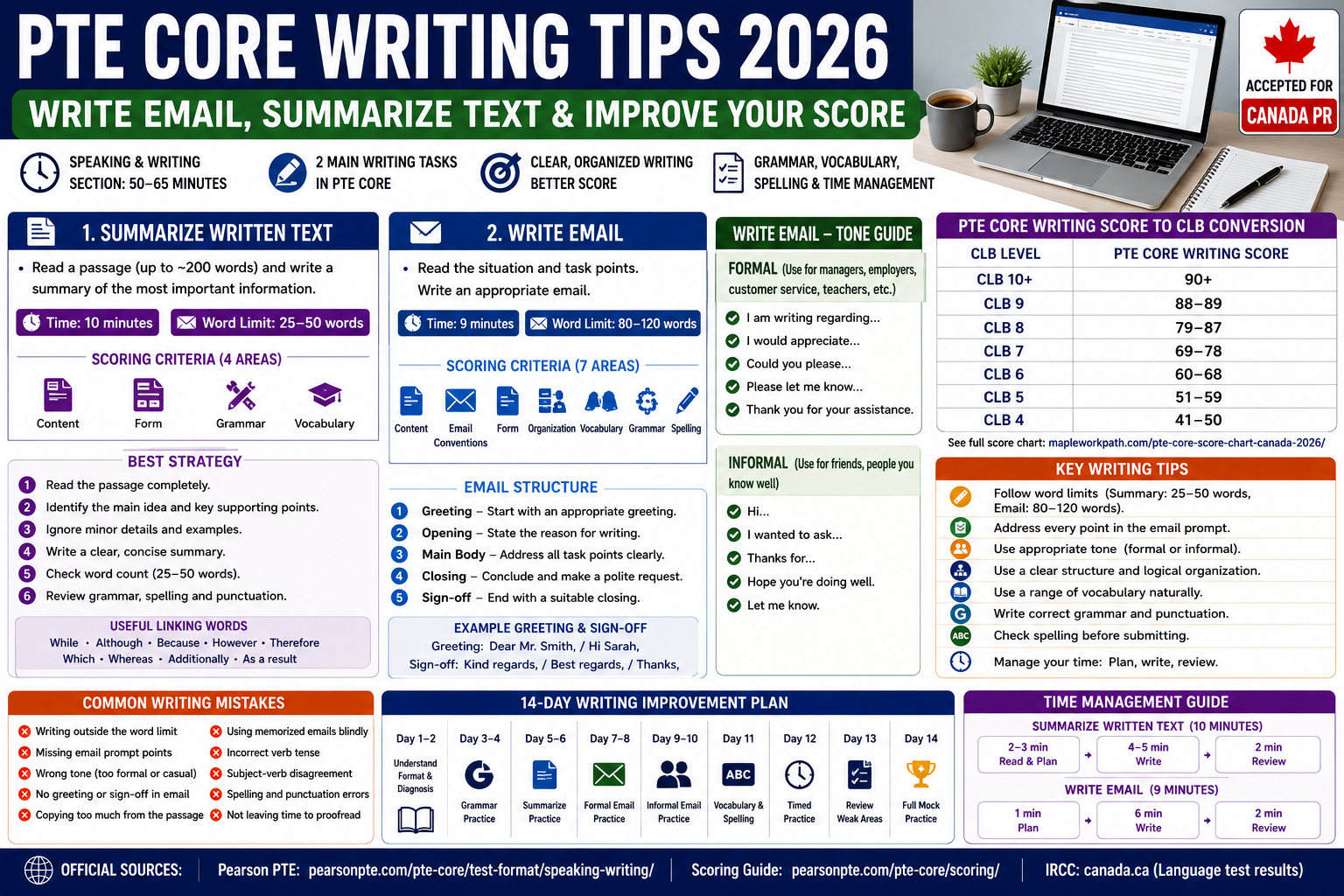
PTE Core Writing can be challenging because you need to understand a prompt quickly, organize your ideas, use correct grammar and vocabulary, stay within the required word limit and finish before the timer ends.
The good news is that PTE Core Writing becomes much easier once you understand exactly how each writing task works.
The two dedicated writing tasks in the Speaking & Writing section are:
- Summarize Written Text
- Write Email
Your Writing score can also be influenced by integrated tasks elsewhere in PTE Core, so strong grammar, vocabulary and spelling can help across different parts of the test.
This guide explains practical PTE Core Writing tips for 2026, including Summarize Written Text, Write Email, word limits, scoring, grammar, vocabulary, email structure, proofreading, common mistakes and a practical 14-day study plan.
PTE Core Writing Format 2026
PTE Core combines Speaking and Writing in Part 1 of the test.
The complete Speaking & Writing section currently takes approximately 50 to 65 minutes and contains seven question types.
The two dedicated writing question types are:
- Summarize Written Text – approximately 1–2 questions
- Write Email – approximately 2–3 questions
You can see all 19 test question types in our PTE Core Test Format 2026 guide.
1. PTE Core Summarize Written Text
In Summarize Written Text, you read a passage and write a short summary containing the most important information.
The reading passage can currently contain up to approximately 200 words.
You have:
10 minutes
to complete each response.
Pearson instructs you to write:
25 to 50 words.
This task assesses both:
- Reading
- Writing
How Summarize Written Text Is Scored
The current Pearson scoring criteria focus on four areas:
- Content
- Form
- Grammar
- Vocabulary
Content
Your summary should accurately communicate the main idea and the essential supporting information.
Do not include every example or small detail from the passage.
Form
Follow the instructed 25–50 word range.
This is one of the easiest parts of the task to control, so always check the word counter before submitting.
Grammar
Your response should use correct sentence structure.
A grammatically correct compound or complex sentence can help you connect several important ideas efficiently.
Vocabulary
Your vocabulary should fit the meaning of the passage.
Use synonyms where they are natural, but do not replace words with complicated vocabulary that changes the original meaning.
Best Strategy for Summarize Written Text
Use this step-by-step method:
- Read the entire passage once.
- Identify the main topic.
- Find the central argument or message.
- Identify one or two essential supporting ideas.
- Ignore minor examples and unnecessary details.
- Write a concise summary.
- Check the word count.
- Check grammar, spelling and punctuation.
Find the Main Idea First
Before writing anything, ask yourself:
What is the writer mainly trying to explain?
If you cannot answer that question in one simple sentence, read the passage again before you begin writing.
The summary should focus on the main message rather than a random detail from the middle of the passage.
How to Identify Important Supporting Points
Look for information that explains:
- Why something happened
- What the main result was
- What problem is being discussed
- What solution is proposed
- What major comparison is being made
Examples, dates and statistics should normally be included only when they are essential to understanding the main point.
Simple Summarize Written Text Structure
A useful flexible structure is:
The passage explains that [main idea], highlighting [supporting idea 1] and [supporting idea 2], which shows that [overall result or conclusion].
Do not copy this structure blindly for every question.
Use it only as a framework and adapt it to the actual passage.
Example of a Strong Summary
Imagine a passage explaining that remote work has become more common because digital technology has improved, while employers are also trying to balance flexibility with collaboration.
A possible summary might be:
Remote work has expanded because digital technology allows employees to work efficiently from different locations, while organizations are developing flexible workplace policies that balance employee independence with communication, teamwork and business productivity.
This response identifies the main idea and supporting information without repeating every detail.
Do Not Copy the Whole Passage
You may use important terminology from the passage, but your summary should demonstrate that you understand the information.
Avoid copying several complete sentences and simply joining them together.
Instead:
- Identify the ideas
- Combine related information
- Remove repetition
- Use concise language
Should Summarize Written Text Be One Sentence?
Pearson allows one or more complete sentences.
A single well-constructed compound or complex sentence can work well because the response is only 25–50 words.
However, do not force everything into one extremely complicated sentence if it causes grammar problems.
Accuracy is more important than complexity.
Useful Linking Words for Summaries
Useful connectors include:
- While
- Although
- Because
- However
- Therefore
- Which
- Whereas
- Additionally
- As a result
Use them only when the relationship between ideas is correct.
Summarize Written Text Time Management
You have 10 minutes, so a practical breakdown is:
- 2–3 minutes: read and identify key ideas
- 4–5 minutes: write the summary
- 2 minutes: check and improve
Do not spend eight minutes reading and leave yourself only two minutes to write.
2. PTE Core Write Email
Write Email tests your ability to communicate clearly and appropriately in an everyday situation.
You receive a prompt describing a situation and usually several points that your email should address.
The prompt can currently contain up to approximately 100 words.
You have:
9 minutes
to complete the email.
Pearson’s task instructions tell candidates to write:
80 to 120 words.
How Write Email Is Scored
Pearson currently evaluates Write Email using seven factors:
- Content
- Email conventions
- Form
- Organization
- Vocabulary
- Grammar
- Spelling
Content
Your response needs to answer the actual task.
If the prompt contains three points, make sure all three are covered.
Email Conventions
Your response should look and sound like an email.
This generally includes:
- Appropriate greeting
- Clear introduction
- Organized body
- Conclusion
- Farewell or sign-off
Form
Follow the task instruction and aim for 80–120 words.
Do not deliberately write an extremely short or excessively long email.
Organization
Your ideas should appear in a logical order.
Keep related information together and use paragraphs where useful.
Vocabulary
Use vocabulary appropriate to the situation.
A formal workplace email should sound different from a casual email to a friend.
Grammar
Use clear and grammatically correct sentences.
You do not need extremely complicated grammar to score well.
Spelling
Check spelling before submitting.
PTE Core recognizes major English spelling conventions, but you should use one convention consistently within your response.
Simple PTE Core Email Structure
Use this reliable structure:
1. Greeting
Examples:
Dear Mr. Smith,
Dear Customer Service Team,
Hi Sarah,
2. Opening Sentence
Immediately explain why you are writing.
Examples:
I am writing to ask about…
I am contacting you regarding…
I wanted to let you know that…
3. Main Body
Address each point from the prompt.
If the prompt asks you to:
- Explain a problem
- Describe what happened
- Request a solution
make sure your email clearly covers all three.
4. Closing Sentence
Examples:
I would appreciate your assistance with this matter.
Please let me know if you require any additional information.
I look forward to hearing from you.
5. Sign-Off
Examples:
Kind regards,
Alex
Best regards,
Alex
Thanks,
Alex
Example PTE Core Formal Email
Imagine that you purchased a product online but received the wrong item.
A strong response might look like this:
Dear Customer Service Team,
I am writing regarding an order I received yesterday. I ordered a black winter jacket in size medium, but the package contained a blue jacket in size large. I would like to exchange the item for the correct product as soon as possible. Please let me know how I can return the incorrect jacket and whether a prepaid return label is available. I have kept the original packaging and receipt.
Thank you for your assistance. I look forward to your response.
Kind regards,
Alex
Formal vs Informal Email
Your tone needs to match the situation.
Formal Email
Use formal or neutral language when writing to:
- Manager
- Employer
- Teacher
- Landlord
- Customer service representative
- Government office
- Someone you do not know well
Examples:
- I would appreciate…
- Could you please…
- I am writing regarding…
- Please let me know…
Informal Email
When writing to a friend or someone you know well, language can be more relaxed.
Examples:
- Hi…
- Thanks for…
- I wanted to ask…
- Hope you’re doing well.
Still use correct grammar and clear organization.
How to Analyze the Email Prompt
Before writing, identify four things:
- Who am I writing to?
- Why am I writing?
- Which points must I include?
- Should my tone be formal or informal?
This takes less than a minute and can prevent you from writing an irrelevant response.
Use the Three Prompt Points as Your Plan
If the email contains three bullet points, use them as your outline.
For example:
- Paragraph 1: reason for writing
- Paragraph 2: first and second required points
- Paragraph 3: final requirement and request
This helps you avoid forgetting an important part of the task.
Write Email Time Management
You only have nine minutes.
A practical approach is:
- 1 minute: analyze the prompt
- 6 minutes: write
- 2 minutes: proofread
Do not spend several minutes trying to create a perfect opening sentence.
Start clearly and move through all required points.
Why Proofreading Matters
A short proofreading period can catch easy mistakes such as:
- Missing word
- Wrong verb tense
- Subject-verb disagreement
- Spelling error
- Missing punctuation
- Forgotten prompt point
- Incorrect greeting
- Word-count problem
Grammar Topics to Improve for PTE Core Writing
Focus on grammar that you actually need in everyday writing.
Important areas include:
- Subject-verb agreement
- Verb tense
- Articles
- Singular and plural nouns
- Prepositions
- Pronouns
- Sentence fragments
- Run-on sentences
- Comma use
- Compound sentences
- Complex sentences
Subject-Verb Agreement
Incorrect:
The employees is requesting new equipment.
Correct:
The employees are requesting new equipment.
Always identify whether the subject is singular or plural.
Use the Correct Verb Tense
If you are explaining something that already happened, use an appropriate past tense.
Example:
I ordered the product last Monday, but it arrived damaged.
If you are making a request about the future:
I would appreciate it if you could send a replacement.
Avoid Sentence Fragments
Weak:
Because the bus was late.
This is incomplete.
Better:
I arrived late because the bus was delayed.
Avoid Extremely Long Sentences
Do not connect every idea with “and.”
Long sentences increase your chance of grammar and punctuation mistakes.
Use a mixture of:
- Simple sentences
- Compound sentences
- Complex sentences
Vocabulary Tips for PTE Core Writing
You do not need to use extremely advanced vocabulary.
Your priority should be:
- Correct meaning
- Appropriate tone
- Natural word combinations
- Variety without unnecessary complexity
For example, instead of repeatedly using “good,” you may use:
- Useful
- Effective
- Helpful
- Suitable
- Positive
But only choose a synonym when it correctly fits the sentence.
Useful Formal Email Vocabulary
- I am writing regarding…
- I would like to request…
- I would appreciate…
- Unfortunately…
- I apologize for…
- Could you please confirm…
- Please let me know…
- Thank you for your assistance.
- I look forward to your response.
Do Not Memorize Full Emails
Memorizing one complete email and forcing it into every prompt is risky.
Pearson evaluates whether your content genuinely addresses the task.
Instead, memorize flexible phrases and structures.
Then adapt them to the actual situation.
Can Memorized Material Hurt Your Score?
Yes.
If a response contains large amounts of pre-prepared material that do not properly answer the prompt, the response may be judged irrelevant.
This is why understanding the task is more important than memorizing long templates.
Improve Spelling for PTE Core Writing
Keep a list of words you regularly spell incorrectly.
Common examples might include:
- Necessary
- Separate
- Accommodation
- Environment
- Opportunity
- Recommendation
- Available
- Successful
- Experience
- Receive
Practice typing these words rather than only reading them.
Typing Speed and PTE Core Writing
You do not need extremely fast typing skills, but slow typing can make nine-minute emails difficult.
Practice typing English for 10–15 minutes each day.
Focus on:
- Accuracy first
- Then speed
- Correct punctuation
- Correct capitalization
Integrated Tasks Can Also Affect Writing
Your PTE Core Writing score is not based only on the two dedicated writing tasks.
Some integrated question types can also contribute to Writing performance.
Examples include:
- Reading & Writing: Fill in the Blanks
- Summarize Written Text
- Summarize Spoken Text
- Listening Fill in the Blanks
- Write from Dictation
This means improving grammar, spelling and vocabulary can support multiple areas of the test.
Our PTE Core Reading Tips 2026 guide explains Reading & Writing Fill in the Blanks in more detail.
How PTE Core Writing Converts to CLB
For Canadian immigration, IRCC converts your individual PTE Core Writing score into a Canadian Language Benchmark level.
| CLB Level | PTE Core Writing |
|---|---|
| CLB 10+ | 90+ |
| CLB 9 | 88–89 |
| CLB 8 | 79–87 |
| CLB 7 | 69–78 |
| CLB 6 | 60–68 |
| CLB 5 | 51–59 |
| CLB 4 | 41–50 |
See our complete PTE Core Score Chart Canada 2026 for Speaking, Listening, Reading and Writing.
What PTE Core Writing Score Is CLB 9?
The current PTE Core Writing range for CLB 9 is:
88–89.
A Writing score of 90 or higher currently corresponds to CLB 10 or above.
PTE Core Writing for Canadian Experience Class
The Canadian Experience Class currently requires:
- CLB 7 in all four abilities for TEER 0 or 1 occupations
- CLB 5 in all four abilities for TEER 2 or 3 occupations
For PTE Core Writing, this means minimum scores of:
- TEER 0 or 1: Writing 69
- TEER 2 or 3: Writing 51
You can read our Canadian Experience Class 2026 guide for complete requirements.
Why CLB 9 Can Matter for Express Entry
For many Express Entry candidates, reaching CLB 9 can provide stronger language and skill-transferability points.
Your exact CRS improvement depends on your complete profile.
Read our Express Entry Canada 2026 guide for more information.
14-Day PTE Core Writing Improvement Plan
Days 1–2: Understand the Format
- Learn Summarize Written Text requirements.
- Learn Write Email requirements.
- Complete one diagnostic writing session.
- Identify grammar and spelling weaknesses.
Days 3–4: Grammar
- Review subject-verb agreement.
- Review verb tenses.
- Practice articles and prepositions.
- Correct old writing mistakes.
Days 5–6: Summarize Written Text
- Practice finding main ideas.
- Practice removing unnecessary details.
- Write within 25–50 words.
- Review grammar after each response.
Days 7–8: Formal Emails
- Practice complaints.
- Practice requests.
- Practice workplace emails.
- Practice customer-service situations.
Days 9–10: Informal and Semi-Formal Emails
- Practice invitations.
- Practice giving information.
- Practice apologies.
- Practice making arrangements.
Day 11: Vocabulary and Spelling
- Review useful email phrases.
- Review frequently misspelled words.
- Practice paraphrasing.
Day 12: Timed Practice
- Complete summaries in 10 minutes.
- Complete emails in 9 minutes.
- Do not pause the timer.
Day 13: Review Weak Areas
- Review your mistakes.
- Rewrite weak responses.
- Check repeated grammar errors.
Day 14: Full Writing Practice
- Complete exam-style tasks.
- Follow word limits.
- Use realistic timing.
- Proofread before finishing.
Daily PTE Core Writing Routine
A useful daily session can include:
- 10 minutes grammar
- 10 minutes vocabulary and spelling
- 20 minutes Summarize Written Text
- 20 minutes Write Email
- 10 minutes reviewing mistakes
If you have less time, reduce the number of tasks but continue reviewing your mistakes.
Common PTE Core Writing Mistakes
- Writing outside the instructed word range
- Missing an email prompt point
- Using the wrong formal or informal tone
- Writing without a greeting or sign-off
- Copying too much from a passage
- Using memorized material that does not fit the task
- Writing extremely complicated sentences with many errors
- Using incorrect verb tense
- Ignoring spelling
- Not leaving time to proofread
- Using the same vocabulary repeatedly
- Writing a summary that focuses on examples instead of the main idea
PTE Core Writing Test-Day Checklist
- I know Summarize Written Text is instructed at 25–50 words.
- I know I have 10 minutes for each summary.
- I know Write Email instructs 80–120 words.
- I know I have 9 minutes for each email.
- I check every point in the email prompt.
- I use an appropriate greeting and sign-off.
- I choose formal or informal language correctly.
- I check grammar.
- I check spelling.
- I check punctuation.
- I leave time for proofreading.
- I know my target PTE Core Writing score.
Official PTE Core Writing Resources
Always verify the latest test format and scoring rules using Pearson’s official information.
Use Pearson’s PTE Core Speaking & Writing format page.
You can also review the official PTE Core scoring guide.
For Canadian immigration score conversion, check IRCC’s official language test results page.
Final Thoughts
Improving your PTE Core Writing score requires a combination of task knowledge, grammar, vocabulary, spelling, organization and time management.
For Summarize Written Text, focus on identifying the main idea, selecting only essential supporting information and staying within the instructed 25–50 word range.
For Write Email, analyze the situation carefully, address every prompt requirement, use an appropriate tone and aim for the instructed 80–120 words.
Do not depend on long memorized templates.
Instead, learn flexible structures and useful phrases that you can adapt to the actual question.
Practice under realistic time limits and review your mistakes after every session.
If CLB 9 is your Canadian immigration target, the current PTE Core Writing range is 88–89.
You can use our PTE Core Score Chart Canada 2026 to check the required score for every language ability.
Before your examination, always verify the latest PTE Core test format and scoring information directly through Pearson.
Leave a Reply