
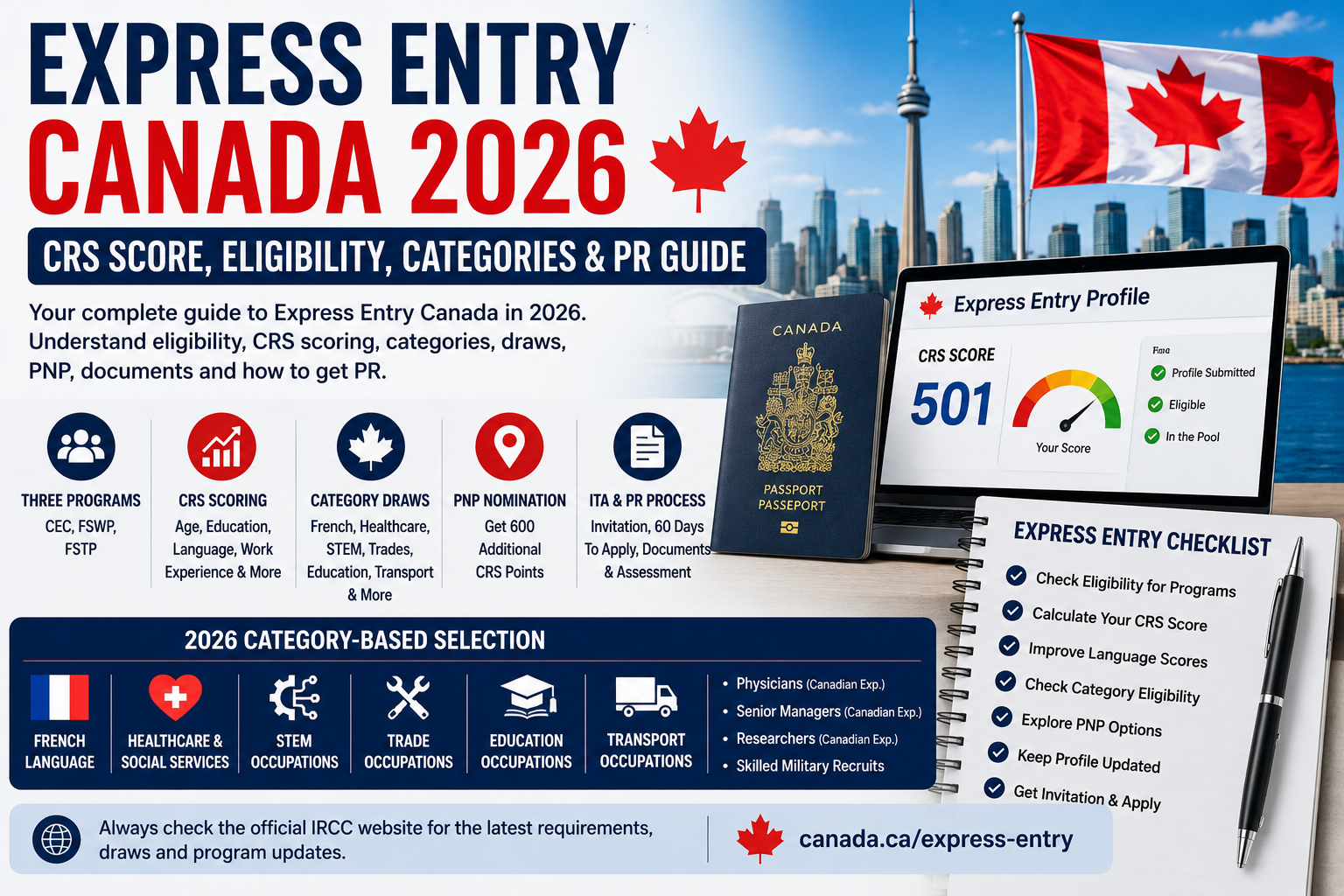
Express Entry is one of Canada’s main systems for managing permanent residence applications from skilled workers.
But Express Entry is not a single immigration program.
It is an online system used by Immigration, Refugees and Citizenship Canada, commonly called IRCC, to manage candidates under several economic immigration programs and rank eligible candidates using the Comprehensive Ranking System, or CRS.
In 2026, understanding Express Entry requires more than simply checking one CRS score. You need to know which immigration program you qualify for, how your CRS score is calculated, whether you fit a category-based selection category and what happens if you receive an Invitation to Apply.
This guide explains Express Entry Canada in 2026 step by step.
Express Entry Canada 2026: Quick Answer
Express Entry manages applications for three federal programs: the Canadian Experience Class, Federal Skilled Worker Program and Federal Skilled Trades Program. You must qualify for at least one program before entering the pool.
There is no permanent minimum CRS invitation score. Every round can have a different cut-off based on its type, the number of invitations and the candidates in the pool. Meeting a category’s requirements also does not guarantee an invitation.
For the latest score, date and round type, check IRCC’s official Express Entry rounds of invitations.
Current Express Entry Categories for 2026
IRCC currently lists these category-based selection categories:
- French-language proficiency
- Healthcare and social services occupations
- Science, technology, engineering and mathematics (STEM) occupations
- Trade occupations
- Education occupations
- Transport occupations
- Physicians with Canadian work experience
- Senior managers with Canadian work experience
- Researchers with Canadian work experience
- Skilled military recruits
For most occupation-based categories, the current rules generally require 12 months of full-time-equivalent work experience in one listed occupation during the past three years. Some categories specifically require Canadian work experience. Confirm your occupation and the complete requirements on IRCC’s current category-based selection page.
Express Entry Process at a Glance
- Confirm that you qualify for at least one Express Entry program.
- Identify the correct NOC and TEER for your work experience.
- Complete an approved language test and obtain an ECA if required.
- Calculate your estimated CRS score.
- Create an accurate profile and enter the pool if eligible.
- Monitor general, program-specific and category-based rounds.
- Submit a complete application only after receiving an Invitation to Apply.
What Is Express Entry Canada?
Express Entry is the Government of Canada’s online system for managing applications from skilled workers who want to become permanent residents.
The basic process is:
- Determine whether you qualify for an Express Entry immigration program.
- Create an Express Entry profile.
- Enter the Express Entry pool if you are eligible.
- Receive a Comprehensive Ranking System score.
- Wait for an eligible invitation round.
- Receive an Invitation to Apply if your profile is selected.
- Submit a complete permanent residence application.
- IRCC assesses your application and admissibility.
Creating an Express Entry profile does not guarantee permanent residence or an invitation.
Which Immigration Programs Use Express Entry?
Express Entry currently manages three federal economic immigration programs:
- Canadian Experience Class
- Federal Skilled Worker Program
- Federal Skilled Trades Program
Candidates who qualify for one of these programs may enter the Express Entry pool.
Eligible candidates can also be connected with an Express Entry-aligned Provincial Nominee Program.
1. Canadian Experience Class
The Canadian Experience Class, or CEC, is designed for skilled workers who have qualifying Canadian work experience.
CEC applicants generally need at least one year of eligible Canadian work experience gained during the previous three years in an occupation classified as TEER 0, 1, 2 or 3.
The minimum language requirement depends on the TEER category:
- TEER 0 or 1: CLB 7 in English or NCLC 7 in French
- TEER 2 or 3: CLB 5 in English or NCLC 5 in French
CEC does not have a minimum education requirement and a job offer is not required.
For a complete breakdown, read our Canadian Experience Class 2026 guide.
2. Federal Skilled Worker Program
The Federal Skilled Worker Program, or FSWP, is primarily for skilled workers with eligible Canadian or foreign work experience.
Among the basic requirements, applicants generally need:
- At least one year of continuous eligible skilled work experience
- Work in TEER 0, 1, 2 or 3
- Minimum CLB or NCLC 7 in all four abilities for the first official language
- At least secondary education
- At least 67 points out of 100 under the Federal Skilled Worker selection grid
The 67-point Federal Skilled Worker selection grid is not the same as your CRS score.
First, the 67-point grid helps determine whether you qualify for the Federal Skilled Worker Program. If eligible and placed in the Express Entry pool, the CRS is then used to rank your profile against other candidates.
3. Federal Skilled Trades Program
The Federal Skilled Trades Program, or FSTP, is for qualified workers in eligible skilled trades.
Applicants generally need:
- At least two years of eligible skilled-trade work experience during the previous five years
- An eligible trade occupation
- A valid full-time job offer for at least one year or a Canadian certificate of qualification in the skilled trade
- Minimum language requirements
The current minimum language level is generally:
- CLB or NCLC 5 for speaking and listening
- CLB or NCLC 4 for reading and writing
There is no minimum education requirement for the Federal Skilled Trades Program, although education can still improve CRS ranking.
What Is a CRS Score?
The Comprehensive Ranking System is the points system IRCC uses to rank eligible Express Entry candidates.
Your CRS score can be affected by factors including:
- Age
- Education
- English ability
- French ability
- Canadian work experience
- Foreign work experience
- Spouse or common-law partner factors
- Skill-transferability combinations
- Canadian post-secondary education
- French-language ability
- A qualifying sibling in Canada
- Provincial or territorial nomination
A higher score generally improves your ranking in the Express Entry pool, but the CRS cut-off varies between invitation rounds.
How Age Affects Your CRS Score
Age can have a significant effect on CRS ranking.
Under the current CRS system, candidates between ages 20 and 29 receive the maximum core age points.
The number of age points gradually decreases after age 29.
However, being older does not mean Express Entry is impossible.
Strong language results, education, Canadian experience, foreign work experience, French ability or a provincial nomination can significantly affect the overall profile.
How Education Affects CRS
Higher levels of recognized education can increase CRS points.
Canadian education may directly contribute to your profile, while eligible foreign education generally requires an Educational Credential Assessment, commonly called an ECA, if you want to use it for immigration purposes.
An ECA shows how your foreign credential compares with Canadian education.
Current immigration-purpose ECAs are generally valid for five years from their issue date.
How Language Scores Affect Express Entry
Language ability is one of the most important CRS factors.
IRCC currently accepts these tests for English:
- IELTS General Training
- CELPIP-General
- PTE Core
For French, IRCC currently accepts:
- TEF Canada
- TCF Canada
You can check current requirements on IRCC’s approved language test page.
Your results are assessed across four abilities:
- Speaking
- Listening
- Reading
- Writing
Why CLB 9 Can Be Important
For many Express Entry candidates, reaching CLB 9 in all four first-language abilities can be particularly valuable.
This is because higher language results can increase direct language points and can also improve skill-transferability points when combined with education or foreign work experience.
However, your exact benefit depends on your complete profile.
Can PTE Core Be Used for Express Entry?
Yes.
PTE Core is currently one of IRCC’s approved English language tests for Express Entry.
Do not confuse PTE Core with other Pearson examinations.
If your goal is Canadian permanent residence through Express Entry, make sure you register for the immigration-approved PTE Core exam.
Can French Improve Your Express Entry Profile?
Yes.
Strong French can be especially valuable in Express Entry.
Under the current CRS system, candidates can receive up to 50 additional points for strong French-language ability, depending on their English results.
French-language proficiency is also one of Canada’s current category-based selection categories.
To qualify for the French-language category in 2026, candidates currently need at least NCLC 7 in all four French abilities and must meet the requirements of the invitation round.
What Is Skill Transferability?
CRS also awards points for combinations of qualifications.
Examples include combinations of:
- Education and strong language ability
- Education and Canadian work experience
- Foreign work experience and language ability
- Foreign work experience and Canadian work experience
- A trade certificate of qualification and language ability
These combinations can make improving one part of your profile more valuable than it first appears.
How Much Does a Provincial Nomination Add?
An Express Entry-aligned provincial or territorial nomination currently adds 600 CRS points.
This is one of the largest possible increases available under the CRS.
You can learn more through the official Provincial Nominee Program information.
Provincial programs have their own criteria and can change frequently.
Do Job Offers Give CRS Points in 2026?
No additional CRS points are currently awarded simply for having a job offer.
IRCC removed the former 50-point and 200-point job-offer CRS awards on March 25, 2025.
This does not mean job offers have no immigration value.
A valid job offer may still be important for eligibility under programs such as the Federal Skilled Trades Program, some Federal Skilled Worker selection factors and certain Provincial Nominee Program streams.
If you are researching employment as part of a PR strategy, see our guide to jobs in Canada that may support PR pathways.
What Are Express Entry Invitation Rounds?
IRCC conducts rounds of invitations throughout the year.
There are currently three main types of Express Entry invitation rounds.
General Rounds
General rounds consider top-ranking candidates who qualify for one of the three federal Express Entry programs.
Program-Specific Rounds
Program-specific rounds target candidates who qualify for a particular program or stream.
For example, IRCC can hold a round targeting candidates eligible for the Provincial Nominee Program.
Category-Based Rounds
Category-based rounds target eligible candidates who meet an economic or immigration priority established by the Minister.
Even in category-based rounds, eligible candidates are ranked using CRS scores.
Express Entry Categories for 2026
IRCC’s current 2026 category-based selection system includes:
- French-language proficiency
- Healthcare and social services occupations
- Science, Technology, Engineering and Math occupations
- Trade occupations
- Education occupations
- Transport occupations
- Physicians with Canadian work experience
- Senior managers with Canadian work experience
- Researchers with Canadian work experience
- Skilled military recruits
IRCC reviews category-based priorities regularly, so candidates should verify the current categories before making major career or immigration decisions.
Healthcare and Social Services Category
This category targets candidates with eligible work experience in designated healthcare and social-services occupations.
Current examples include occupations such as:
- Doctors
- Registered nurses
- Licensed practical nurses
- Pharmacists
- Physiotherapists
- Medical laboratory professionals
- Social workers
- Social and community service workers
- Nurse aides and related occupations
For occupation-based categories in 2026, candidates generally need at least 12 months of qualifying work experience in a single eligible occupation during the previous three years.
The experience can generally be obtained in Canada or abroad for these renewed occupation-based categories, subject to the complete category rules.
STEM Category
The STEM category targets selected occupations in science, technology, engineering and mathematics.
Do not assume that every technology or engineering occupation is included.
The exact NOC code matters.
Use our guide on how to find your NOC and TEER code before relying on your occupation for an immigration strategy.
Trade Occupations Category
The trades category currently includes selected occupations such as:
- Electricians
- Plumbers
- Carpenters
- Welders
- Construction managers
- Construction estimators
- Heavy-duty equipment mechanics
- HVAC mechanics
- Bricklayers
- Roofers
Always check the official list because only specified NOC codes qualify.
Education Category
Selected education occupations are also included in category-based selection.
Examples can include:
- Secondary school teachers
- Elementary and kindergarten teachers
- Early childhood educators and assistants
- Teacher assistants
- Certain instructors working with persons with disabilities
Transport Category
The current transport category includes selected occupations such as:
- Aircraft mechanics and inspectors
- Air pilots and flight engineers
- Aircraft avionics-related technicians
- Automotive service technicians and certain truck and bus mechanics
Not every transport job is included, so verify the exact NOC before relying on this category.
New Canadian-Experience Categories in 2026
Canada also introduced categories focused on attracting and retaining certain professionals with Canadian work experience.
These include:
- Physicians with Canadian work experience
- Researchers with Canadian work experience
- Senior managers with Canadian work experience
These categories have their own eligibility requirements and eligible NOC codes.
Skilled Military Recruits Category
Skilled military recruits are also included in the current 2026 category system.
This category is intended for eligible candidates with a qualifying job offer from the Canadian Armed Forces and who satisfy the applicable Express Entry and category requirements.
Does Being in a Category Guarantee an Invitation?
No.
Being eligible for a category does not automatically result in an Invitation to Apply.
You must first qualify for one of the three Express Entry programs and enter the pool.
IRCC then identifies candidates who meet the requirements of a particular category and ranks eligible candidates using their CRS scores.
The highest-ranking eligible candidates may receive invitations when IRCC holds a round for that category.
What CRS Score Do You Need in 2026?
There is no single CRS score that guarantees permanent residence.
Cut-off scores vary depending on:
- The type of invitation round
- The number of invitations issued
- The candidates currently in the pool
- The immigration program being targeted
- The category being targeted
Instead of relying on an old cut-off from a previous draw, check IRCC’s current Express Entry rounds of invitations.
What Is the Tie-Breaking Rule?
If multiple candidates have the same CRS score at the cut-off, IRCC can use the date and time their Express Entry profiles were submitted as a tie-breaking rule.
The exact tie-breaking information is published with the instructions for each invitation round.
How Can You Improve Your CRS Score?
There is no single strategy that works for everyone, but possible ways to strengthen an Express Entry profile can include:
- Improving English scores
- Improving French scores
- Gaining additional eligible Canadian work experience
- Gaining eligible foreign work experience
- Completing additional recognized education
- Obtaining eligible Canadian post-secondary education
- Obtaining a provincial nomination
- Updating spouse or partner factors where applicable
Why Improving Language Scores Can Be Powerful
Language improvement can affect several parts of the CRS at the same time.
Higher language results may increase:
- Core language points
- Education and language skill-transferability points
- Foreign work experience and language skill-transferability points
- French additional points where applicable
This is why language preparation can be strategically important for many candidates.
Can Canadian Work Experience Increase CRS?
Yes.
Eligible Canadian work experience can directly contribute to CRS points and can interact with education and foreign work experience through skill-transferability factors.
If you are currently working in Canada, make sure you understand whether your occupation and experience qualify.
Can Foreign Work Experience Help?
Yes.
Eligible foreign work experience can contribute to skill-transferability points, particularly when combined with strong language results or Canadian work experience.
Foreign experience may also be central to qualifying for the Federal Skilled Worker Program.
Can Canadian Education Add CRS Points?
Yes.
Current CRS rules can provide additional points for eligible Canadian post-secondary education.
The amount depends on the type and length of the eligible credential.
Current additional points can reach:
- 15 points for certain one- or two-year Canadian post-secondary credentials
- 30 points for certain Canadian credentials of three years or longer
Complete rules should always be checked on IRCC’s current CRS page.
Can Having a Sibling in Canada Add Points?
Under the current CRS system, an eligible brother or sister living in Canada who is at least 18 years old and is a Canadian citizen or permanent resident can provide 15 additional CRS points.
Specific relationship requirements apply.
Express Entry and Provincial Nominee Programs
Express Entry and PNP can work together.
A province or territory may nominate an eligible candidate through an Express Entry-aligned stream.
An accepted provincial nomination currently provides 600 additional CRS points.
If you receive a nomination, you are generally expected to settle in the province or territory that nominated you.
Do Express Entry Applicants Need Proof of Funds?
The answer depends on the immigration program and your situation.
Canadian Experience Class applicants do not need to meet the Express Entry settlement-funds requirement.
Federal Skilled Worker and Federal Skilled Trades applicants generally need to meet proof-of-funds requirements unless they qualify for an applicable exemption.
Settlement-fund amounts can change, so check IRCC’s official proof of funds page rather than relying on an old number.
What Documents Should You Prepare?
Depending on your situation, Express Entry may require information or documents such as:
- Passport or travel document
- Approved language test results
- Educational Credential Assessment where applicable
- Canadian education documents
- Employment records
- Proof of qualifying work experience
- Provincial nomination where applicable
- Proof of funds where required
- Police certificates
- Medical examination information
- Other documents requested by IRCC
Review IRCC’s current Express Entry document guidance before applying.
How to Create an Express Entry Profile
Before creating your profile:
- Determine which Express Entry program you may qualify for.
- Identify your correct NOC and TEER.
- Complete an approved language test.
- Obtain an ECA if required for foreign education.
- Organize your work history.
- Gather the required document information.
- Create your profile through your IRCC secure account.
If IRCC determines that you meet the requirements of an Express Entry program, your profile can be placed into the pool and assigned a CRS score.
What Happens After You Enter the Express Entry Pool?
Once you enter the pool:
- You receive a CRS score.
- Your profile is ranked against eligible candidates.
- You may be considered in general rounds.
- You may be considered in program-specific rounds.
- You may be considered in category-based rounds if you meet a category’s requirements.
You should keep your profile accurate and update it when important information changes.
What Happens If You Receive an Invitation to Apply?
If IRCC sends you an Invitation to Apply, commonly called an ITA, you currently have 60 days to submit your complete permanent residence application.
Your invitation tells you which Express Entry program you have been invited under.
You must provide truthful information and supporting documents.
IRCC assesses whether the information in your application supports the information in your Express Entry profile.
Should You Decline an ITA If Your Situation Changed?
If your circumstances change and your updated CRS score would have been below the cut-off for the invitation you received, applying without carefully checking your eligibility can create serious problems.
IRCC allows candidates to decline an invitation.
If you decline and remain eligible, you can generally return to the pool and be considered in future rounds.
There is no guarantee of receiving another invitation.
Common Express Entry Mistakes to Avoid
- Choosing the wrong NOC
- Assuming every Canadian job qualifies as skilled work
- Using the wrong language test
- Allowing language results to expire
- Entering incorrect work dates or job duties
- Confusing the FSW 67-point grid with CRS points
- Assuming a job offer still gives 50 or 200 CRS points
- Assuming category eligibility guarantees an invitation
- Using outdated draw scores as a guaranteed target
- Failing to update the profile when circumstances change
- Submitting documents that do not support the information claimed
How NOC and TEER Connect to Express Entry
Your NOC can affect:
- Program eligibility
- Whether your work experience qualifies
- Your TEER category
- Category-based selection eligibility
- Employment documentation
Do not choose a NOC because it appears more favourable for immigration.
Choose the classification that accurately matches your real work duties.
See our NOC and TEER step-by-step guide if you are unsure.
How Your Career Strategy Can Support Express Entry
Your immigration plan and career plan can support each other.
If you are building Canadian experience, consider whether your job:
- Matches your long-term career goals
- Falls within an eligible TEER category
- Can help build useful skilled experience
- May connect with a provincial pathway
- Fits a current category-based occupation where applicable
You can review our guide to jobs for newcomers in Canada for additional career ideas.
Prepare a Strong Canadian Job Application
If gaining Canadian skilled work experience is part of your strategy, you still need a strong job application.
Use a professional Canadian-style resume and a customized Canadian cover letter.
Focus on legitimate jobs that match your skills instead of choosing work solely because someone claims it will guarantee PR.
Express Entry 2026 Checklist
Before creating or relying on an Express Entry profile, check:
- Which Express Entry program you qualify for
- Your correct NOC and TEER
- Your work experience dates and duties
- Your approved language test scores
- Your education and ECA where applicable
- Your current CRS score
- Whether you qualify for any 2026 category
- Whether you need proof of funds
- Whether a provincial program may apply
- Whether your documents support every claim in your profile
Important: Express Entry Does Not Guarantee PR
Entering the Express Entry pool does not guarantee an Invitation to Apply.
Receiving an ITA also does not automatically guarantee permanent residence.
IRCC still reviews your program eligibility, documents, information, category eligibility where applicable and admissibility.
Immigration rules, category priorities and invitation patterns can change.
Always verify current information directly through IRCC before making an important immigration decision.
Final Thoughts
Express Entry remains one of Canada’s most important economic immigration systems in 2026.
The system currently manages the Canadian Experience Class, Federal Skilled Worker Program and Federal Skilled Trades Program.
Eligible candidates enter the Express Entry pool and are ranked using the Comprehensive Ranking System.
Your CRS score can be affected by age, education, language ability, Canadian and foreign work experience, spouse factors, skill-transferability combinations and additional factors such as French ability, Canadian education and a provincial nomination.
In 2026, category-based selection continues to target French-language proficiency, healthcare and social services, STEM, trades, education and transport, along with specific Canadian-experience categories and skilled military recruits.
There is no single CRS score that guarantees permanent residence because invitation scores and round types vary.
The strongest strategy is to understand the immigration program you qualify for, calculate your current CRS accurately, improve the parts of your profile that can realistically be strengthened and keep checking current IRCC rules.
You can explore more guides in our PR Pathways in Canada section.
Check your Express Entry CRS score
Use our free calculator to estimate your points for age, education, language, work experience, spouse factors and provincial nomination.
Want to improve your score? Read 12 practical ways to increase your Express Entry CRS score in 2026, then compare scenarios in our free calculator.
Related guide: If you have foreign skilled work experience, read our Federal Skilled Worker Program 2026 eligibility and 67-point guide.
Leave a Reply