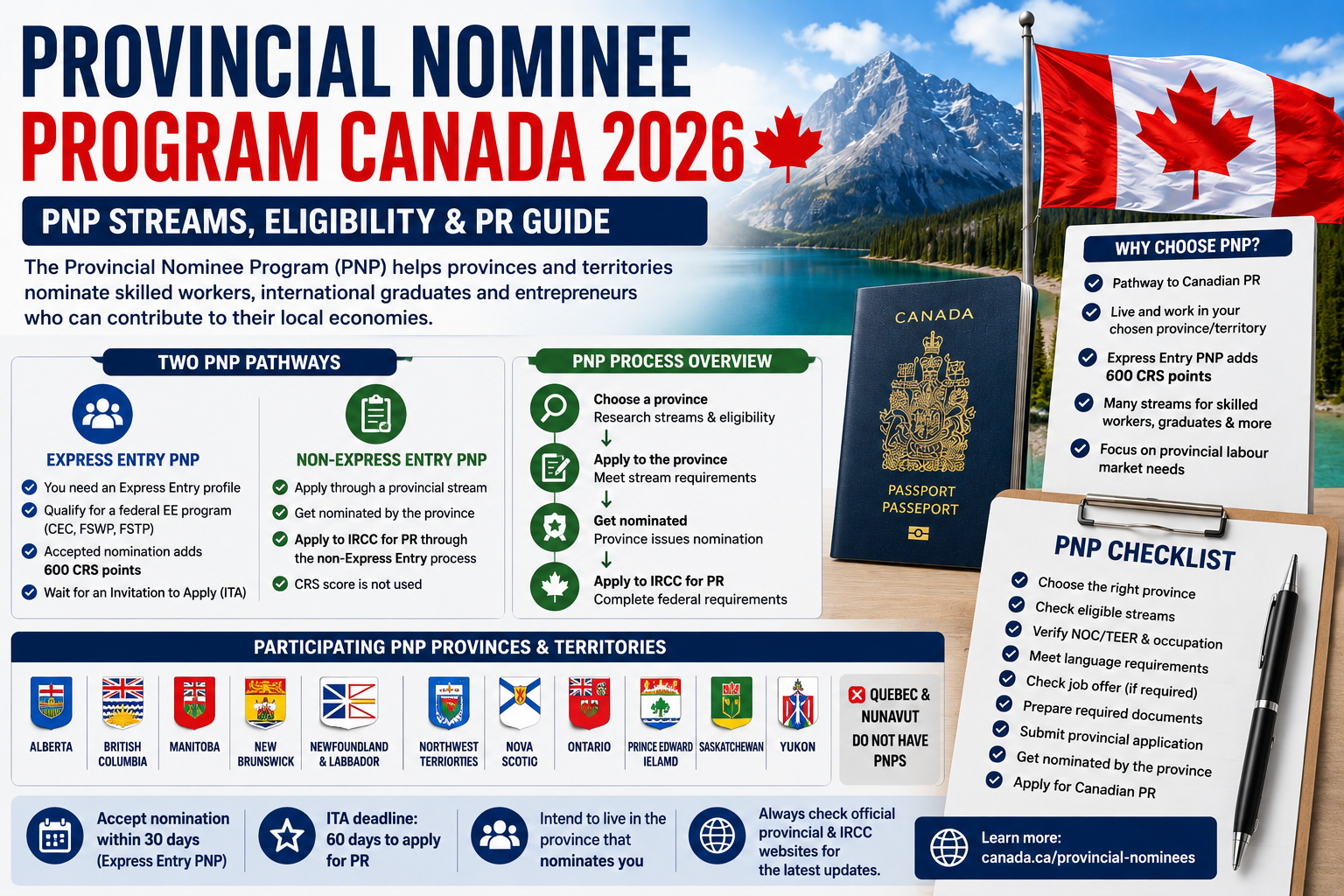
The Provincial Nominee Program, commonly called the PNP, is one of Canada’s major pathways to permanent residence for people who want to live and work in a particular province or territory.
Unlike a single federal immigration program, the PNP is made up of different immigration streams operated by participating provinces and territories.
Each province or territory can design streams based on its own economic needs, labour shortages and immigration priorities.
This means PNP eligibility can be very different from one part of Canada to another.
In 2026, some PNP pathways work with Express Entry while others use a separate non-Express Entry process.
This guide explains how the Provincial Nominee Program works, how a nomination can affect your CRS score, the difference between Express Entry and non-Express Entry PNP streams and what to check before choosing a province.
PNP Canada 2026: Quick Answer
The Provincial Nominee Program (PNP) lets participating provinces and territories nominate people whose skills match local labour needs. You first meet the province’s rules; after nomination, you still complete the federal permanent-residence process with IRCC.
For an Express Entry-linked nomination, accepting it adds 600 CRS points. A non-Express Entry nomination follows a separate federal permanent-residence application. A PNP is not automatic PR, and you must genuinely intend to settle in the province that nominated you.
Express Entry PNP vs Non-Express Entry PNP at a Glance
| Route | Best for | What happens after nomination |
|---|---|---|
| Express Entry-linked PNP | People eligible for a federal Express Entry program | Accept the nomination in your account, receive 600 CRS points, then wait for an Invitation to Apply. |
| Non-Express Entry PNP | People who qualify for a provincial base stream | Apply to IRCC for permanent residence through the non-Express Entry process. |
Important: Stream rules, openings and invitations change. Check the exact provincial program before applying.
What Is the Provincial Nominee Program?
The Provincial Nominee Program allows participating Canadian provinces and territories to nominate people who have the skills, education and work experience that may help their local economies.
If a province or territory nominates you, it is indicating that it wants you to settle there and contribute to that region.
However, receiving a nomination is not the same as automatically becoming a permanent resident.
After nomination, you still need to complete the appropriate federal permanent residence process with Immigration, Refugees and Citizenship Canada, commonly called IRCC.
Which Provinces and Territories Have PNPs?
Participating PNP jurisdictions currently include:
- Alberta
- British Columbia
- Manitoba
- New Brunswick
- Newfoundland and Labrador
- Northwest Territories
- Nova Scotia
- Ontario
- Prince Edward Island
- Saskatchewan
- Yukon
Quebec and Nunavut do not operate Provincial Nominee Programs.
Quebec operates its own immigration programs, while people interested in Nunavut must explore other applicable immigration options.
Two Main Ways to Apply Through the PNP
There are currently two main federal application processes for provincial nominees:
- Express Entry PNP
- Non-Express Entry PNP
The route you use depends on the stream offered by the province or territory and whether you qualify for a federal Express Entry program.
What Is Express Entry PNP?
An Express Entry-linked PNP stream connects a provincial nomination with Canada’s Express Entry system.
To use this route, you generally must:
- Meet the requirements of an eligible provincial or territorial PNP stream
- Be nominated by that province or territory
- Qualify for at least one federal Express Entry program
The three federal programs managed through Express Entry are:
- Canadian Experience Class
- Federal Skilled Worker Program
- Federal Skilled Trades Program
For a complete explanation of these programs and CRS ranking, read our Express Entry Canada 2026 guide.
How Many CRS Points Does a Provincial Nomination Give?
An accepted Express Entry-linked provincial or territorial nomination currently gives 600 additional CRS points.
This is one of the largest possible increases under the Comprehensive Ranking System.
For example, if a candidate had a CRS score of 430 before nomination, an accepted provincial nomination could raise the score to approximately 1,030, assuming no other profile changes.
The 600-point nomination does not itself mean that IRCC has approved your permanent residence application.
It significantly improves your Express Entry ranking and may help you receive an Invitation to Apply.
Does a PNP Nomination Guarantee an Invitation to Apply?
No immigration outcome should be treated as guaranteed.
An accepted Express Entry nomination adds 600 CRS points, which can make a profile highly competitive.
However, the candidate must remain eligible, keep the profile accurate and be selected in an applicable invitation round.
IRCC makes the final decision on permanent residence after reviewing the application and supporting documents.
How Do You Get an Express Entry Provincial Nomination?
There are generally two ways a candidate may pursue an Express Entry-linked nomination.
Apply Directly to a Province or Territory
You can research the province where you genuinely want to live and check its current PNP streams.
If you meet the requirements of an Express Entry-linked stream, you may be able to submit an application or expression of interest according to that province’s process.
Be Identified Through the Express Entry Pool
Participating provinces and territories can also search the Express Entry pool for candidates who may meet their immigration priorities.
A province may send an eligible candidate a notification of interest or similar invitation to apply to its provincial program.
Receiving interest from a province is not the same as receiving a final nomination.
You must still follow the province’s instructions and satisfy its requirements.
How Long Do You Have to Accept an Express Entry Nomination?
After a province or territory electronically confirms an Express Entry nomination, IRCC sends a message to the candidate’s account.
Under the current process, you have 30 calendar days to accept or reject the nomination.
If you accept it and remain eligible, the 600 additional CRS points are added to your profile.
If you reject or ignore the nomination, you do not receive those provincial nomination points.
Can You Have More Than One Provincial Nomination?
You may receive interest from more than one province or territory, depending on your circumstances.
However, under the current Express Entry PNP process, you can only have one nomination at a time.
If you already have a nomination offer but want to accept a different province’s nomination, you would need to deal with the existing nomination according to IRCC’s rules first.
This is another reason not to apply to provinces randomly.
You should genuinely intend to live in the province that nominates you.
What Is the Non-Express Entry PNP Process?
The non-Express Entry PNP process is used for provincial streams that are not connected to Express Entry.
The basic process generally involves:
- Choose the province or territory where you genuinely intend to live.
- Find a non-Express Entry PNP stream for which you may qualify.
- Apply to the province or territory.
- Receive a provincial nomination if approved.
- Apply to IRCC for permanent residence through the non-Express Entry process.
- Complete federal admissibility and document requirements.
For this route, receiving the provincial nomination comes before the federal permanent residence application.
Express Entry PNP vs Non-Express Entry PNP
The two processes have important differences.
Express Entry PNP
- You must qualify for an Express Entry federal program.
- You need an Express Entry profile.
- An accepted provincial nomination adds 600 CRS points.
- You wait for an applicable Invitation to Apply.
- You submit your permanent residence application through Express Entry.
Non-Express Entry PNP
- You apply under an eligible provincial non-Express Entry stream.
- You do not need to qualify for a federal Express Entry program for that specific route.
- CRS ranking is not used for the federal non-Express Entry application process.
- After receiving a provincial nomination, you apply separately to IRCC for permanent residence.
Neither route should be considered automatically better for everyone.
Your best option depends on your immigration profile and the province’s current requirements.
Do You Need a Job Offer for PNP?
Not every PNP stream has the same job-offer requirement.
Some streams are employer-driven and require a qualifying job offer.
Other streams may select candidates based on factors such as:
- Occupation
- Work experience
- Express Entry profile
- Education
- Language ability
- Previous study in the province
- Previous work in the province
- Family or community connections
- Regional labour-market needs
Never assume that a job offer is required or not required without checking the exact stream.
Do You Need Canadian Work Experience for PNP?
Again, it depends on the stream.
Some provincial programs are designed for people already working in the province.
Others may consider candidates with foreign work experience.
Some streams are connected to international graduates, skilled workers, healthcare workers, tradespeople or other groups.
The exact criteria can change.
Why Your NOC and TEER Matter for PNP
Your occupation can play an important role in provincial selection.
Some provinces may prioritize particular occupations based on labour-market demand.
Other programs may require a minimum TEER level or specific work experience.
Your NOC should accurately match the work you actually perform.
Do not select a NOC just because you believe it gives you a better immigration opportunity.
If you are unsure, use our NOC and TEER Code Canada guide.
Can TEER 4 or TEER 5 Workers Use PNP?
Potentially, depending on the province and the specific stream.
This is one area where PNP can be different from programs such as the Canadian Experience Class, whose skilled-work requirement generally focuses on TEER 0, 1, 2 and 3.
Some provincial streams may include opportunities for occupations outside those TEER levels where the province has specific labour-market needs.
Always verify the current stream requirements.
Canadian Experience Class vs PNP
The Canadian Experience Class and PNP are different pathways, but they can sometimes work together.
A person may qualify for the Canadian Experience Class and also receive an Express Entry provincial nomination.
CEC eligibility depends primarily on meeting the federal Canadian skilled work-experience and language requirements.
PNP eligibility depends on the province or territory’s own stream requirements.
An Express Entry-linked nomination can then add 600 CRS points to the candidate’s profile.
How Provinces Choose PNP Candidates
Provinces and territories use PNPs to address their own economic and demographic needs.
Depending on the stream, they may look at factors such as:
- Your occupation
- Your NOC and TEER
- Years of work experience
- Current employment
- Job offer
- Language score
- Education
- Age
- Express Entry CRS score
- Connection to the province
- Whether you studied or worked there
- Whether your skills match regional labour shortages
There is no universal PNP points system that applies to every province.
Alberta Provincial Nominee Program
Alberta operates its own provincial immigration program and can select candidates based on provincial economic and labour-market priorities.
Streams, eligibility requirements and selection priorities can change.
If Alberta is your preferred destination, use the official Alberta government immigration website rather than relying only on old blogs or social-media posts.
British Columbia Provincial Nominee Program
British Columbia operates immigration pathways designed around the province’s labour-market and economic needs.
Some opportunities may relate to skilled workers, graduates, healthcare, entrepreneurs or other targeted groups depending on current provincial policy.
Always check the current British Columbia program requirements before applying.
Manitoba Provincial Nominee Program
Manitoba’s provincial immigration program can consider factors such as employment, skills, education and connection to the province depending on the stream.
Some Manitoba pathways use expressions of interest and provincial ranking systems.
Current eligibility and invitation criteria should be checked directly with Manitoba.
Ontario Immigrant Nominee Program
Ontario operates the Ontario Immigrant Nominee Program, commonly called OINP.
Depending on current streams, Ontario can target people with job offers, Express Entry profiles, in-demand skills, graduate education or other qualifications.
Because Ontario receives significant immigration interest, candidates should pay close attention to current stream status and invitation requirements.
Saskatchewan Provincial Nominee Program
Saskatchewan operates provincial immigration pathways for workers and other applicants who may help meet provincial economic needs.
Occupation eligibility, employer requirements and application processes can change, so always check Saskatchewan’s current official guidance.
Atlantic Province PNPs
The Atlantic provinces that operate PNPs are:
- New Brunswick
- Newfoundland and Labrador
- Nova Scotia
- Prince Edward Island
Each has its own provincial immigration streams.
Do not confuse these programs with the Atlantic Immigration Program, which is a separate federal-provincial immigration pathway.
Northwest Territories and Yukon
The Northwest Territories and Yukon also operate territorial nominee programs.
These programs may provide options for candidates who genuinely want to live and work in northern Canada and meet the applicable requirements.
Regional labour-market needs can be particularly important in territorial immigration programs.
Why Quebec Is Different
Quebec does not participate in the Provincial Nominee Program.
Quebec has separate immigration selection programs under its own immigration system.
If your goal is to settle in Quebec, research Quebec’s official immigration programs instead of applying for PNP.
Why Nunavut Is Different
Nunavut currently does not operate a Provincial Nominee Program.
People interested in living and working in Nunavut must consider other immigration pathways for which they may qualify.
Do You Have to Live in the Province That Nominates You?
A provincial nomination is based on the expectation that you genuinely intend to settle in the nominating province or territory.
When applying for a PNP, you should be able to demonstrate a real intention to live there.
Applying to a province only to obtain immigration points while planning from the beginning to settle somewhere else can create serious concerns.
How Can You Show Your Intention to Live in a Province?
Depending on your situation, factors that may support your intention can include:
- Working in the province
- A provincial job offer
- Previous education in the province
- Family or community connections
- Research into housing and employment
- Job applications in the province
- Previous visits
- A clear explanation of why the province fits your career and family plans
The evidence relevant to you depends on the program and your personal circumstances.
What Happens After an Express Entry Nomination?
If a province nominates you through Express Entry, the process generally includes:
- The province or territory confirms the nomination electronically.
- You receive a message in your Express Entry account.
- You accept the nomination within the required period.
- Your profile receives 600 additional CRS points.
- You wait for an applicable Express Entry invitation round.
- If invited, you submit a complete permanent residence application.
IRCC currently gives Express Entry applicants 60 calendar days after an Invitation to Apply to submit the permanent residence application.
What Happens After a Non-Express Entry Nomination?
After receiving a nomination under a non-Express Entry stream, you generally apply online for permanent residence through the federal PR Portal.
You must submit the required forms, fees and supporting documents.
IRCC then assesses your federal permanent residence application.
Does a Provincial Nomination Give You a Work Permit?
No.
A provincial nomination by itself does not automatically give you authorization to work in Canada.
If you need to work while your permanent residence application is being processed, you must have valid work authorization.
Depending on your situation, you may qualify for a work permit or a bridging open work permit, but those have separate eligibility requirements.
What Documents May Be Required for PNP?
Requirements vary by province and stream, but documents may include:
- Passport
- Language test results
- Education documents
- Educational Credential Assessment where required
- Employment reference letters
- Job offer documents where required
- Work permits
- Proof of Canadian status
- Proof of settlement funds where applicable
- Provincial connection documents
- Marriage or family documents where applicable
- Police certificates
- Medical examination information
Do not prepare your application using a generic document checklist from another province.
Follow the checklist for your exact stream.
Do PNP Applicants Need Language Tests?
Many PNP streams require approved language test results, but the minimum score varies by stream and occupation.
For Express Entry-linked PNP streams, you also need to satisfy the language requirements of the federal Express Entry program for which you qualify.
Accepted Express Entry tests currently include IELTS General Training, CELPIP-General and PTE Core for English, as well as TEF Canada and TCF Canada for French.
Can French Help With PNP?
French ability can potentially strengthen immigration options depending on the province and stream.
Some provinces may target French-speaking or bilingual candidates.
Strong French can also improve an Express Entry CRS profile.
Do not assume that French automatically results in a nomination; you still need to meet the stream requirements.
Can International Students Apply for PNP?
Yes, some PNP streams may be available to eligible international graduates.
However, graduating in a province does not automatically guarantee a nomination.
Requirements may involve:
- Type of credential
- Institution
- Length of study
- Job offer
- Occupation
- Work experience
- Language level
- Intent to remain in the province
Always verify the stream that applies to graduates in the province where you studied.
Can Temporary Foreign Workers Apply for PNP?
Many provincial pathways are relevant to temporary foreign workers who are already employed in Canada.
The exact requirements may depend on occupation, employer, length of employment, work permit status and province.
Having Canadian work experience can help in some streams but does not make everyone automatically eligible.
Can Applicants Outside Canada Get a Provincial Nomination?
Potentially.
Some provincial streams can consider qualified candidates living outside Canada.
Others require current employment, a job offer or a connection to the province.
Your location alone does not determine eligibility.
Do You Need a High CRS Score for PNP?
Not every PNP stream uses your federal CRS score in the same way.
For some Express Entry-linked streams, a province may use CRS or its own selection criteria when deciding whom to invite.
Other streams use separate provincial scoring or eligibility systems.
A lower federal CRS score does not automatically mean PNP is impossible.
However, you must meet the exact provincial stream criteria.
Can a PNP Help Someone With a Low CRS Score?
An Express Entry provincial nomination can be particularly valuable for a candidate whose CRS score is not competitive in other invitation rounds because an accepted nomination adds 600 additional CRS points.
But getting the nomination itself can be competitive.
You should not treat PNP as an automatic backup plan.
How to Choose the Best Province for Your PR Strategy
Do not choose a province only because someone online says it has an “easy PNP.”
Instead, compare:
- Your occupation
- Your NOC and TEER
- Your work experience
- Your language scores
- Your education
- Whether you have a qualifying job offer
- Your current province of employment
- Your family connections
- Your willingness to genuinely settle there
- The province’s current immigration priorities
The best province is the one where your profile matches a real pathway and where you genuinely intend to build your life.
Finding Jobs That May Support a PNP Pathway
If a provincial stream requires employment or a job offer, focus on legitimate employers and occupations that match the stream.
Our guide to jobs in Canada that may support PR pathways explains how employment and immigration can connect.
You can also compare occupations in our jobs for newcomers in Canada guide.
Prepare a Strong Job Application
If a job offer is important for the provincial stream you are pursuing, prepare professional employment applications.
Use a Canadian-style resume and customize your Canadian cover letter for the employer and position.
Never pay someone for a fake job offer.
A job used for immigration purposes should be a genuine employment opportunity.
Beware of PNP Scams
Be cautious if someone claims:
- They can guarantee a provincial nomination
- They can guarantee permanent residence
- You must pay them for a fake employer letter
- You can use job duties you never performed
- You can claim you intend to live in a province when you do not
- A closed or outdated stream is still accepting applications
Verify program information through official provincial government websites and IRCC.
Common PNP Mistakes to Avoid
- Applying to a province where you do not genuinely intend to live
- Using the wrong NOC
- Assuming every PNP stream requires a job offer
- Assuming no PNP stream requires a job offer
- Using outdated eligibility requirements
- Ignoring provincial application deadlines
- Allowing language test results to expire
- Providing inaccurate work experience
- Failing to maintain Express Entry eligibility for an Express Entry PNP
- Assuming nomination automatically gives work authorization
- Assuming nomination automatically guarantees permanent residence
Do PNP Streams Stay Open All Year?
Not necessarily.
Provincial programs can:
- Open or close intake
- Pause applications
- Change occupation lists
- Change scoring systems
- Change job-offer requirements
- Target specific sectors
- Issue invitations periodically
- Reach annual nomination allocations
This is why older immigration articles and social-media videos can become outdated quickly.
Does the Federal Government Still Review a PNP Application?
Yes.
A provincial nomination does not replace the federal permanent residence assessment.
IRCC still reviews the application and determines whether the applicant meets federal requirements, including admissibility.
Applicants may need medical examinations, police certificates, biometrics and other supporting documents depending on their situation.
How Long Does PNP Take?
There is no single processing time for every PNP application.
Total time can depend on:
- The province
- The stream
- How long provincial nomination takes
- Whether the application is Express Entry or non-Express Entry
- Whether the application is complete
- Federal processing capacity
- Background checks
- Medical and security requirements
- Annual immigration levels and available spaces
Check the current provincial information and IRCC processing-time tools instead of relying on an old estimate.
PNP 2026 Step-by-Step Checklist
Before applying, work through this checklist:
- Choose the province or territory where you genuinely want to live.
- Check whether it operates a PNP.
- Review its currently open streams.
- Find your correct NOC and TEER.
- Check occupation requirements.
- Check language requirements.
- Check education requirements.
- Check whether a job offer is required.
- Check whether Canadian work experience is required.
- Determine whether the stream uses Express Entry or non-Express Entry.
- Prepare the exact provincial documents requested.
- Submit your provincial application correctly.
- If nominated, follow the federal permanent residence process.
Important: Provincial Nomination Does Not Guarantee PR
A provincial nomination can be extremely valuable, particularly when it is linked to Express Entry.
However, nomination is only one stage of the immigration process.
You still need to maintain eligibility, provide truthful documentation and satisfy IRCC’s permanent residence and admissibility requirements.
PNP policies can also change according to provincial economic priorities and federal immigration levels.
Where to Check Current PNP Information
Start with the Government of Canada’s official Provincial Nominee Program page.
From there, follow the official link for the province or territory you are interested in.
For Express Entry nominations, also review IRCC’s official PNP Express Entry process.
For nominations outside Express Entry, use IRCC’s non-Express Entry PNP guidance.
Final Thoughts
The Provincial Nominee Program remains an important permanent residence pathway in Canada in 2026.
Participating provinces and territories use their programs to nominate candidates whose skills and experience match regional needs.
There are two main application routes: Express Entry PNP and non-Express Entry PNP.
If you receive and accept an Express Entry-linked provincial nomination, you currently receive 600 additional CRS points.
However, each province has different streams, and requirements relating to jobs, occupations, language, education and work experience can vary significantly.
The strongest strategy is not to search for an “easy PNP.”
Instead, identify your correct NOC, understand your Express Entry profile, compare provincial requirements and focus on provinces where your qualifications match a current immigration pathway and where you genuinely want to live.
Always verify the latest requirements through official provincial government websites and IRCC before making an important immigration decision.
You can continue learning through our PR Pathways in Canada guides.
Leave a Reply