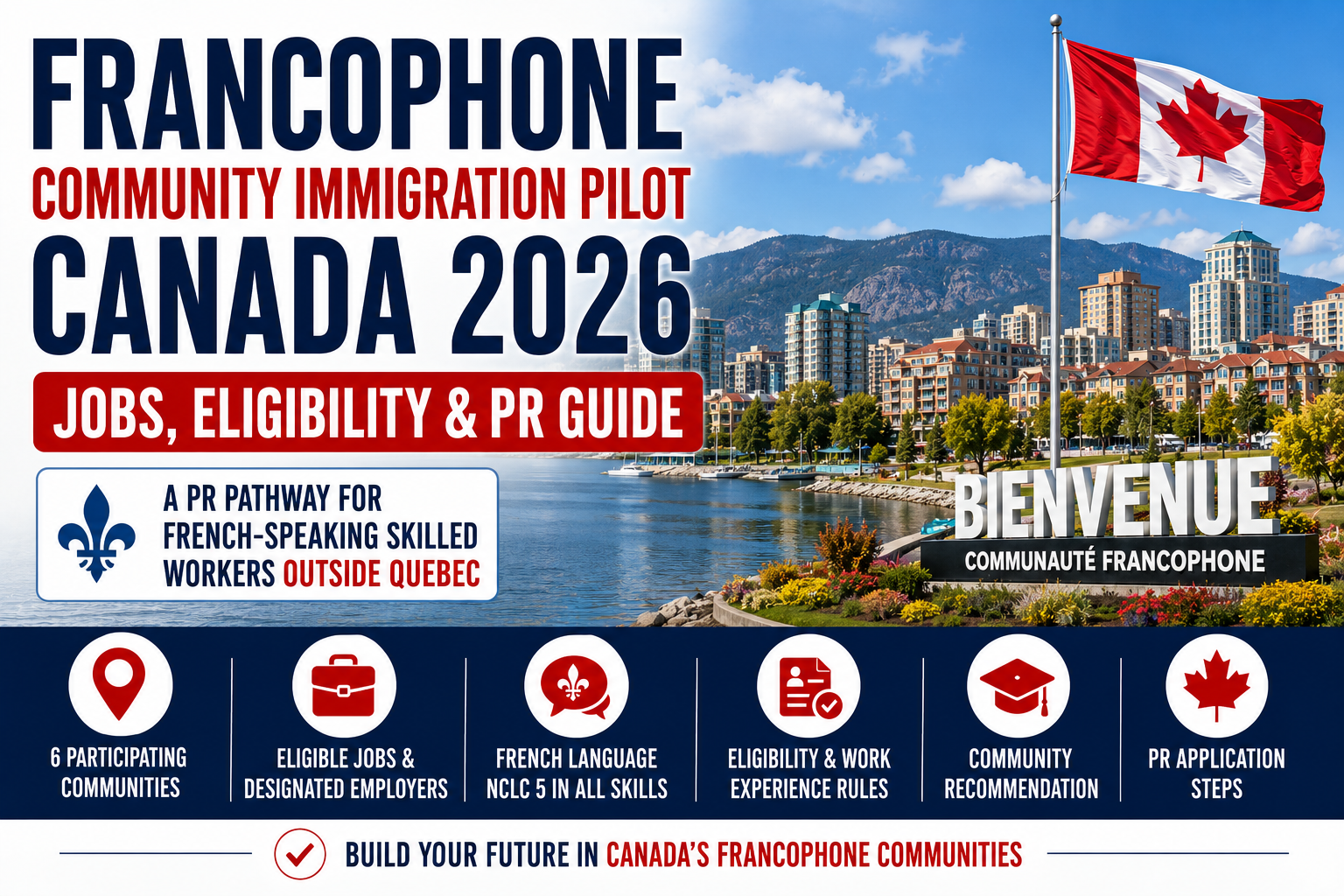
The Francophone Community Immigration Pilot, commonly called FCIP, is a Canadian permanent residence pathway designed to attract French-speaking skilled workers to selected Francophone-minority communities outside Quebec.
In 2026, the pilot is open and includes six participating communities across New Brunswick, Ontario, Manitoba and British Columbia.
FCIP is not part of Express Entry and does not use a CRS score.
Instead, applicants generally need a valid job offer from a designated employer in a participating community, qualifying related work experience unless exempt, French-language ability of at least NCLC 5, eligible education, settlement funds when required and a recommendation from the community.
This guide explains the Francophone Community Immigration Pilot Canada in 2026, including participating communities, designated employers, eligible jobs, NOC and TEER rules, work experience, French-language requirements, education, settlement funds, community recommendations, permanent residence and the optional work permit.
What Is the Francophone Community Immigration Pilot?
The Francophone Community Immigration Pilot is an economic immigration pathway for French-speaking skilled workers who want to work and settle permanently in participating Francophone-minority communities outside Quebec.
The Government of Canada selected communities that demonstrated they could support skilled newcomers while strengthening French-speaking populations outside Quebec.
Participating communities identify priority sectors and occupations, designate eligible employers and review candidates for community recommendations.
Immigration, Refugees and Citizenship Canada, commonly called IRCC, makes the final decision on permanent residence applications.
Is FCIP Open in 2026?
Yes.
The Francophone Community Immigration Pilot is currently open.
However, each participating community can have its own:
- Priority sectors
- Priority occupations
- Designated employers
- Application procedures
- Community recommendation process
- Local intake limits or timelines
This means applicants should always check both the federal FCIP rules and the official website of the community where they want to work.
Which Communities Participate in FCIP?
The six participating communities currently listed by IRCC are:
- Acadian Peninsula, New Brunswick
- Sudbury, Ontario
- Timmins, Ontario
- Superior East Region, Ontario
- St. Pierre Jolys, Manitoba
- Kelowna, British Columbia
You can access each community’s official information through IRCC’s FCIP job-offer page.
Who Can Apply for FCIP?
To apply for permanent residence under the Francophone Community Immigration Pilot, you generally need to:
- Have a valid job offer from a designated employer in a participating community
- Have at least one year or 1,560 hours of related work experience during the previous three years, unless you qualify for an international-graduate exemption
- Meet the French-language requirement
- Have an eligible Canadian educational credential or equivalent foreign education
- Show sufficient settlement funds when required
- Receive a recommendation from the participating community
- Meet IRCC’s federal permanent residence and admissibility requirements
You can review the official FCIP eligibility page before applying.
Does FCIP Require Express Entry?
No.
You do not need an Express Entry profile to apply through FCIP.
The Francophone Community Immigration Pilot also does not use the Comprehensive Ranking System, commonly called CRS.
This makes it different from federal programs managed through Express Entry.
To understand that system separately, read our Express Entry Canada 2026 guide.
Do You Need a Job Offer for FCIP?
Yes.
A valid job offer is one of the central requirements of FCIP.
The job offer must come from an employer officially designated by one of the participating communities.
A job offer from an employer that is not designated under FCIP does not automatically qualify for the pilot.
What Is a Designated Employer?
A designated employer is an employer that a participating community has approved to hire eligible workers through FCIP.
Each community is responsible for designating employers located within its area.
Designation allows the employer to make qualifying FCIP job offers and participate in the community recommendation process.
However, designation does not mean the employer is always hiring.
Does FCIP Find a Job for You?
No.
FCIP does not automatically match immigration applicants with jobs.
You normally need to research:
- Participating communities
- Priority sectors
- Priority occupations
- Designated employers
- Current job vacancies
You can approach eligible employers yourself, and designated employers may also identify qualified candidates independently.
FCIP Job Offer Requirements
Under the current pilot rules, a qualifying job generally must be:
- Located within the boundaries of the participating community
- From a designated employer
- Full-time
- At least 30 paid hours per week
- Non-seasonal
- Year-round
- Indeterminate, meaning it has no set end date
- A genuine employment opportunity
- At an eligible NOC and TEER level for your work-experience background
Volunteer work and unpaid internships are not qualifying employment.
Can TEER 5 Jobs Qualify for FCIP?
Yes, potentially.
FCIP can include qualifying job offers across TEER categories 0 through 5.
This is important because several other Canadian economic immigration programs focus mainly on TEER 0, 1, 2 and 3 occupations.
However, your previous work experience must satisfy FCIP’s TEER relationship rules.
How NOC and TEER Work for FCIP
Every Canadian occupation is classified under the National Occupation Classification, commonly called NOC.
The NOC also assigns a TEER category based on the training, education, experience and responsibilities normally associated with the occupation.
For FCIP, your NOC and TEER can affect:
- Whether your previous work experience qualifies
- Whether your job offer is related to your experience
- Your community’s priority occupation requirements
- Whether the employer’s position can be recommended
If you are unsure which occupation matches your real duties, use our NOC and TEER Code Canada guide.
FCIP Work Experience Requirement
Most applicants currently need at least one year or 1,560 hours of related work experience during the previous three years.
Your qualifying work experience must generally:
- Be paid employment
- Not be unpaid volunteer work
- Not be an unpaid internship
- Not be self-employment
- Include the actions described in the applicable NOC
- Include most of the NOC’s main duties
- Meet the required TEER relationship with the FCIP job offer
FCIP Job Offer and Work Experience TEER Table
| Job Offer TEER | Previous Work Experience Can Be |
|---|---|
| TEER 0 or 1 | TEER 0, 1, 2 or 3 |
| TEER 2 | TEER 1, 2, 3 or 4 |
| TEER 3 or 4 | TEER 2, 3 or 4 |
| TEER 5 | The same 5-digit NOC code as the job offer |
This means one year of unrelated work experience does not automatically satisfy the FCIP requirement.
Special FCIP Rule for Certain Healthcare Workers
FCIP currently provides a special exception for certain nursing occupations.
If your qualifying work experience is under:
- NOC 31301 – Registered nurses and registered psychiatric nurses
you may be able to accept an eligible job offer under:
- NOC 33102 – Nurse aides, orderlies and patient service associates
- NOC 44101 – Home support workers, caregivers and related occupations
Remember that healthcare professions may also have provincial licensing or certification requirements separate from immigration eligibility.
Can Self-Employment Count for FCIP?
No.
Under the current FCIP work-experience rules, self-employed work does not count toward the required qualifying work experience.
Can Volunteer Work Count?
No.
Volunteer work and unpaid internships do not count toward the 1,560-hour requirement.
Your qualifying work experience must be paid.
How Do You Prove Your Work Experience?
When applying for permanent residence, you should be prepared to document the work experience you are claiming.
Evidence may include:
- Employer reference letters
- Employment contracts
- Pay stubs
- Your most recent Canadian work permit where applicable
- T4 slips where applicable
- Notices of Assessment where applicable
A strong employment reference letter should normally show information such as:
- Your employment dates
- Your main responsibilities and duties
- Your NOC code if known
- Your salary and benefits
- Hours worked each week
- Employer name and contact information
FCIP International Graduate Work Experience Exemption
Certain international graduates from publicly funded post-secondary institutions in the recommending community may be exempt from the normal work-experience requirement.
There are two main situations.
Credential From a Program of 2 Years or Longer
You may qualify for the exemption if you:
- Completed an eligible credential from a publicly funded post-secondary institution in the recommending community
- Studied full-time for the entire program
- Completed a program of at least two years
- Received the credential no more than 18 months before applying for permanent residence
- Were physically in the community for at least 16 of the final 24 months while studying
Master’s Degree or Higher
You may also qualify when you completed a master’s degree or higher that took two years or less and you:
- Studied full-time for the entire degree
- Received the degree no more than 18 months before applying for permanent residence
- Were physically in the community for the duration of your studies
Which International Graduate Programs May Not Qualify?
The work-experience exemption does not apply in certain situations.
For example, it may not apply if:
- Studying English or French made up more than half of your program
- Distance learning made up more than half of the program
- You received a scholarship or fellowship requiring you to return to your home country to use what you learned
Always verify your exact credential against current IRCC requirements.
French Language Requirement for FCIP
French ability is a core requirement of the Francophone Community Immigration Pilot.
Unlike RCIP, where the minimum language level changes according to the TEER category, FCIP currently requires a minimum of:
NCLC 5 in all four French-language abilities.
The four abilities are:
- Reading
- Writing
- Listening
- Speaking
Which French Tests Does FCIP Accept?
IRCC currently accepts:
- TEF Canada – Test d’évaluation de français
- TCF Canada – Test de connaissance du français
You must achieve at least NCLC 5 in each of the four tested abilities.
Check IRCC’s official FCIP language assessment page for current score-conversion tables.
Can You Use IELTS or PTE Core for FCIP?
FCIP specifically requires French-language proficiency.
IRCC’s current FCIP language page lists TEF Canada and TCF Canada for proving the required French level.
An English test such as IELTS General Training, CELPIP-General or PTE Core does not replace the required French-language result for FCIP eligibility.
Is NCLC 5 Enough for FCIP?
NCLC 5 in all four abilities is the current federal minimum language requirement.
However, meeting the federal minimum does not automatically guarantee:
- A job offer
- A community recommendation
- Permanent residence approval
Employers may expect stronger French or English abilities depending on the position.
Does English Help With FCIP?
English ability may still be valuable when looking for work or settling in a bilingual workplace or community.
However, the core federal FCIP language requirement is based on French proficiency.
You still need the approved French test result meeting at least NCLC 5 in every ability.
How Long Are FCIP Language Test Results Valid?
Language test results used for Canadian immigration generally need to remain valid according to IRCC requirements when you submit your application.
Before applying, check the validity date shown on your results and verify current IRCC instructions.
FCIP Education Requirements
You need an eligible educational credential to apply through FCIP.
If you completed your education in Canada, an eligible credential can include:
- A Canadian secondary school diploma
- A recognized Canadian post-secondary certificate
- A Canadian diploma
- A Canadian degree
What If Your Education Is From Outside Canada?
If your education was completed outside Canada, you generally need an Educational Credential Assessment, commonly called an ECA.
Your ECA needs to show that your completed foreign credential is equivalent to at least an eligible Canadian educational credential.
The report must generally:
- Come from an organization or professional body designated by IRCC
- Be less than five years old when you apply
- Confirm the Canadian equivalency of your completed foreign education
Check IRCC’s official FCIP education assessment page.
Does an ECA Give You a Professional Licence?
No.
An Educational Credential Assessment is used to compare foreign education with Canadian education for immigration purposes.
It does not automatically qualify you to practise a regulated profession in Canada.
Jobs such as nursing, medicine, engineering and certain skilled trades can have separate licensing or certification requirements.
Do You Need Settlement Funds for FCIP?
Most FCIP applicants need to show enough money to support themselves and their family after settling in Canada.
However, under the current rules, you do not need to show FCIP settlement funds if you are already working in Canada with a valid work permit.
Settlement-fund amounts can be updated by IRCC, so check the official amount immediately before applying.
Use IRCC’s current FCIP proof-of-funds page.
Who Counts Toward Your Family Size?
When calculating settlement funds, IRCC generally requires you to include:
- Yourself
- Your spouse or common-law partner
- Your dependent children
- Your spouse or common-law partner’s dependent children
Certain family members need to be counted even if they are not accompanying you to Canada.
What Is an FCIP Community Recommendation?
A valid designated-employer job offer alone is not enough to apply for permanent residence.
You also need a recommendation from the participating community.
Once a designated employer gives you an eligible job offer, the employer sends your community recommendation application directly to the community for review.
The community checks whether:
- Your job is in a priority sector or occupation
- The employment offer is genuine
- You meet the FCIP requirements
- You meet applicable community-specific requirements
If the community recommends you, you can move forward with your permanent residence application.
Does a Job Offer Guarantee a Community Recommendation?
No.
A job offer from a designated employer does not automatically guarantee a community recommendation.
The participating community still reviews the candidate and employment offer.
Does Community Recommendation Guarantee PR?
No.
A community recommendation allows you to move to the federal permanent residence application stage.
IRCC still decides whether you qualify for permanent residence.
Who Submits the Community Recommendation Application?
Under the current FCIP process, the designated employer sends the community recommendation application directly to the participating community after making an eligible job offer.
If the community approves the recommendation, the candidate can use that recommendation when applying for permanent residence.
How to Apply for FCIP Permanent Residence
After receiving the required community recommendation, you can apply online for permanent residence.
Follow IRCC’s official FCIP permanent residence instructions.
Do not submit incomplete or inaccurate information simply to meet a deadline.
FCIP Application Process Step by Step
- Choose one of the six participating Francophone communities.
- Review the community’s current priority sectors and occupations.
- Identify your correct NOC and TEER.
- Review its designated employers.
- Find a legitimate job that matches your experience.
- Apply to the employer.
- Receive an eligible job offer.
- Confirm your work-experience eligibility or graduate exemption.
- Complete an approved French-language test.
- Reach at least NCLC 5 in all four French abilities.
- Confirm your education or obtain an ECA where required.
- Prepare settlement-fund evidence if required.
- Your designated employer submits the recommendation application to the community.
- Receive the community recommendation if approved.
- Apply to IRCC for permanent residence.
- Complete federal document, medical, biometrics and admissibility requirements.
- Wait for IRCC’s final decision.
What Documents May Be Required?
Your exact document checklist depends on your circumstances, but documents can include:
- Passport or travel document
- Offer of Employment form
- Community recommendation documentation
- TEF Canada or TCF Canada results
- Canadian education documents
- Educational Credential Assessment where applicable
- Employer reference letters
- Employment contracts
- Proof of qualifying work experience
- Canadian work permits where applicable
- Proof of settlement funds where required
- Police certificates
- Medical examination information
- Civil-status documents
- Documents for accompanying family members
Always follow IRCC’s current checklist for your exact application.
Can You Get a Work Permit While FCIP PR Is Processing?
Potentially.
If you have applied for permanent residence through FCIP and meet the applicable requirements, you may also qualify for a temporary work permit.
Under the current program, the FCIP work permit:
- Can be valid for up to two years
- Is specifically for the Francophone Community Immigration Pilot
- Is employer-specific
- Allows you to work only for the employer that provided your eligible FCIP job offer
You generally need:
- An eligible job offer from your designated employer
- A recommendation from the participating community
- To otherwise be eligible to apply for the work permit
Check IRCC’s official FCIP work permit page.
Can Your Spouse Get an Open Work Permit?
Under current FCIP guidance, your spouse or common-law partner may be able to apply for an open work permit at the same time you apply for your two-year FCIP work permit.
The spouse or partner’s work authorization is currently limited to employment within the same participating community.
Does FCIP Require an LMIA?
FCIP uses its own designated-employer and community-recommendation process.
The optional FCIP work permit uses the immigration pilot’s employer-specific work-permit process rather than the normal LMIA route when the applicable requirements are met.
This does not mean that any employer can simply hire through FCIP.
The employer still needs to be officially designated and must follow the pilot requirements.
FCIP vs Rural Community Immigration Pilot
The Francophone Community Immigration Pilot and the Rural Community Immigration Pilot have several similarities.
Both generally involve:
- Participating communities
- Designated employers
- Eligible job offers
- Related work experience or an eligible graduate exemption
- Education requirements
- Settlement funds when required
- Community recommendations
The major difference is language.
FCIP is specifically designed to strengthen Francophone-minority communities and currently requires at least NCLC 5 in French in all four abilities.
RCIP uses different minimum language levels depending on the TEER category of the job offer.
FCIP vs Express Entry
Francophone Community Immigration Pilot
- Requires a qualifying job offer from a designated employer
- Requires French at NCLC 5 in all four abilities
- Requires a community recommendation
- Does not use CRS ranking
- Is limited to six participating Francophone communities
Express Entry
- Uses the Comprehensive Ranking System
- Manages CEC, Federal Skilled Worker and Federal Skilled Trades programs
- Does not require a community recommendation
- Can include category-based invitations for French-language proficiency
- Is not limited to the six FCIP communities
Read our complete Express Entry Canada 2026 guide for more details.
FCIP vs Provincial Nominee Program
The Provincial Nominee Program allows participating provinces and territories to nominate eligible candidates through their own immigration streams.
FCIP is a separate federal community-based pilot.
Instead of receiving a provincial nomination, an FCIP candidate needs a recommendation from one of the participating Francophone communities.
FCIP vs Atlantic Immigration Program
The Atlantic Immigration Program and FCIP both involve designated employers, but they are different pathways.
AIP operates throughout New Brunswick, Newfoundland and Labrador, Nova Scotia and Prince Edward Island using designated Atlantic employers and provincial endorsement.
FCIP operates only in its six participating Francophone communities and requires a community recommendation and qualifying French-language ability.
Can French Also Help With Express Entry?
Yes.
French can be valuable beyond FCIP.
Canada’s Express Entry system can award additional CRS points for strong French ability, depending on the candidate’s full language profile.
French-language proficiency is also one of the current Express Entry category-based selection categories.
This means improving French may create more than one potential immigration option.
Is FCIP Easier Than Express Entry?
There is no Canadian immigration program that is automatically easier for everyone.
FCIP may be worth researching if:
- You can communicate in French at NCLC 5 or higher
- Your occupation matches a participating community’s priorities
- You can obtain legitimate employment from a designated employer
- Your work experience satisfies the pilot’s NOC and TEER rules
- Your education qualifies
- You genuinely want to live in the participating Francophone community
Express Entry may be stronger for someone with a competitive CRS profile who does not have an FCIP job offer.
What Jobs Can Qualify for FCIP?
There is no single national list of FCIP jobs that applies equally to all six communities.
Each participating community determines priority sectors and occupations based on its own labour-market needs.
Potential sectors may include areas such as:
- Healthcare
- Education
- Social and community services
- Skilled trades
- Construction
- Manufacturing
- Hospitality
- Transportation
- Business services
- Agriculture
- Other locally needed occupations
Never rely on a generic online “FCIP jobs list.”
Check the current priority occupations on the official community website.
How to Find FCIP Jobs
A practical FCIP job-search strategy is:
- Select a participating community where you genuinely want to live.
- Visit its official FCIP website.
- Check its priority sectors and occupations.
- Review its designated employers.
- Research each relevant employer.
- Visit the employer’s official careers page.
- Find positions that genuinely match your background.
- Prepare a Canadian-style resume.
- Write a targeted cover letter.
- Apply according to the employer’s instructions.
- Prepare for an interview in French, English or both depending on the job.
You can also use the Government of Canada’s Job Bank to research legitimate employment opportunities.
Do Not Treat a Designated Employer List as a Job List
This is important.
An employer appearing on a designated-employer list does not necessarily mean that the employer currently has an open position.
Instead of emailing every company with the same generic resume:
- Check current vacancies
- Match your skills to the job
- Customize your resume
- Customize your cover letter
- Follow the employer’s application instructions
Prepare a Canadian Resume for FCIP Jobs
Your resume should focus on your actual qualifications for the position.
Use our Canadian Resume Format 2026 guide when preparing applications.
Write a Targeted Canadian Cover Letter
Your cover letter can explain:
- Why your experience matches the job
- Why you are interested in the employer
- Why you want to live in the community
- Relevant French-language abilities
Use our Canadian Cover Letter Format 2026 guide.
Can an FCIP Job Support Permanent Residence?
Potentially, when the employer, job and candidate satisfy all FCIP requirements.
However, a Canadian job does not automatically guarantee permanent residence.
Read our broader guide to jobs in Canada that may support PR pathways.
Can You Apply for FCIP From Outside Canada?
Potentially, yes.
You do not necessarily need to be living in Canada before pursuing FCIP.
You still need to obtain an eligible designated-employer job offer and satisfy the other pilot requirements.
Can You Apply for FCIP While Already in Canada?
Yes, eligible temporary residents in Canada may potentially apply.
You must maintain valid immigration status and work authorization where required.
If you are already working in Canada with a valid work permit, you currently do not need to show FCIP settlement funds.
Do You Have to Live in the Community?
FCIP is designed for candidates who genuinely want to work and settle in the participating Francophone community.
The program should not be treated simply as a way to obtain permanent residence while planning from the beginning to live somewhere completely different.
Before applying, research:
- Housing
- Employment opportunities
- Transportation
- Healthcare
- Schools
- French-language services
- Community organizations
- Cost of living
Does FCIP Guarantee Permanent Residence?
No.
A designated-employer job offer and community recommendation do not guarantee final PR approval.
IRCC still assesses:
- Your FCIP eligibility
- Your job offer
- Your work experience
- Your language test
- Your education
- Your settlement funds where required
- Your supporting documents
- Your medical admissibility
- Your criminal admissibility
- Your security admissibility
The final decision belongs to IRCC.
Beware of Fake FCIP Job Offers
Be cautious if someone claims:
- They can guarantee an FCIP job for payment
- You can buy a designated-employer offer
- You can purchase a community recommendation
- You do not need French
- You can use fake work experience
- You do not need to actually perform the job
- They can guarantee Canadian permanent residence
Always verify designated employers through the participating community’s official website.
Common FCIP Mistakes to Avoid
- Applying without the required French ability
- Assuming English can replace the FCIP French requirement
- Using an employer that is not officially designated
- Assuming a designated employer is automatically hiring
- Using the wrong NOC
- Ignoring TEER work-experience requirements
- Counting self-employment toward qualifying work experience
- Counting unpaid work toward the 1,560 hours
- Assuming every international graduate is exempt from work experience
- Ignoring community priority occupations
- Using an expired ECA
- Submitting incomplete employment evidence
- Assuming a job offer guarantees community recommendation
- Assuming community recommendation guarantees PR
- Paying for fake employment or immigration documents
FCIP 2026 Checklist
Before relying on FCIP as your permanent residence strategy, check:
- I selected one of the six participating Francophone communities.
- I genuinely want to live and work in that community.
- I reviewed its current priority sectors and occupations.
- I identified my correct NOC and TEER.
- My employer is officially designated.
- My job offer is within the community.
- My job is full-time and at least 30 paid hours per week.
- My job is non-seasonal and indeterminate.
- My previous work experience satisfies the relevant TEER rules.
- I have at least 1,560 hours of qualifying work experience or qualify for the graduate exemption.
- I completed TEF Canada or TCF Canada.
- I achieved at least NCLC 5 in reading.
- I achieved at least NCLC 5 in writing.
- I achieved at least NCLC 5 in listening.
- I achieved at least NCLC 5 in speaking.
- I have an eligible educational credential or valid ECA.
- I have sufficient settlement funds if required.
- My employer submitted the community recommendation application.
- I received the required community recommendation.
- I prepared my permanent residence documents.
Where to Check Official FCIP Information
FCIP rules, designated employers and community priorities can change.
Always start with the Government of Canada’s official Francophone Community Immigration Pilot page.
Then check your chosen community’s official website for:
- Current designated employers
- Priority occupations
- Priority sectors
- Community boundaries
- Recommendation procedures
- Local FCIP updates
Final Thoughts
The Francophone Community Immigration Pilot can be an important permanent residence pathway for French-speaking skilled workers who genuinely want to build their lives in Francophone-minority communities outside Quebec.
In 2026, FCIP is open and includes six participating communities: Acadian Peninsula, Sudbury, Timmins, Superior East Region, St. Pierre Jolys and Kelowna.
Applicants generally need a genuine job offer from a designated employer, related qualifying work experience, eligible education, settlement funds when required and a community recommendation.
The normal work-experience requirement is currently at least one year or 1,560 hours during the previous three years, although certain eligible international graduates may be exempt.
French is central to this program.
You currently need at least NCLC 5 in reading, writing, listening and speaking using an approved French-language test such as TEF Canada or TCF Canada.
FCIP does not use Express Entry CRS ranking.
The strongest strategy is to improve your French, identify your correct NOC, research a community where you genuinely want to live and apply only for legitimate jobs with designated employers that match your real skills and experience.
Always verify the latest federal and community requirements before making an important immigration decision.
You can explore more guides in our PR Pathways in Canada section.
Leave a Reply