
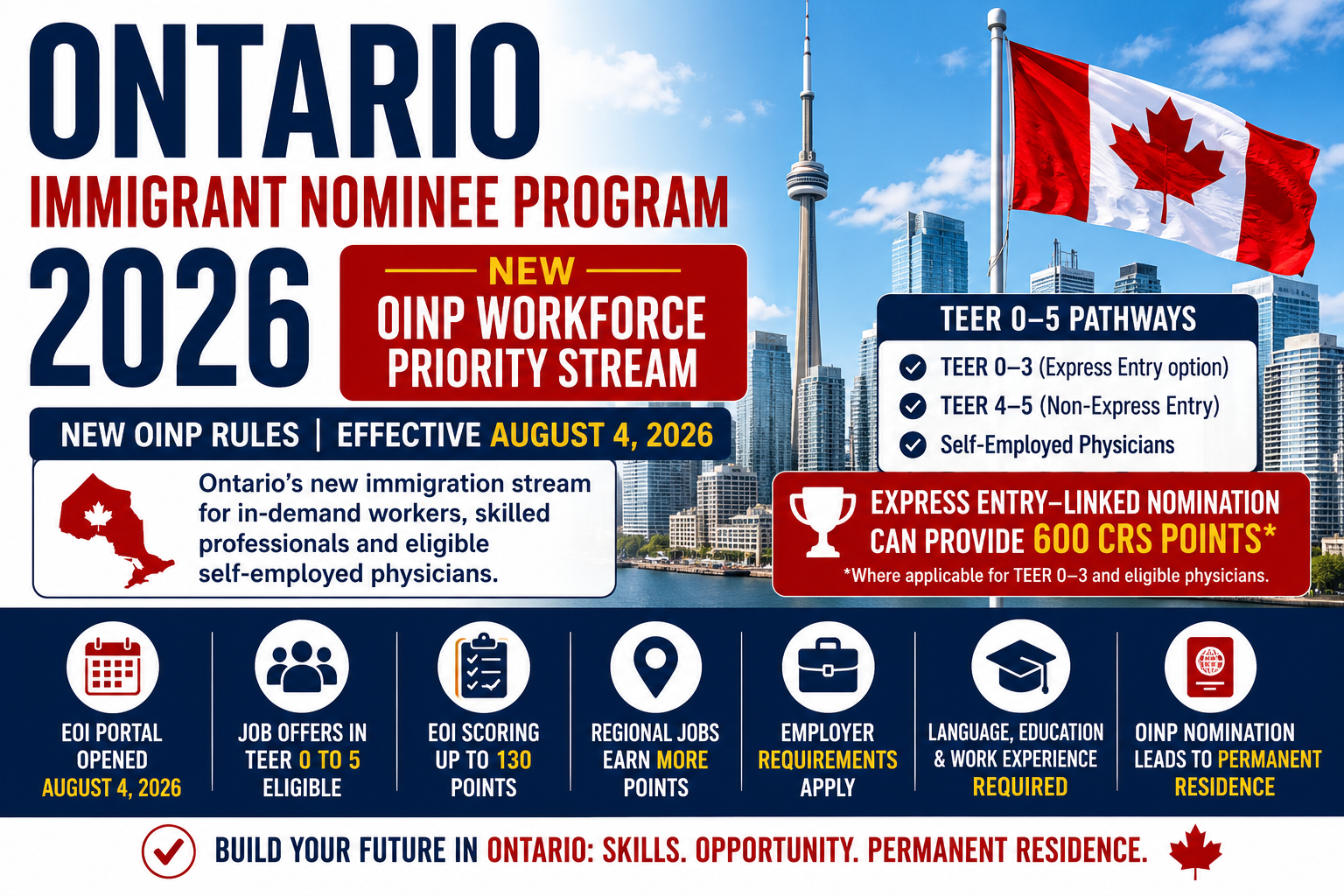
The Ontario Immigrant Nominee Program, commonly called the OINP, went through one of its biggest changes in 2026.
Ontario closed its eight previous immigration streams and introduced a new Ontario Workforce Priority Stream designed around employers, Ontario labour-market needs, work experience, education, language ability and regional employment.
The new Expression of Interest system officially opened on August 4, 2026.
The Ontario Workforce Priority Stream now provides pathways for workers with qualifying Ontario job offers across NOC TEER categories 0 through 5, as well as a separate pathway for eligible self-employed physicians.
This means many older articles, videos and immigration guides describing the former OINP streams are now outdated.
This guide explains the Ontario Immigrant Nominee Program in 2026, including the new Workforce Priority Stream, TEER 0–3 and TEER 4–5 pathways, self-employed physicians, job offers, work experience, language requirements, education, Expression of Interest scoring and the permanent residence process.
What Is the Ontario Immigrant Nominee Program?
The Ontario Immigrant Nominee Program is Ontario’s provincial immigration program.
Through the OINP, Ontario can nominate eligible foreign nationals who have skills and experience that may contribute to the province’s economy and labour market.
Receiving an Ontario nomination does not itself make someone a permanent resident.
After nomination, the applicant must complete the appropriate federal permanent residence process with Immigration, Refugees and Citizenship Canada, commonly called IRCC.
IRCC makes the final decision on permanent residence.
What Changed in OINP in 2026?
Ontario redesigned its immigration program in 2026.
Regulatory changes came into force in June 2026 and removed the previous eight OINP streams.
Ontario replaced them with the new Ontario Workforce Priority Stream as the first phase of its redesigned provincial immigration system.
You can review Ontario’s official 2026 OINP updates for current announcements.
Which Old OINP Streams Closed?
The following eight former streams were closed during the 2026 redesign:
- Employer Job Offer: Foreign Worker
- Employer Job Offer: International Student
- Employer Job Offer: In-Demand Skills
- Masters Graduate
- PhD Graduate
- Express Entry Human Capital Priorities
- Express Entry French-Speaking Skilled Worker
- Express Entry Skilled Trades
No new invitations are being issued under these former streams.
What Happened to Old OINP Applications?
If someone had only registered an Expression of Interest or job offer under a former stream and had not received an invitation, Ontario indicated that those registrations would be withdrawn during the transition.
Eligible candidates need to register again under the new Ontario Workforce Priority Stream.
However, applications that had already been submitted after receiving an invitation under a former stream continue to be assessed using the eligibility requirements that applied when the application was submitted.
What Is the Ontario Workforce Priority Stream?
The Ontario Workforce Priority Stream is Ontario’s new immigration pathway for eligible foreign workers who have qualifying Ontario employment and for certain self-employed physicians.
The stream contains three main pathways:
- TEER 0–3 job-offer pathway
- TEER 4–5 job-offer pathway
- Self-employed physician pathway
The TEER category of your job offer determines which worker requirements apply to you.
Is the New OINP Open in 2026?
Yes.
Ontario officially opened the Expression of Interest portal for the Ontario Workforce Priority Stream on August 4, 2026.
Eligible candidates and employers can now begin the new process according to Ontario’s current rules.
How Many OINP Nominations Does Ontario Have in 2026?
Ontario received a federal allocation of 14,119 nominations for 2026.
This allocation applies across Ontario’s provincial nominee activity for the year, including applications being processed under former streams and nominations under the redesigned program.
An allocation does not mean every eligible person will automatically receive a nomination.
Does the New OINP Require a Job Offer?
For most applicants, yes.
The TEER 0–3 and TEER 4–5 pathways require a qualifying full-time and permanent Ontario job offer.
The main exception is the self-employed physician pathway, which can allow qualifying physicians to apply without a traditional employer job offer.
What Is a Qualifying OINP Job Offer?
A qualifying job offer generally needs to represent genuine, permanent employment with an eligible Ontario employer.
The position generally needs to be:
- Full-time
- Permanent
- Paid
- Based primarily in Ontario
- In an eligible NOC occupation
- Supported by an employer that meets OINP requirements
Full-time employment generally means at least 30 paid hours per week and at least 1,560 paid hours per year.
Seasonal and fixed-term positions generally do not meet the permanent job-offer requirement.
Can Any NOC Occupation Qualify?
The redesigned Ontario Workforce Priority Stream is broader than the previous structure because it can include job offers across NOC TEER categories 0 through 5.
However, eligibility is not determined by TEER alone.
The applicant, employer, job offer, wage, work experience, language and education requirements still need to be satisfied.
Ontario may also use targeted invitation rounds based on labour-market priorities.
Why Your NOC and TEER Are Important
Your National Occupation Classification code identifies the Canadian occupation that best matches your actual job duties.
Your NOC also determines your TEER category.
Under the new OINP, TEER affects:
- Which pathway you fall under
- Your work-experience requirement
- Your minimum language level
- Your education requirement
- Your Expression of Interest points
- Whether an Express Entry nomination option may be available
If you are unsure about your occupation, use our NOC and TEER Code Canada guide.
TEER 0–3 Ontario Workforce Priority Pathway
The TEER 0–3 pathway is designed for applicants with qualifying Ontario job offers in management, professional, technical, skilled trade and other occupations classified as TEER 0, 1, 2 or 3.
Applicants need to satisfy Ontario’s employment, work-experience, language, education and other requirements.
TEER 0–3 Work Experience Requirement
For a TEER 0, 1, 2 or 3 job offer, applicants generally need to meet one of several possible work-experience routes.
These currently include:
- At least 6 consecutive months of paid full-time experience in the actual job-offer position during the 12 months before applying
- For an eligible recent Ontario graduate, at least 3 consecutive months of paid full-time experience in the job-offer position during the previous 12 months
- At least 2 years of cumulative paid work experience in the same NOC occupation during the previous 5 years
- A qualifying mandatory licence or authorization where Ontario or Canadian law requires one to perform the job
Some occupations have special rules, so candidates should always verify their exact NOC on the official Ontario page.
What Counts as 6 Months of OINP Experience?
The six-month route requires experience in the actual employment position connected with the job offer.
This means the same employer, occupation and work location should generally match the employment position being submitted to Ontario.
Ontario defines qualifying full-time experience for this route as at least 30 paid hours per week and at least 780 paid hours over the applicable period.
Special Rule for Recent Ontario Graduates
Eligible recent Ontario graduates may qualify with a shorter work-experience period.
Instead of six months, certain recent Ontario graduates may qualify with at least three consecutive months of paid full-time work in the job-offer position during the previous 12 months.
Additional requirements apply to determine whether someone qualifies as a recent Ontario graduate.
Two-Year Work Experience Alternative
A TEER 0–3 applicant may also qualify through longer previous experience.
Ontario currently allows an applicant to potentially use at least:
2 years of cumulative paid full-time work experience during the previous 5 years
in the same NOC occupation as the job-offer position, subject to certain occupation-specific exceptions.
Equivalent eligible part-time experience may also be considered.
Can a Licence Replace the Work Experience Requirement?
Potentially.
If Ontario or Canadian law requires a mandatory licence or professional authorization to perform the job, an applicant who already holds the required valid licence may not need to demonstrate the normal work-experience requirement.
However, special rules apply to some occupations.
For example, transport truck drivers and certain transit drivers may still need the specific six-month employment experience even when licensed.
TEER 0–3 Language Requirement
The normal language requirement for a TEER 0–3 job offer is:
CLB 6 or higher in all four language abilities.
For certain listed skilled-trade occupations, the minimum is generally:
CLB 5 or higher in all four abilities.
The four abilities are:
- Reading
- Writing
- Listening
- Speaking
Can Recent Ontario Graduates Be Exempt From Language Testing?
Some eligible recent Ontario graduates may satisfy the language requirement through an eligible Ontario credential rather than submitting a language test.
Ontario currently recognizes certain credentials completed at eligible Ontario institutions within the previous three years, including qualifying:
- Post-secondary degrees
- Post-secondary diplomas
- Ontario College Graduate Certificates
- Master’s degrees
- PhD degrees
The exact credential conditions should be checked before relying on this exemption.
Which English Tests Does OINP Accept?
Ontario currently accepts:
- IELTS General Training
- CELPIP-General
- PTE Core
Ontario does not accept IELTS Academic or PTE Academic as substitutes for the approved immigration tests.
Which French Tests Does OINP Accept?
Ontario currently accepts:
- TEF Canada
- TCF Canada
Language test results used for the stream generally need to have a test date within two years before the application is submitted.
TEER 0–3 Education Requirement
The education requirement depends partly on the occupation.
For many TEER 0–3 occupations that are not listed skilled trades, applicants generally need at least:
- A Canadian post-secondary degree or diploma requiring at least one year of full-time study, or
- An equivalent foreign credential supported by an Educational Credential Assessment where required
Different criteria may apply to eligible skilled-trade occupations.
TEER 4–5 Ontario Workforce Priority Pathway
The new TEER 4–5 pathway is important because it opens the Ontario Workforce Priority Stream to workers across TEER 4 and TEER 5 occupations, subject to program requirements.
These applicants also need a qualifying full-time and permanent Ontario job offer.
TEER 4–5 Work Experience Requirement
A TEER 4 or TEER 5 applicant generally needs:
At least 9 months of cumulative work experience during the previous 2 years in the job-offer position with the job-offer employer.
This is different from the TEER 0–3 pathway, which provides several alternative ways to satisfy its experience requirement.
TEER 4–5 Language Requirement
The current minimum language requirement is:
CLB 4 or higher in all four language abilities.
This can be demonstrated through an approved English or French language test.
TEER 4–5 Education Requirement
Applicants generally need at least:
- A Canadian secondary school diploma, or
- A foreign credential equivalent to a Canadian secondary school diploma
If foreign education is being used, an Educational Credential Assessment may be required.
Can TEER 4 and TEER 5 Workers Get 600 CRS Points?
This is an important distinction.
The new TEER 4–5 Ontario Workforce Priority pathway uses the non-Express Entry provincial nomination process.
Therefore, TEER 4–5 applicants should not assume that receiving an Ontario nomination automatically adds 600 points to an Express Entry CRS score.
The 600-point CRS benefit applies when a provincial nomination is specifically connected to Express Entry.
Can TEER 0–3 OINP Applicants Use Express Entry?
Eligible TEER 0–3 Workforce Priority applicants may have an Express Entry nomination option where they meet the applicable federal Express Entry requirements.
An accepted Express Entry-linked provincial nomination provides 600 additional CRS points.
However, applicants should not confuse this with Ontario’s former Express Entry streams.
The former Human Capital Priorities, French-Speaking Skilled Worker and Skilled Trades streams were closed in June 2026.
For a complete explanation of the federal system, read our Express Entry Canada 2026 guide.
What Is the Self-Employed Physician Pathway?
The redesigned Ontario Workforce Priority Stream includes a special pathway for eligible self-employed physicians.
This pathway does not require a conventional employer job offer.
To qualify, a physician generally needs to demonstrate that they:
- Are a member in good standing with the College of Physicians and Surgeons of Ontario
- Hold an eligible valid certificate of registration
- Are eligible to bill through the Ontario Health Insurance Plan, commonly called OHIP
Which Physician Registration Classes Are Eligible?
Ontario currently identifies eligible physician registration classes including:
- Independent practice
- Academic practice
- Provisional practice
Physicians should verify their exact registration status directly with the College of Physicians and Surgeons of Ontario and the OINP.
Do Self-Employed Physicians Need a Job Offer?
No.
This is the main exception to the job-offer requirement in the new Ontario Workforce Priority Stream.
Eligible self-employed physicians can potentially qualify based on their Ontario medical registration and OHIP eligibility.
Can Self-Employed Physicians Use Express Entry?
Yes, eligible self-employed physicians applying under this pathway currently have the option to be nominated through the federal Express Entry system where applicable.
An Express Entry-linked provincial nomination can provide 600 additional CRS points after it is accepted in the federal Express Entry profile.
What Is the OINP Expression of Interest System?
The Ontario Workforce Priority Stream uses an Expression of Interest system, commonly called an EOI.
An EOI is not the same as a full immigration application.
It is a profile that allows Ontario to:
- Confirm basic candidate information
- Assign an EOI score
- Place the candidate in the selection pool
- Invite selected candidates to submit full nomination applications
Who Starts the OINP Process?
For job-offer applicants, the employer starts the process.
The employer must register through Ontario’s Employer Portal and submit the employment position and job-offer information.
The candidate can then register an Expression of Interest linked to that employment opportunity.
A simple job-offer letter by itself is not enough to create an OINP application.
How Does the OINP Process Work Step by Step?
- Find a genuine qualifying Ontario employer and job.
- Confirm your correct NOC and TEER.
- Make sure you meet the work-experience requirement.
- Complete an approved language test if required.
- Confirm your education or obtain an ECA if required.
- Your employer registers through the Employer Portal.
- Your employer submits the qualifying employment position.
- You register an Expression of Interest.
- Ontario assigns your EOI points.
- You remain in the selection pool.
- Ontario may issue invitations based on its immigration and labour-market priorities.
- If invited, submit the complete OINP application and supporting documents.
- Your employer submits its required employment-position approval application.
- Ontario assesses both sides of the application.
- If approved, Ontario issues a provincial nomination.
- You then complete the appropriate federal permanent residence process with IRCC.
How Long Do You Have After an OINP Invitation?
Under the current Ontario Workforce Priority Stream, an invited candidate must generally submit the nomination application and required payment within:
17 calendar days from the date of the invitation.
This is a short application window.
Candidates should prepare important documents before receiving an invitation rather than waiting until the invitation arrives.
What Does Ontario Score in the New EOI System?
Ontario’s new Expression of Interest scoring system evaluates several labour-market and human-capital factors.
Current scoring factors include areas such as:
- NOC TEER category
- Broad occupational category
- Hourly wage
- Ontario work experience
- Canadian earnings history
- Legal immigration status in Canada
- Education
- Number of Canadian credentials
- English or French language ability
- Ability in both official languages
- Location of the Ontario job or medical practice
How Many OINP EOI Points Are Available?
Job-offer applicants can currently receive up to approximately 130 EOI points under the published scoring framework.
Self-employed physicians have a different maximum because some employment-related scoring factors do not apply to them.
Your EOI score is not the same as an Express Entry CRS score.
Does OINP Score Age?
Age is not included as a separate factor in Ontario’s current published Workforce Priority EOI scoring system.
This is another important difference between OINP scoring and the federal Express Entry CRS.
How TEER Affects OINP Points
Current scoring gives:
- 9 points for TEER 0 or TEER 1
- 6 points for TEER 2 or TEER 3
- 0 points for TEER 4
- 0 points for TEER 5
Receiving zero points in the TEER factor does not automatically make a TEER 4 or TEER 5 applicant ineligible.
It simply means that this specific EOI scoring factor does not award TEER points to those categories.
How Occupation Category Affects OINP Points
Ontario also gives different points based on the broad occupational category connected to the NOC code.
For example, health occupations currently receive strong points under this factor, while different categories receive different amounts.
This allows Ontario to give more weight to occupations that align with provincial labour-market priorities.
How Wage Affects Your OINP Score
Hourly wage is another important scoring factor for job-offer applicants.
Higher qualifying hourly wages can result in more EOI points.
However, applicants must still satisfy the actual wage requirement for the job offer.
Do not confuse the wage scoring factor with minimum program eligibility.
What Wage Must an Ontario Job Offer Pay?
The wage requirement depends on the occupation, location and applicant situation.
Ontario generally compares the job-offer wage with current wage information for that occupation and region.
Eligible recent Ontario graduates can have different wage rules in certain circumstances.
Check the current Government of Canada’s Job Bank wage information and Ontario’s exact stream requirements before relying on a salary figure.
How Ontario Work Experience Affects EOI Points
The redesigned system rewards Ontario employment experience.
Candidates with longer periods of qualifying Ontario work experience can receive more points.
This means someone already working successfully in Ontario may have an advantage compared with someone who has no Ontario work history.
Canadian Earnings History
Ontario also considers certain Canadian earnings history.
This factor is based on information that can be supported by a Canada Revenue Agency Notice of Assessment from the previous five years.
Current scoring bands award points based on an applicant’s highest qualifying annual Canadian earnings.
Does a Work Permit Give OINP Points?
Yes.
Current EOI scoring includes legal status in Canada.
A valid work permit currently receives more points than a valid study permit under this scoring factor.
However, legal status points are separate from the basic requirement to maintain lawful immigration status when applying from inside Canada.
Education Points in the New OINP
Ontario awards EOI points for the applicant’s highest education level.
Higher credentials can receive more points.
Ontario also separately awards points for qualifying Canadian education credentials.
Foreign education may require an Educational Credential Assessment to be used.
Does Canadian Education Help?
Yes.
The current system provides additional EOI points for qualifying Canadian education.
Applicants can receive points based on the number of eligible Canadian credentials they hold.
Canadian education may therefore help both with certain eligibility alternatives and with EOI ranking.
Language Points in OINP
Ontario’s EOI ranking also rewards higher language ability.
Current first-official-language scoring provides progressively more points for stronger CLB levels.
The highest published language band is CLB 9 or higher.
Higher language results can therefore improve an EOI score even when an applicant already meets the minimum language requirement.
Can French Increase Your OINP Score?
Potentially, yes.
Ontario separately awards points for knowledge of Canada’s official languages.
Candidates who demonstrate qualifying ability in both English and French can receive additional points.
French can also create additional federal immigration opportunities through Express Entry.
Why Job Location Matters in OINP
One of the major features of the new OINP scoring system is regionalization.
Ontario gives different EOI points depending on where the employment position is located.
Current regionalization scoring includes:
- Northern Ontario – 15 points
- Eastern Ontario – 10 points
- Central Ontario outside the GTA – 10 points
- Southwestern Ontario – 10 points
- GTA outside the City of Toronto – 5 points
- City of Toronto – 0 points
This does not mean Toronto jobs are ineligible.
It means Toronto currently receives no points under this particular regionalization factor.
Why Ontario Is Giving More Regional Points
The new system is designed partly to support communities outside the largest urban centre and help employers address labour shortages across the province.
A candidate with a job in Northern Ontario can therefore receive more regionalization points than an otherwise similar candidate with a job in Toronto.
What Employer Requirements Apply?
The employer is a major part of the Ontario Workforce Priority application.
Ontario currently requires participating employers to meet conditions including:
- Being actively in business for at least three years
- Having business premises in Ontario where the applicant will work
- Meeting applicable gross annual revenue requirements
- Meeting minimum Canadian citizen or permanent resident employee requirements
- Having no disqualifying outstanding orders under Ontario employment or occupational health and safety legislation
Employer thresholds vary according to the location of the employment position.
Are Employer Requirements Lower Outside Major Cities?
Ontario introduced more flexible employer revenue requirements for certain rural communities as part of the 2026 redesign.
This is intended to improve access to provincial immigration for employers in smaller and rural areas.
The exact revenue and employee thresholds should be checked using the official Workforce Priority Stream page.
Can International Students Apply to OINP in 2026?
Potentially, but there is no longer a separate International Student stream.
The former Employer Job Offer: International Student stream closed in June 2026.
International graduates now generally need to qualify under the new Workforce Priority Stream.
This usually means securing a qualifying Ontario job offer unless they qualify for the separate self-employed physician pathway.
Can Ontario Master’s Graduates Apply Without a Job Offer?
The old Master’s Graduate stream that allowed eligible applicants to pursue nomination without an employer job offer has been closed.
Simply having an Ontario master’s degree no longer creates a standalone OINP pathway under the first phase of the redesigned program.
However, the education can still contribute to eligibility and EOI scoring under the new system.
Can Ontario PhD Graduates Apply Without a Job Offer?
The previous PhD Graduate stream also closed.
A PhD may provide strong education points, but the credential by itself does not replace the job-offer requirement for normal Workforce Priority worker applicants.
What Happened to Ontario Human Capital Priorities?
The former Express Entry Human Capital Priorities Stream is closed.
Older articles telling applicants to wait for an Ontario Notification of Interest under Human Capital Priorities may therefore be outdated.
Always verify that any immigration guide you are reading reflects Ontario’s 2026 redesign.
What Happened to Ontario’s French-Speaking Skilled Worker Stream?
The former Express Entry French-Speaking Skilled Worker Stream was also closed.
French remains valuable because it can provide OINP EOI points and can improve Express Entry opportunities, but the previous Ontario stream no longer exists.
What Happened to Ontario’s Skilled Trades Stream?
The former Express Entry Skilled Trades Stream has also been closed.
Skilled trades workers may instead qualify under the new Workforce Priority Stream if they meet the current job-offer and other requirements.
OINP vs Express Entry
OINP and Express Entry are not the same system.
Ontario Workforce Priority Stream
- Operated by Ontario
- Uses an Ontario Expression of Interest
- Uses Ontario-specific scoring factors
- Generally requires a qualifying Ontario job offer
- Covers TEER 0 through 5
- Includes a special self-employed physician pathway
Express Entry
- Operated by IRCC
- Uses the federal Comprehensive Ranking System
- Manages Canadian Experience Class, Federal Skilled Worker and Federal Skilled Trades applications
- Does not require an Ontario job offer to enter every program
OINP vs Canadian Experience Class
The Canadian Experience Class is a federal Express Entry program based primarily on qualifying Canadian skilled work experience.
CEC generally focuses on TEER 0, 1, 2 and 3 experience.
The Ontario Workforce Priority Stream can include TEER 4 and TEER 5 job offers as well.
However, OINP generally requires a qualifying Ontario employer and job offer while CEC does not require a job offer for program eligibility.
OINP vs Other Provincial Nominee Programs
Each province operates its immigration program differently.
Ontario’s 2026 redesign should not be assumed to apply to Alberta, British Columbia, Manitoba, Saskatchewan or other provinces.
Read our Provincial Nominee Program Canada 2026 guide for a broader explanation.
Can a Job in Ontario Support Permanent Residence?
Potentially.
A qualifying Ontario job can be an important part of the new OINP Workforce Priority Stream.
However, a normal job does not automatically provide permanent residence.
The candidate, job offer and employer must satisfy the applicable immigration requirements.
Read our guide to jobs in Canada that may support PR pathways.
How to Find Jobs That May Fit the New OINP
A practical job-search strategy is:
- Identify your correct NOC and TEER.
- Determine whether you would fall under TEER 0–3 or TEER 4–5.
- Review your current work experience.
- Check Ontario employers hiring in your occupation.
- Compare the offered wage with current Job Bank information.
- Research jobs outside Toronto as well as inside the GTA.
- Create a professional Canadian resume.
- Customize your cover letter for each employer.
- Apply to legitimate vacancies.
- Verify that the employer is willing and able to complete the OINP Employer Portal process.
Prepare a Canadian Resume
Your resume should focus on getting the real job first.
Employers hire based on skills, experience and suitability for the position rather than simply because a candidate wants permanent residence.
Use our Canadian Resume Format 2026 guide.
Write a Targeted Cover Letter
Your cover letter should explain how your experience matches the employer’s actual needs.
Use our Canadian Cover Letter Format 2026 guide when applying.
Can You Apply to OINP From Outside Canada?
Potentially, depending on the pathway and your circumstances.
The Workforce Priority Stream’s longer two-year work-experience alternative for certain TEER 0–3 applicants can include qualifying previous experience, but the applicant still needs a qualifying Ontario job offer unless applying as an eligible self-employed physician.
Always review your exact eligibility before making plans from overseas.
Can You Apply While Already in Ontario?
Yes, many candidates are already living and working in Ontario.
If you apply from inside Canada, you must maintain valid legal immigration status or qualifying maintained status where applicable.
A work permit, study permit or visitor record can demonstrate legal temporary status depending on your circumstances.
Do You Need to Intend to Live in Ontario?
Yes.
A provincial nomination is intended for people who genuinely plan to live and work in Ontario after becoming permanent residents.
Ontario can examine ties demonstrating that intention, including:
- Current or previous Ontario employment
- Job applications and interviews
- Ontario education
- Property or housing
- Visits
- Professional networks
- Family relationships
- Personal connections
What Documents May Be Required?
Your exact documents depend on your pathway and circumstances, but you may need:
- Passport
- Canadian immigration-status documents
- Ontario job-offer information
- Employer documentation
- Employment reference letters
- Pay stubs
- Language test results
- Education documents
- Educational Credential Assessment where applicable
- Professional licence where required
- CRA Notices of Assessment where points are claimed
- Resume
- Documents showing your intention to live in Ontario
If Ontario invites you to apply, use the current official document checklist rather than an old checklist from a former OINP stream.
Common OINP Mistakes to Avoid in 2026
- Following requirements for one of the eight closed streams
- Assuming the old Master’s Graduate stream is still open
- Assuming the old Human Capital Priorities stream still exists
- Using the wrong NOC
- Confusing TEER eligibility with EOI scoring
- Assuming every Ontario nomination automatically gives 600 CRS points
- Using a job that is not permanent
- Using a job offer without the employer completing the Employer Portal process
- Failing to meet the work-experience requirement
- Using IELTS Academic or PTE Academic instead of approved immigration tests
- Submitting expired language results
- Failing to obtain an ECA when required
- Claiming EOI points without supporting documents
- Missing the short application deadline after an invitation
- Paying for a fake Ontario job offer
Beware of Fake OINP Job Offers
Major immigration changes can create opportunities for scammers.
Be cautious if someone claims:
- They can guarantee an OINP nomination
- They can sell you a legitimate Ontario job offer
- You do not need to perform the actual work
- You can use fake payroll or employment records
- You can invent work experience
- They can guarantee permanent residence
A genuine OINP job must represent legitimate employment with an eligible Ontario employer.
Does OINP Guarantee Permanent Residence?
No.
Receiving an Ontario nomination is an important immigration milestone, but it does not guarantee federal permanent residence approval.
IRCC still assesses:
- Your permanent residence eligibility
- Your documentation
- Your identity
- Your medical admissibility
- Your criminal admissibility
- Your security admissibility
- Whether your information is truthful and complete
OINP 2026 Checklist
Before relying on the new Ontario Workforce Priority Stream, check:
- I am using the new 2026 Workforce Priority rules rather than a closed OINP stream.
- I identified my correct NOC.
- I identified my TEER category.
- I know whether I fall under TEER 0–3, TEER 4–5 or the physician pathway.
- I have a qualifying Ontario job offer if required.
- My employer understands the OINP Employer Portal process.
- I meet the applicable work-experience requirement.
- I hold any mandatory professional licence required for my job.
- I meet the applicable language requirement.
- I have an approved language test if required.
- My language results are still valid.
- I satisfy the education requirement.
- I have an ECA if required.
- I have valid immigration status if applying from inside Canada.
- I genuinely intend to live and work in Ontario.
- I can document every EOI point I claim.
- I am prepared to submit quickly if Ontario invites me.
Where to Check Current OINP Information
The Ontario immigration system changed significantly in 2026, so older immigration information can be especially misleading.
Always verify important requirements using Ontario’s official Ontario Workforce Priority Stream page.
You should also monitor Ontario’s official 2026 OINP updates for new invitation rounds, rule changes and further phases of the redesign.
Final Thoughts
The Ontario Immigrant Nominee Program changed dramatically in 2026.
Ontario removed its eight former streams and introduced the Ontario Workforce Priority Stream, with a new Expression of Interest system that opened on August 4, 2026.
The redesigned stream now includes workers with qualifying job offers across TEER 0 through 5 as well as eligible self-employed physicians.
TEER 0–3 applicants generally need to meet one of several work-experience options and normally need CLB 6, with different rules for certain skilled trades and eligible recent Ontario graduates.
TEER 4–5 applicants generally need nine months of qualifying experience with the job-offer employer during the previous two years, at least CLB 4 and a Canadian high school credential or equivalent.
The new EOI scoring system considers factors such as occupation, TEER, wage, Ontario experience, Canadian earnings, legal status, education, language and the location of the job.
Ontario is also giving additional regionalization points to jobs outside Toronto.
One of the most important things to understand is that the old Ontario Express Entry streams are gone.
Eligible TEER 0–3 candidates and self-employed physicians may have an Express Entry nomination option, but TEER 4–5 applicants follow the non-Express Entry route.
The strongest strategy is to identify your correct NOC, understand which Workforce Priority pathway applies to you, build genuine Ontario employment experience, improve your language score and work with a legitimate employer that can satisfy Ontario’s requirements.
Because the program was redesigned recently, always check the current Ontario government rules before making an immigration decision.
You can explore more immigration guides in our PR Pathways in Canada section.
Leave a Reply